
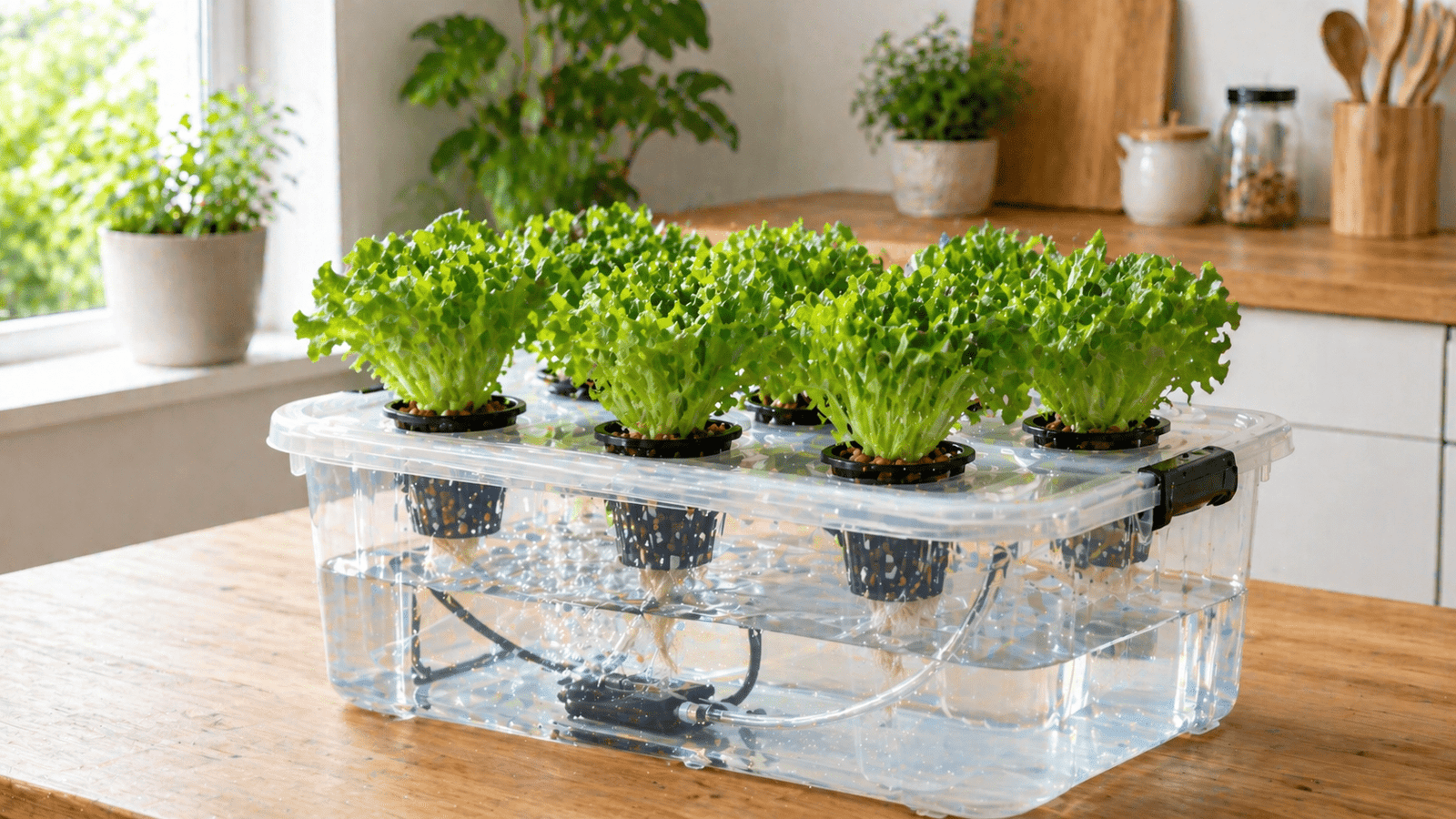
An IKEA hydroponic system is the cheapest, fastest way to grow fresh lettuce and herbs at home in the UK without spending £100 on a kit. With a single £4 IKEA SAMLA storage box, six net pots, clay pebbles, and a small air pump, you can build a working six-plant hydroponic system in under an hour for around £15.
This is the full UK build guide for an IKEA hydroponic system — every part, every measurement, every drilling step, plus the first crop plan that actually works in a typical British home.
🎯 Quick Answer
To build an IKEA hydroponic system, take a 22L IKEA SAMLA storage box and lid, drill six 50mm holes in the lid using a hole saw, drop in 50mm net pots, fill with clay pebbles, add 15L of pH-balanced nutrient solution and an air pump with airstone. Total cost: roughly £15 if you already own a drill. The system grows six lettuce or herb plants and lasts for years.
📖 In this guide
- Why an IKEA hydroponic system works so well
- Complete UK shopping list (£15 total)
- Tools you’ll need to build it
- 7-step IKEA hydroponic system build guide
- Setting up your first crop
- Nutrients and pH for an IKEA hydroponic system
- 5 mistakes to avoid with this build
- How to scale up to 12 or 18 plants
- Frequently asked questions
Why an IKEA hydroponic system works so well
The IKEA SAMLA box is, accidentally, one of the best DIY hydroponic reservoirs you can buy in the UK. Three reasons make it ideal.
First, the dimensions. The 22-litre SAMLA measures 39 × 28 × 28 cm — wide enough to space six plants properly, deep enough to hold 15 litres of nutrient solution, and tall enough that net pots sit comfortably without bottoming out.
Second, the lid is a flat, rigid plastic surface that takes a hole saw cleanly without cracking. That’s not true of most cheap storage boxes from supermarkets.
Third, it’s clear plastic — which is normally a problem because algae loves light. We solve this in step 7 by wrapping the box, but the trade-off is worth it for the £4 price tag.
What is an IKEA hydroponic system? A DIY Deep Water Culture (DWC) hydroponic setup built around an IKEA SAMLA storage box. The plant roots hang into a nutrient-rich water reservoir, while an air pump keeps the water oxygenated. It’s the simplest type of hydroponic system to build and one of the most reliable for beginners.
Key takeaways
- An IKEA hydroponic system costs around £15 to build using a SAMLA 22L box
- Build time is 45–60 minutes if you already own a drill
- The system grows 6 lettuce, herb, or leafy green plants comfortably
- It uses Deep Water Culture (DWC), the easiest hydroponic method for beginners
- Nutrients last 4–6 weeks before a full reservoir change is needed
Complete UK shopping list for your IKEA hydroponic system
Every part of this IKEA hydroponic system can be bought in the UK from IKEA, Amazon UK, or B&Q. These are real prices as of 2026.
| Item | Specification | UK source | Approximate price |
|---|---|---|---|
| IKEA SAMLA box | 22 litre, 39×28×28 cm, transparent | IKEA | £4.00 |
| IKEA SAMLA lid | For 11/22 L box, transparent | IKEA | £1.50 |
| Net pots | 50mm / 5cm × 6 pots | Amazon UK | £3.50 (pack of 10) |
| Clay pebbles (hydroton) | 10 litres, expanded clay aggregate | Amazon UK / HydroHobby | £8 (10L bag — only need 1L) |
| Air pump + airstone | 3W, 1 outlet, 240 L/h | Amazon UK | £10 |
| Hydroponic nutrient | Formulex 100ml or trial size | Amazon UK / Growth Technology | £6 |
| pH test strips or drops | Basic kit | Amazon UK | £5 |
| Effective build cost | If you already have spare clay pebbles, nutrient and an air pump | £12–£16 | |
| Full first-time cost | If buying everything new | £38 |
The £15 figure assumes you already own (or can borrow) a drill, a hole saw and an air pump. Even buying everything fresh, you’ll have leftover clay pebbles, nutrient and net pots for two more builds.
Tools you’ll need to build the IKEA hydroponic system
| Tool | Purpose | Substitute |
|---|---|---|
| Cordless drill | Driving the hole saw | Corded drill works fine |
| 50mm hole saw | Cutting holes for net pots | 2-inch (51mm) imperial works too |
| Sharpie or permanent marker | Marking hole positions | Any felt-tip pen |
| Ruler or tape measure | Spacing the holes evenly | String marked at intervals |
| Sandpaper | Smoothing rough edges | Scissors will trim plastic burrs |
| Black bin liner or duct tape | Light-proofing the box | Aluminium foil works equally well |
7-step IKEA hydroponic system build guide
This is the full step-by-step build. Total time is 45–60 minutes. If you’ve never used a hole saw before, allow 90 minutes and read step 3 twice.
Step 1 · 5 mins
Wash the box and lid
IKEA boxes pick up dust and packaging residue. Wash the SAMLA box and lid with warm water and a drop of washing-up liquid. Rinse thoroughly. Any soap residue can harm plant roots.
Step 2 · 10 mins
Mark six hole positions on the lid
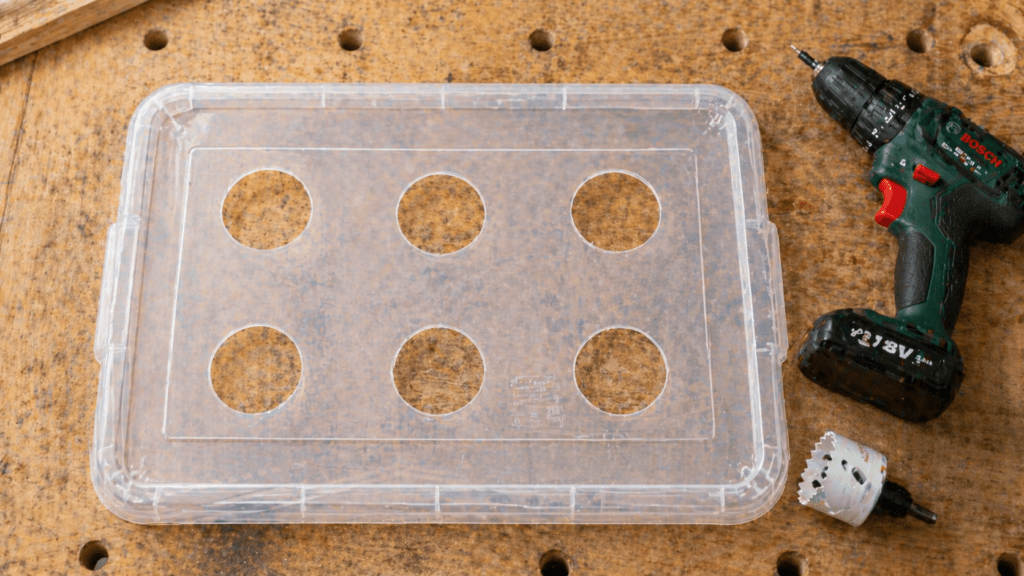
Lay the lid flat. Mark six evenly spaced points in a 2×3 grid. The IKEA SAMLA 22L lid measures roughly 39 × 28 cm, so mark holes at: 13cm and 26cm along the long edge, and 9cm and 19cm along the short edge. Each net pot needs a 5cm gap from the box edge.
Step 3 · 15 mins
Drill the six 50mm holes
Fit your 50mm hole saw to the drill. Place a piece of scrap wood or cardboard underneath the lid to protect your work surface. Press down firmly but slowly — let the saw cut through the plastic at its own pace. Going too fast cracks the lid.
Step 4 · 5 mins
Smooth the cut edges
Run sandpaper or a craft knife around each hole to remove rough plastic burrs. Test fit each net pot — it should drop into the hole and rest on its lip. If it falls through, the hole is too big; widen with a half-size larger saw or buy 60mm net pots.
Step 5 · 10 mins
Light-proof the box
Wrap the outside of the SAMLA box in black bin liner, aluminium foil or duct tape. Cover everything except the very top centimetre near the lid. Light hitting the nutrient solution will grow algae within 7 days, which clogs roots and pumps. This step is non-negotiable.
Step 6 · 5 mins
Add clay pebbles to the net pots
Rinse 1 litre of clay pebbles (hydroton) in a sieve under cold water until the water runs clear. Fill each net pot to the rim with rinsed pebbles. The pebbles support the plant and let roots breathe.
Step 7 · 10 mins
Mix nutrients and install the air pump
Fill the SAMLA box with 15 litres of cold tap water (let it sit for 24 hours first to release chlorine). Add nutrients per the bottle instructions. Test pH — aim for 5.8–6.2. Drop the airstone in, close the lid with net pots in place, and plug in the air pump. You’re done.
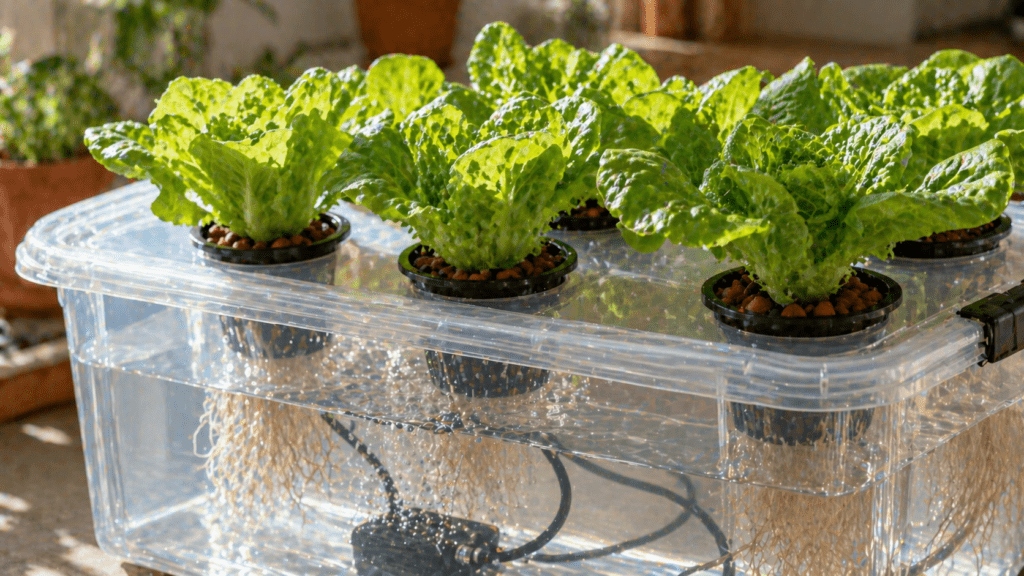
Watch: IKEA hydroponic system build in under 5 minutes
Setting up your first crop in the IKEA hydroponic system
Six plants is the perfect number for a beginner — enough variety to stay interesting, few enough to manage easily. Here’s what to plant first.
| Crop | Why it suits this system | Time to harvest | Variety to try |
|---|---|---|---|
| Lettuce | Compact roots, light feeder | 4–5 weeks | Salad Bowl, Little Gem |
| Basil | Tall but narrow, loves DWC | 5–7 weeks | Genovese, Sweet |
| Pak choi | Fast, beginner-friendly | 3–4 weeks | Joi Choi, Mei Qing |
| Spinach | Cool-season UK favourite | 4–6 weeks | Matador, Medania |
| Coriander | Cut and come again | 4–5 weeks | Cilantro Slow Bolt |
| Mint | Cuttings root in water in 10 days | 2–4 weeks | Spearmint from Tesco |
Avoid fruiting crops (tomatoes, peppers, cucumbers) on your first IKEA hydroponic system build — they need bigger reservoirs, deeper roots and stronger nutrient regimes than a 22L box can comfortably support.
Nutrients and pH for an IKEA hydroponic system
An IKEA hydroponic system uses standard hydroponic nutrient solutions and pH ranges. There’s nothing special about the box — it’s just the reservoir.
| Setting | Target value | Why it matters |
|---|---|---|
| pH range | 5.8–6.2 | Where most leafy crops absorb nutrients best |
| EC (seedlings) | 0.8–1.2 mS/cm | Young plants burn at higher concentrations |
| EC (mature) | 1.4–1.8 mS/cm | Optimal for established lettuce and herbs |
| Water temperature | 18–22°C | Below 15°C halts growth; above 25°C invites root rot |
| Top-up frequency | Every 3–5 days | 15L reservoir lasts 4–6 weeks total |
| Full nutrient change | Every 4–6 weeks | Nutrient ratios drift as plants drink selectively |
UK nutrient brands for this build
Three nutrient products work well with an IKEA hydroponic system:
- Formulex (Growth Technology) — single-bottle, idiot-proof, made in the UK. Around £14 per 500ml.
- Chempak Hydroponic Feed — UK-brand powder, mixes to a strong solution. Around £8 per box.
- General Hydroponics MaxiGro — single-pack powder, great for vegetative leafy greens.
5 mistakes to avoid with an IKEA hydroponic system
Mistake 1 — Skipping the light-proofing step
Clear plastic plus nutrient water plus daylight equals algae. Every IKEA hydroponic system that fails in week 3 fails because of light. Wrap the box.
Mistake 2 — Overfilling with water
Net pots should sit with the bottom 1–2 cm of clay pebbles touching the water — not submerged. Roots need air. A box filled to the brim drowns plants in week 2.
Mistake 3 — Drilling holes too close to the edge
Holes within 4cm of the box edge weaken the lid. It bows under wet net pots and tips plants sideways. Stick to a 5cm minimum margin.
Mistake 4 — Putting the box on a south-facing windowsill in summer
UK summer sun heats the SAMLA box quickly. Once water exceeds 25°C, roots start rotting. North or east-facing positions, or a grow light in a shaded room, work better.
Mistake 5 — Forgetting the air pump
DWC without aeration kills plants in 4–7 days. The £10 air pump is not optional. Run it 24/7. The electricity cost is under £2 per year.
How to scale up to 12 or 18 plants
Once your first IKEA hydroponic system is producing reliably, scaling up is simple — and the SAMLA range is your friend. The 45L SAMLA box (57×39×28 cm) holds 12 net pots easily. The 65L box holds 18. All SAMLA lids are dimensioned to fit the box family, so the same drilling technique works.
| SAMLA box | Plants | Volume | UK price |
|---|---|---|---|
| 22L (39×28×28 cm) | 6 | 15L water | £4–£5 |
| 45L (57×39×28 cm) | 12 | 30L water | £8–£10 |
| 65L (78×56×18 cm) | 18 | 40L water | £12 |
Once you scale past 18 plants, switch to a more efficient system like an NFT channel or a Dutch bucket setup. See our DIY PVC tower guide for a £50 vertical system that grows 24+ plants.
Build Your First Hydroponic System on a Budget
22 pages of UK-tested DIY hydroponic builds — from the IKEA system on this page to mason jars, 5-gallon buckets, NFT channels, and PVC towers. Real UK shopping lists from B&Q, Screwfix and Amazon UK.
✓ 8 complete builds · ✓ UK parts lists · ✓ Tool guides · ✓ Instant PDF download
3 pro tips to get more from your IKEA hydroponic system
- Stick a thermometer to the side of the box. A £2 stick-on aquarium thermometer from Amazon UK lets you spot temperature issues at a glance — the #1 invisible killer of hydroponic plants.
- Run two systems in succession. Plant your second IKEA hydroponic system two weeks after the first. You’ll have a continuous lettuce harvest instead of one big glut followed by nothing.
- Reuse the clay pebbles. After harvest, rinse the pebbles in hot water with a splash of hydrogen peroxide, dry them, and use them again. They last 5+ years if treated this way.
Frequently asked questions about IKEA hydroponic systems
What size IKEA box is best for a hydroponic system?
The 22-litre SAMLA box (39×28×28 cm) is the sweet spot for an IKEA hydroponic system. It holds enough nutrient water for six lettuce or herb plants, has a flat lid that takes a hole saw cleanly, and costs around £4 in the UK. The 45L SAMLA scales to 12 plants if you need more.
How much does an IKEA hydroponic system cost to build?
Around £15 if you already own a drill, hole saw and air pump. From scratch with all parts new, expect £35–£40. Even the from-scratch cost is half what you’d pay for a basic commercial DWC kit, and you’ll have leftover net pots, clay pebbles and nutrients for two more builds.
What can you grow in an IKEA hydroponic system?
Leafy greens (lettuce, spinach, pak choi, kale), herbs (basil, mint, coriander, parsley) and microgreens grow exceptionally well. Avoid fruiting crops like tomatoes, peppers and strawberries — they need larger reservoirs and stronger nutrient regimes than a 22L SAMLA box can provide reliably.
Do I need grow lights for an IKEA hydroponic system?
From April to September, a south or east-facing UK windowsill provides enough light for leafy greens. From October to March, a £25 LED grow light from Amazon UK is essential — UK winter daylight is too weak and too short for hydroponic crops without supplementation.
How long does an IKEA hydroponic system last?
The IKEA SAMLA box itself lasts indefinitely if kept indoors. The lid develops some wear from sun and net pot pressure but typically lasts 3–5 years. Clay pebbles and net pots are reusable across builds for many years.
Can I use the IKEA hydroponic system without an air pump?
Only if you switch to the Kratky method, which uses a non-circulating shallow water level instead of aeration. For Deep Water Culture, an air pump is required — without aeration, roots suffocate within a week. Read our Kratky method guide if you want a no-electricity option.
Where can I buy IKEA SAMLA boxes in the UK?
Direct from IKEA UK (in store or online at ikea.co.uk), or from Amazon UK and eBay UK resellers. Prices are cheapest at IKEA itself — third-party resellers usually mark up by 200–300%.
Is an IKEA hydroponic system safe for food?
The IKEA SAMLA box isn’t food-grade certified, but it’s made from food-safe HDPE plastic with no known leaching issues. For peace of mind, line the inside with a food-grade plastic bag, or use a food-grade plastic storage box from Argos or Wilko instead.
Related posts for UK DIY hydroponic builders
- The £30 Hydroponic System That Actually Works (Step-by-Step Build) — slightly larger budget DIY build
- How to Start Hydroponics with Mason Jars (Easiest Method) — even cheaper alternative
- DIY Hydroponics with Plastic Bottles: The Ultimate Zero-Budget Setup — free hydroponic system
- 5 Hydroponic Systems You Can Build with Items from the Pound Shop — UK budget builds
- Cheap vs Expensive Hydroponic Kits: Is It Worth Paying More? — DIY vs commercial kits
- How Much Does It Cost to Start Hydroponics at Home? Full Breakdown — full UK cost analysis
Further reading from UK retailers and authorities
- IKEA SAMLA 22L box — official IKEA UK product page with current pricing
- RHS hydroponics guide — Royal Horticultural Society’s overview of soilless growing
- Growth Technology (UK) — manufacturer of Formulex, the UK’s most beginner-friendly hydroponic nutrient
Build your IKEA hydroponic system this weekend
An IKEA hydroponic system is the lowest-risk way to start hydroponic growing in the UK. The cost is low enough that failure barely stings, the build is simple enough that no DIY experience is needed, and the SAMLA box is robust enough to last for years of growing.
If you build it this weekend and plant lettuce or basil seedlings on Sunday, you’ll be eating your first harvest by the end of May. Then you scale to a 45L box, then to a second system, and before long you’ve replaced your supermarket salad shelf entirely.
Your next step: head to your nearest IKEA (or order online), grab a 22L SAMLA box and lid, and pick up the rest of the parts from Amazon UK. The build itself is one Saturday morning.