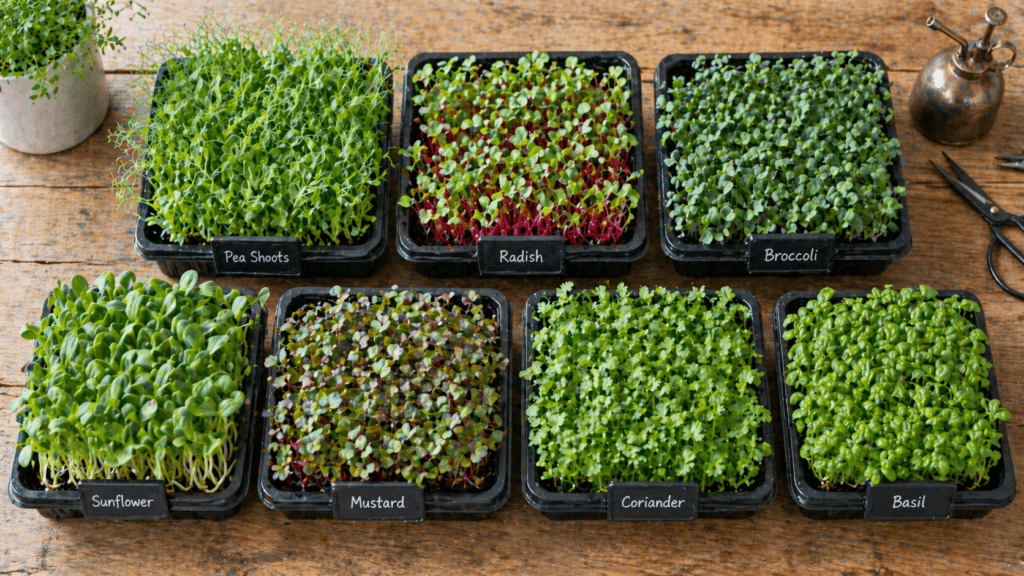
The best microgreens to sell UK home growers can profit from aren’t always the ones you see in supermarkets. The varieties that actually make money at British farmers markets, restaurant accounts and direct-to-consumer sales are chosen for one thing above all: margin per tray. A tray that takes 7 days, costs £1 to grow and sells for £6 is a far better business than one that takes 21 days and sells for £8.

This guide ranks the seven best microgreens to sell UK growers can choose right now in 2026 — by real margins, real UK prices, and how fast each variety turns over a 1020 tray. Every figure here reflects current British market data.

🎯 Quick Answer

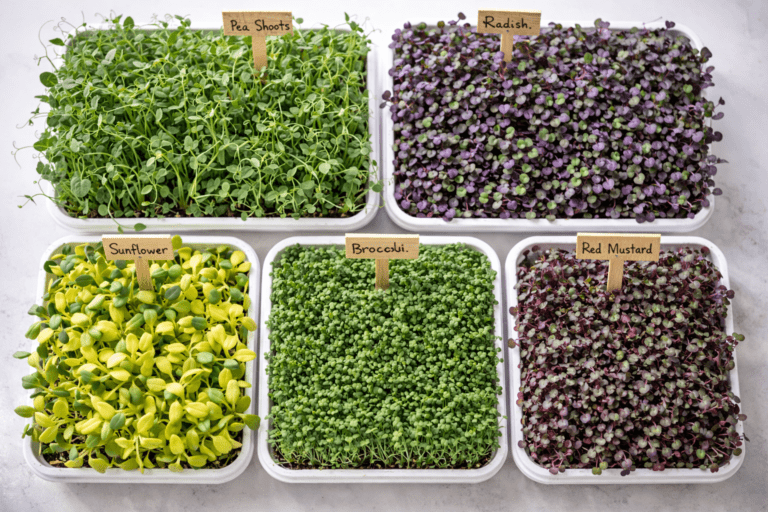
The best microgreens to sell UK growers can profit from are radish, pea shoots, sunflower, broccoli, mustard, coriander and basil. Radish and pea shoots offer the strongest margins thanks to fast 7–10 day cycles. Sunflower delivers the highest revenue per tray. Specialty varieties like coriander and basil command premium restaurant prices of £40–£60 per kg. A typical UK home grower running 25 trays per week can clear £400–£900 monthly profit.

Profitable pea shoot microgreens being harvested for UK farmers market sale

Why microgreens are so profitable in the UK

Microgreens command premium prices in the UK because they punch above their weight on three fronts: nutrition, flavour intensity and visual appeal. Restaurants pay handsomely for the garnish factor. Health-conscious consumers pay for the nutrient density. Both groups will queue at a farmers market for fresh punnets a soil-grower can’t match.

The economics work because microgreens compress an entire vegetable’s value into 7–14 days of growth on a kitchen shelf. A 1020 tray (50 × 25 cm) can produce 200–500g of saleable greens for £1–£2 of input costs and sell for £20–£35 at retail.

What are microgreens? Young vegetable greens harvested 7–21 days after germination, when the first true leaves appear. They contain 4–40 times the nutrient density of mature vegetables and command 8–15× higher prices per gram in UK markets.

Key takeaways

  • UK microgreens sell for £3.50–£6 per 80g punnet at farmers markets
  • Restaurant wholesale prices range £40–£60 per kg in 2026
  • Production cost per tray is typically £1–£2 in the UK
  • Best margins come from fast-cycle varieties: radish, pea shoots, sunflower
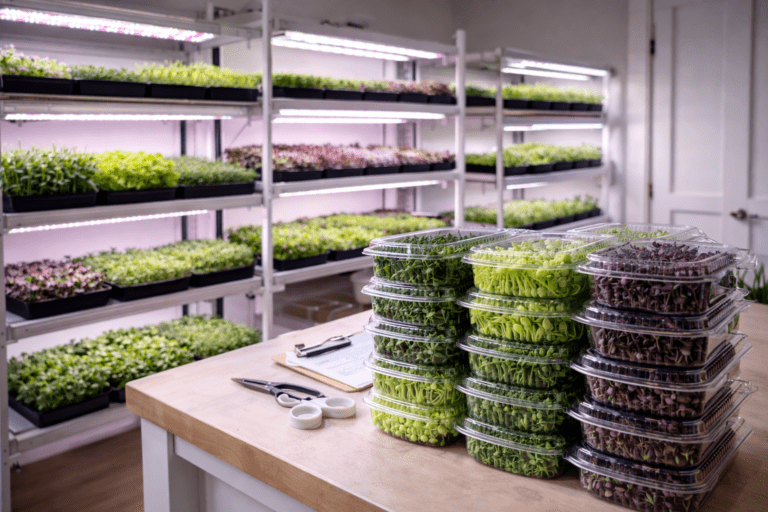
  • A spare room with 4 shelves can produce 25–40 trays per week year-round
  • UK home growers can earn £400–£2,000 monthly side income

How we ranked the best microgreens to sell UK growers should choose

Margin alone isn’t the full story. The best microgreens to sell UK growers can profit from are ranked across five real factors:

  1. Cycle time — how fast a tray turns over (faster = more cycles per month)
  2. Yield per tray — grams of saleable produce
  3. UK market price — actual farmers market and restaurant rates
  4. Production cost — seed, growing medium, water, energy
  5. UK demand — how easy it is to sell every tray you grow

The 7 best microgreens to sell UK growers can profit from

#1Radish microgreens

Cycle: 7–10 days · Yield: 350–450g per tray · UK retail: £4.50/80g punnet · Margin per tray: £18–£24

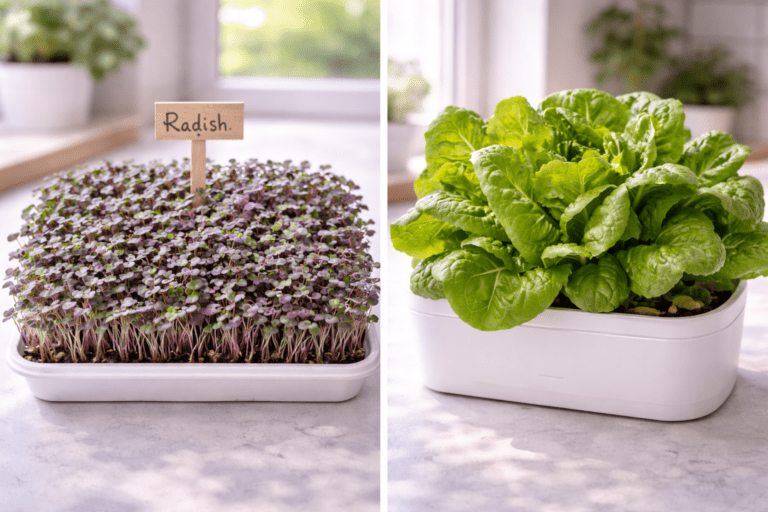
Radish wins on raw velocity. The 7-day cycle means you can run a tray 3–4 times per month — almost double the throughput of slower crops. Red Rambo and China Rose varieties produce stunning purple-red stems that sell themselves at UK farmers markets. Seed cost is around 30p per tray. Buy seeds from Sky Sprouts UK or Marshalls.

#2Pea shoots

Cycle: 10–14 days · Yield: 400–700g per tray · UK retail: £4–£5/100g · Margin per tray: £20–£28

The classic UK farmers market microgreen. Sweet, tender and unmatched volume per tray. Customers know what they are, chefs love them in salads and stir-fries, and they’re forgiving to grow. Use UK-grown marrowfat or speckled pea seeds from Wolfe Microgreens or Skyline Seeds for the best yields. Cost per tray: 80p–£1.20 in seed alone (peas are heavy seeders).

#3Sunflower microgreens

Cycle: 8–12 days · Yield: 450–600g per tray · UK retail: £5–£6/100g · Margin per tray: £25–£32

The premium-priced visual showstopper. Large, crunchy, nutty leaves that command top farmers market prices. Higher seed cost than radish (£1.20–£1.80 per tray) but delivers the highest revenue per tray of any UK microgreen. Black oil sunflower seeds from Sky Sprouts or Sprout Mate UK are the standard.

#4Broccoli microgreens

Cycle: 8–12 days · Yield: 250–350g per tray · UK retail: £4.50–£5.50/80g · Margin per tray: £15–£20

The health-food hero. UK customers who know about sulforaphane (a phytonutrient linked to cancer prevention research) will pay a premium. Mild flavour means broccoli microgreens go into smoothies as well as salads, doubling the customer base. Calabrese variety yields best.

#5Mustard microgreens

Cycle: 7–10 days · Yield: 200–300g per tray · UK retail: £4.50–£5.50/80g · Margin per tray: £14–£18

Restaurant favourite. Spicy bite that chefs use as a flavour-bomb garnish on roasts, fish and Asian dishes. Red Garnet variety adds visual drama. Slightly trickier to grow than radish but commands a higher restaurant price (£45–£55 per kg wholesale).

#6Coriander microgreens

Cycle: 14–21 days · Yield: 150–200g per tray · UK retail: £6–£8/50g · Margin per tray: £18–£25

The specialty profit driver. Cycle time is double radish but UK demand from Indian, Asian and Latin restaurants pushes wholesale prices to £55–£70 per kg. Slow germination (5–8 days) means you need patience and good airflow to avoid mould. Use split coriander seed for faster germination.

#7Basil microgreens

Cycle: 14–21 days · Yield: 100–150g per tray · UK retail: £8–£12/50g · Margin per tray: £20–£30

The luxury restaurant micro. Italian and fine-dining UK chefs pay £60–£80 per kg for premium-quality basil microgreens. Lower yields per tray are offset by exceptional pricing. Genovese, Thai and Lemon basil varieties all sell. Tricky for beginners — needs warmth (22°C+) and gentle watering. Master radish and peas first.

UK microgreen price comparison table (2026)

Microgreen Retail (80g punnet) Restaurant wholesale (per kg) Cycle days Margin per tray
Radish £4.00–£4.50 £35–£45 7–10 £18–£24
Pea shoots £3.50–£4.50 £30–£40 10–14 £20–£28
Sunflower £5.00–£6.00 £40–£55 8–12 £25–£32
Broccoli £4.50–£5.50 £40–£50 8–12 £15–£20
Mustard £4.50–£5.50 £45–£55 7–10 £14–£18
Coriander £6.00–£8.00 £55–£70 14–21 £18–£25
Basil £8.00–£12.00 £60–£80 14–21 £20–£30

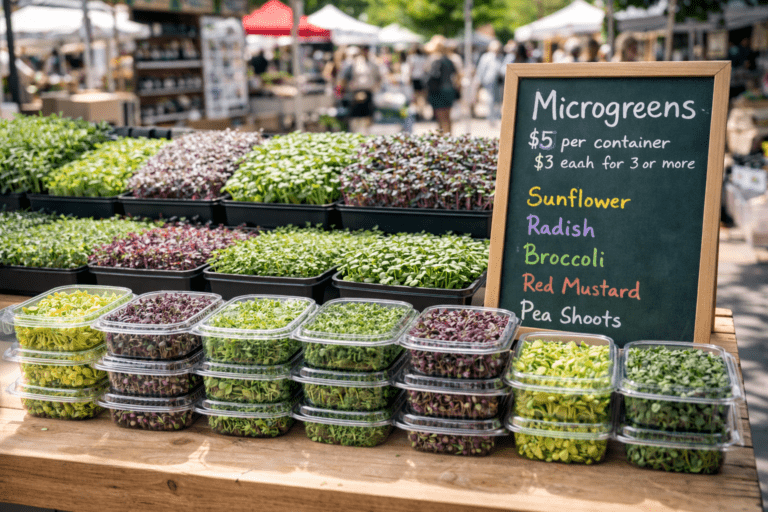
UK farmers market stall selling microgreens punnets at £3.50 each

Watch: how to start a profitable microgreens side hustle

Where to sell microgreens

Where you sell determines what price you can charge. The best microgreens to sell UK growers can profit from need to be matched to the right channel.

Channel Price level Volume potential Effort
Farmers markets Highest retail (£4–£12 per punnet) Moderate (10–30 punnets/week) High (Saturday mornings)
Local restaurants Wholesale (£30–£80/kg) High (1–5 kg/week per chef) Medium (delivery rounds)
Veg box schemes Wholesale (£25–£40/kg) High (recurring weekly orders) Low (predictable demand)
Health food shops Mid (£3–£5/punnet wholesale) Medium (5–15 punnets/week) Medium (weekly delivery)
Direct-to-consumer (Instagram, local Facebook) Retail (£3.50–£6 per punnet) Variable Medium (marketing time)
Cafes and gastropubs Wholesale (£35–£50/kg) Low–Medium Medium

Most UK home growers run two or three channels in parallel — typically a Saturday farmers market plus 1–2 local restaurant accounts. That mix balances cash flow, volume and price.

Selling microgreens in the UK is one of the simplest food-business pathways. You’ll need to handle three things:

  1. Register as a food business — free, online, with your local council. Required at least 28 days before you start trading. Visit gov.uk food business registration.
  2. Food hygiene certificate (Level 2) — not legally mandatory for fresh produce, but most UK farmers market organisers ask for it. Online courses cost £15–£25 from providers like Virtual College or High Speed Training.
  3. Public liability insurance — typically £60–£120 per year for a small food trader. NFU Mutual and Direct Line Business both cover UK microgreen growers.

You don’t need a commercial kitchen, EHO inspection, or special hydroponic licence to grow and sell microgreens from a UK home setup. Microgreens are classified as fresh produce.

💷

Microgreens: Hobby to Side Income

The complete UK guide to turning microgreens into a £500–£2,000/month side business. Variety profiles, pricing strategies, customer acquisition, restaurant cold-pitching scripts, and the production schedule that makes 25 trays per week feel easy.

✓ 23 pages · ✓ UK pricing strategies · ✓ Restaurant pitch scripts · ✓ Instant PDF download

Get The Ebook — £12.99 →

5 mistakes that kill UK microgreen profits

Mistake 1 — Growing first, selling second

Most failed UK microgreen businesses planted dozens of trays before securing a single buyer. Reverse the order: pitch three local restaurants and one farmers market stall before you sow tray one.

Mistake 2 — Underpricing at farmers markets

UK customers will pay £4.50 for a punnet of fresh microgreens because they’re rare. Charging £2.50 trains your market to expect supermarket prices and destroys your margins. Start higher — you can always lower.

Mistake 3 — Growing too many varieties at once

Three varieties grown brilliantly outsell ten varieties grown poorly. Master radish, pea shoots and sunflower first. Add specialty crops only when those three run on autopilot.

Mistake 4 — Ignoring UK seasonal demand spikes

UK microgreen demand peaks in November–December (Christmas restaurant menus) and May–August (farmers market season). Plan production around these spikes — and don’t waste output in February when demand drops.

Mistake 5 — Cheap seeds from unverified sources

Bargain seeds from generic online sellers often have low germination rates and unknown chemical treatments. Stick to reputable UK microgreen seed suppliers like Sky Sprouts, Wolfe Microgreens, or Skyline.

How to scale a UK microgreen side business

The scaling path for UK home growers is well-trodden. Here’s the realistic progression.

Stage Trays/week UK monthly profit Time investment
Hobby (months 1–3) 5–10 £100–£250 3–5 hrs/week
Side hustle (months 3–9) 15–25 £400–£900 6–10 hrs/week
Serious side income (year 1+) 30–50 £1,000–£2,000 12–18 hrs/week
Small business (year 2+) 60–120 £2,500–£5,000 20–30 hrs/week

Each scaling tier requires more shelving, lighting and (eventually) a dedicated grow room. A single bedroom can comfortably hold 4 shelves × 8 trays = 32 trays per cycle.

3 pro tips for selling more UK microgreens

  1. Pre-sell every tray before you sow it. A £20 tray that’s already sold is worth far more than a £30 tray you have to push at market. Use Instagram Stories or local Facebook groups for weekly pre-orders.
  2. Cold-pitch UK restaurants on a Tuesday morning. Mondays are too hectic, Wednesdays the menu is set. Tuesday at 10am catches chefs receptive and curious. Bring a sample tray, not a flyer.
  3. Build a £4 punnet “starter” and a £6 premium punnet. Most UK market customers go for the premium when they see the price gap is small. You sell more high-margin product without alienating budget-conscious buyers.

Frequently asked questions about the best microgreens to sell UK

How much can a UK home microgreen grower realistically earn?

A UK home grower running 25 trays per week across radish, pea shoots and sunflower can clear £400–£900 monthly profit after costs. Scaling to 50 trays per week with established restaurant accounts pushes that to £1,500–£2,000 monthly. Above £2,500/month, most growers transition into a small business with dedicated grow space.

What’s the most profitable microgreen to sell in the UK?

Radish microgreens deliver the strongest margins thanks to a 7-day cycle that allows 3+ tray turns per month. Sunflower microgreens deliver the highest revenue per individual tray. The most profitable choice depends on whether you’re optimising for velocity (radish) or per-tray gross (sunflower).

Do you need a licence to sell microgreens in the UK?

You need to register as a food business with your local council (free, online), but no special licence or commercial kitchen is required. Microgreens are classified as fresh produce. Most UK farmers markets ask for a Level 2 food hygiene certificate (£15–£25 online) and £60–£120 annual public liability insurance.

Where can UK home growers buy microgreen seeds in bulk?

The leading UK microgreen seed suppliers are Sky Sprouts, Wolfe Microgreens, Skyline Seeds, and Marshalls. For bulk orders (1kg+), bypass garden centres and order direct from these specialists. Bulk pricing typically runs 40–60% cheaper than retail seed packets.

Can you sell microgreens to UK supermarkets?

Selling to UK supermarket chains (Tesco, Sainsbury’s, Waitrose) usually requires accreditation through schemes like Red Tractor or LEAF, plus volumes most home growers can’t meet. Independent UK greengrocers, farm shops, and health food stores are far more accessible for small producers.

How long do microgreens stay fresh after harvest?

Properly harvested and refrigerated UK microgreens last 7–10 days in clear plastic punnets at 4°C. Coriander and basil are most fragile (5–7 days). Pea shoots and sunflower keep longest (10–12 days). Always harvest the morning of market day for premium freshness.

What’s the cheapest way to start a UK microgreens business?

A starter setup costs £80–£150 in the UK: 10 1020 trays (£25), an LED grow light (£40), seeds for three varieties (£20), growing medium (£15), and a basic shelving unit (£25). See our microgreens beginner guide for the full setup.

Is hydroponic microgreen growing better than soil for UK sellers?

Hydroponic microgreens grow slightly faster and stay cleaner (no soil to brush off), making them more attractive to restaurants. Soil-grown trays cost less per tray but require post-harvest washing. Most successful UK microgreen businesses use hemp mats or coco coir as a hybrid clean-grow medium.

Related posts for UK microgreen growers

Further reading from UK authorities and suppliers

Start growing the best microgreens to sell UK customers will pay for

The best microgreens to sell UK growers can profit from in 2026 are the ones that match your sales channel. Farmers markets reward fast-cycle visual crops like radish and pea shoots. Restaurants pay premiums for specialty varieties like coriander and basil. Veg box schemes love reliable broccoli and sunflower.

Whatever you choose, the formula is the same: secure buyers first, master 3 varieties, price boldly, and scale only when each tray you grow has a customer waiting for it.

Your next step: pick two varieties from this guide, source seeds from a UK specialist supplier, and pitch one local restaurant or farmers market organiser this week. Sow your first tray once you have a confirmed buyer.