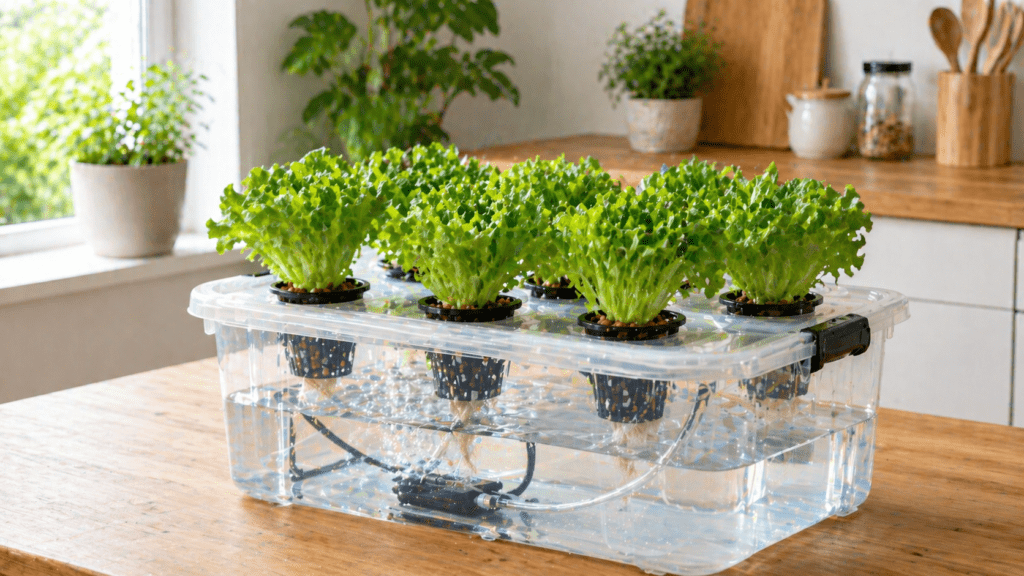
An opaque, food-safe storage box can make a practical small hydroponic reservoir when it is strong enough to hold water, blocks light and has a secure lid. For a beginner build, keep the design simple: support a few net pots in the lid, use a suitable hydroponic nutrient solution and provide aeration if you are building deep water culture (DWC).
Choose the storage box carefully
The container is the reservoir, so strength matters more than appearance. Choose a box that can safely hold the intended volume of water without bowing excessively. An opaque container is preferable because light reaching nutrient solution encourages algae. If the plastic is translucent, cover the outside with a light-blocking material without obstructing access to the lid.
Before using any container for edible crops, check the manufacturer's intended use and material information. Avoid containers that previously held chemicals or unknown substances.
What you need
- Strong opaque storage box with a well-fitting lid
- Net pots sized for the planting holes
- Suitable growing medium
- Complete hydroponic nutrient
- pH and EC/TDS meters if you plan to monitor the solution closely
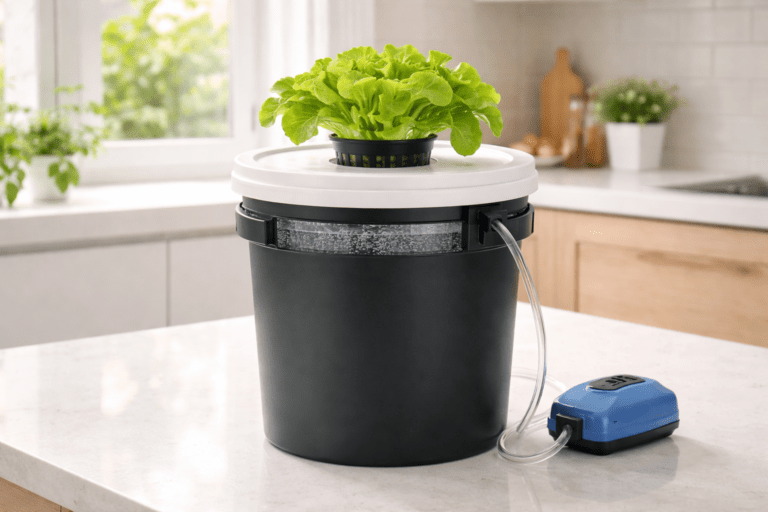
- Air pump, airline and air stone for a DWC build
- Hole saw or suitable cutting tool, used safely
Measure your net pots before cutting the lid. The rim should sit securely on the lid rather than falling through the opening.
Simple storage-box DWC build
- Decide how many plants the lid can support without overcrowding mature foliage and roots.
- Mark the net-pot positions with enough spacing between them.
- Remove the lid before cutting and make the holes with an appropriate tool.
- Clean away all plastic debris.
- Position the air stone in the reservoir and route the airline so the lid still closes properly.
- Add water and nutrients according to the nutrient manufacturer's instructions, then measure and adjust pH as needed.
- Fit the lid and place established seedlings into the net pots.
Keep electrical equipment and connections protected from splashes and follow the manufacturer's instructions for pumps and grow lights.
Managing the reservoir
Roots need both water and oxygen. In DWC, the air pump helps oxygenate the nutrient solution. Check the water level, plant condition and roots regularly, and avoid allowing the reservoir to become excessively warm. Record pH and EC rather than reacting to every small movement; trends are more useful than isolated readings.
If you need help with solution strength, see the hydroponic nutrient schedule and pH adjustment guide.
Plants that suit a small box system
Leafy greens and many culinary herbs are good starting choices because they remain relatively compact. Lettuce is particularly beginner-friendly. Larger fruiting plants such as tomatoes and cucumbers need much more root space, light, support and nutrient management, so avoid packing several of them into a small reservoir.
Common problems to avoid
Algae
Block light from the reservoir and planting holes. If algae is already present, clean the system and address the light leak rather than relying only on additives.
Brown or unhealthy roots
Check solution temperature, aeration, cleanliness and plant health. Brown staining is not always root rot, but slimy roots, poor smell and declining plants deserve attention.
Overcrowding
Design for the mature plant, not the seedling. Too many plants compete for light and create a dense root mass that makes reservoir maintenance harder.
Storage-box hydroponics FAQs
Does the box have to be an IKEA box?
No. The important features are appropriate material, strength, size, a workable lid and good light exclusion. Check the specifications of whichever container you choose.
Do I need an air pump?
For DWC, active aeration is normally part of the system. Passive Kratky hydroponics works differently and deliberately develops an air gap as the solution level falls.
How many plants fit in one box?
That depends on the reservoir dimensions and crop. Give plants enough spacing for mature foliage and roots rather than trying to maximise the number of holes.