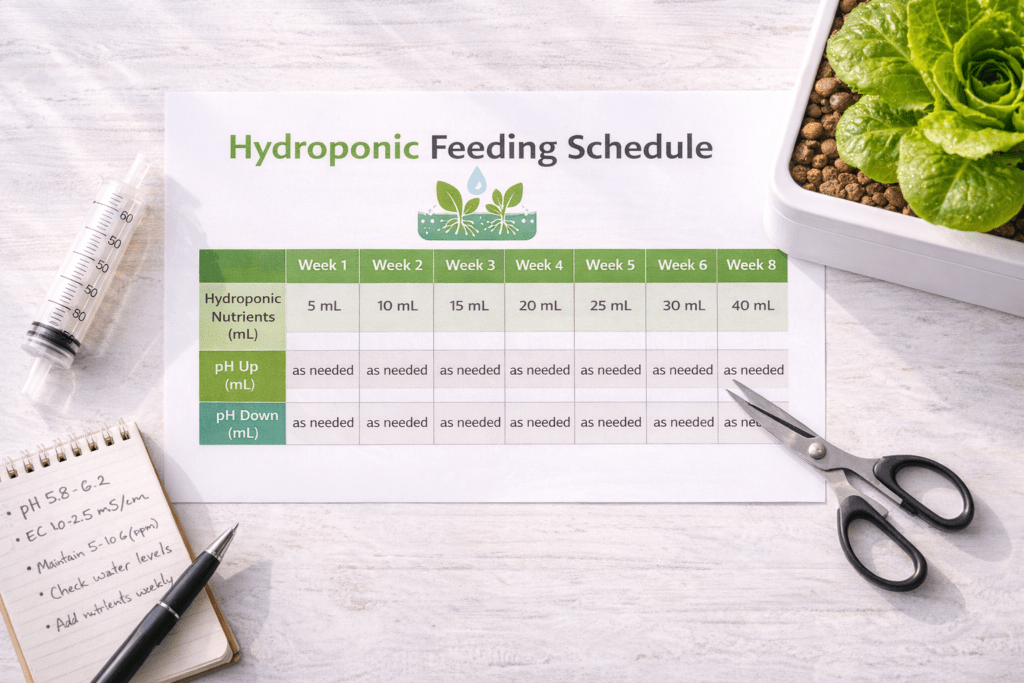
Getting hydroponic nutrients right does not mean feeding every plant the same amount every week. Young seedlings generally need a milder nutrient solution, while established and fruiting plants can require considerably more. Lettuce also has very different requirements from a mature tomato plant.
Hydroponic Nutrient Schedule at a Glance
The table below provides practical starting points. They are ranges rather than rigid targets: cultivar, temperature, lighting, water quality, system type and your nutrient formulation can all affect the ideal concentration.
| Crop | Growth stage | Suggested EC | Typical pH |
|---|---|---|---|
| Lettuce | Seedling | 0.6–1.0 | 5.8–6.5 |
| Lettuce | Established | 1.2–1.8 | 6.0–7.0 |
| Basil | Seedling / young | 0.6–1.0 | 5.5–6.0 |
| Basil | Established | 1.0–1.6 | 5.5–6.0 |
| Tomato | Seedling | 0.8–1.2 | 5.5–6.5 |
| Tomato | Vegetative | 1.5–2.5 | 5.5–6.5 |
| Tomato | Flowering / fruiting | 2.0–4.0 | 6.0–6.5 |
For established crops, Oklahoma State University's hydroponics guidance lists lettuce at EC 1.2–1.8 mS/cm, basil at 1.0–1.6 mS/cm and tomato at 2.0–4.0 mS/cm. Use published ranges as reference points, not as a reason to force a healthy plant to a particular number.
What Does a Hydroponic Nutrient Schedule Actually Do?
Plants do not need exactly the same concentration of nutrients throughout their lives. A newly germinated seed has stored reserves for its earliest growth. Once roots and leaves develop, demand for mineral nutrients increases. Fruiting plants such as tomatoes introduce another stage because flowering and fruit production place different demands on the plant.
A useful feeding schedule therefore progresses with the plant rather than telling you to add the same dose every seven days.
EC
Electrical conductivity (EC) indicates the concentration of dissolved salts in the nutrient solution. Higher EC generally means a more concentrated solution.
pH
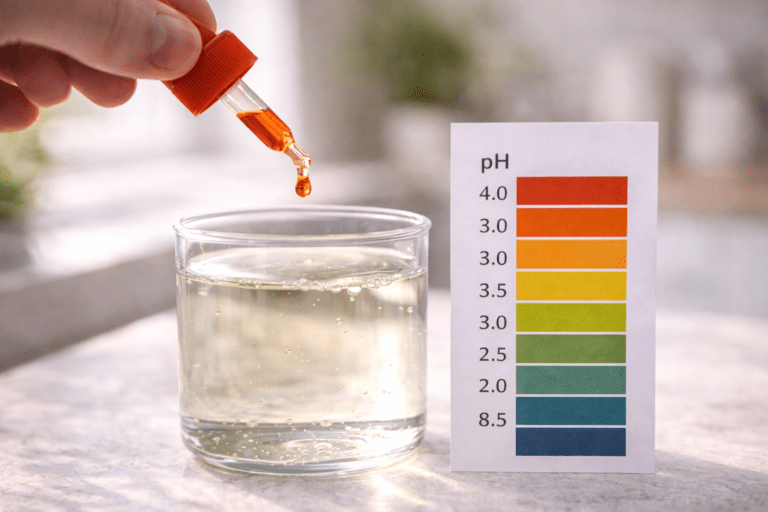
pH affects nutrient availability. Nutrients can be present in the reservoir but become less available to plants when the root-zone pH moves outside a suitable range.
Water level
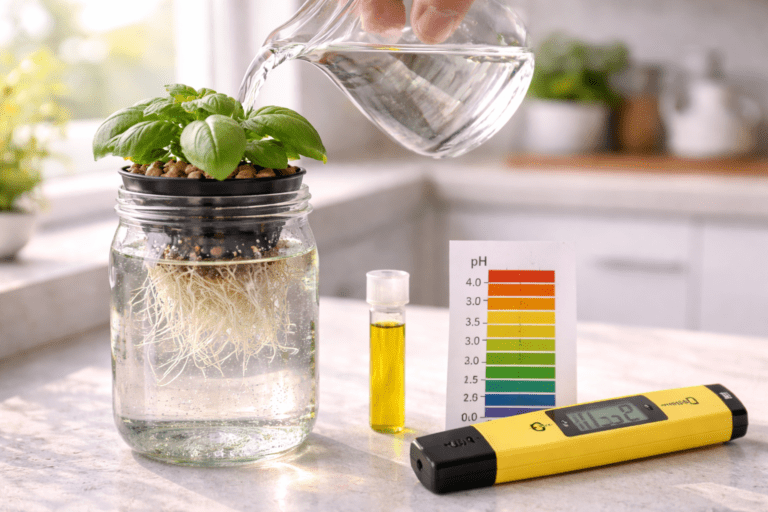
Plants take up both water and nutrients, but not necessarily at identical rates. Checking EC, pH and water level together tells you much more than adding nutrients simply because another week has passed.
Hydroponic Lettuce Nutrient Schedule
Lettuce is an excellent beginner crop because it grows relatively quickly and generally uses a weaker nutrient solution than heavy-feeding fruiting crops.
| Stage | Approximate period | Suggested EC |
|---|---|---|
| Germination | Days 1–7 | Very mild / no nutrient initially |
| Young seedling | Week 1–2 | 0.6–1.0 |
| Early growth | Week 2–3 | 1.0–1.4 |
| Established growth | Week 3 onward | 1.2–1.8 |
Do not increase EC automatically because another week has passed. Plant size and condition are more useful indicators than the calendar alone. For the complete crop process, see our hydroponic lettuce guide.
Hydroponic Basil Nutrient Schedule
Do not assume every herb has identical requirements. Basil, mint and coriander may all be described as hydroponic herbs, but their ideal conditions can differ.
| Growth stage | Suggested EC |
|---|---|
| Seedling | 0.6–0.8 |
| Young plant | 0.8–1.2 |
| Established basil | 1.0–1.6 |
For established basil, EC 1.0–1.6 mS/cm and pH 5.5–6.0 are useful reference ranges. Read our hydroponic herbs guide for crop-specific advice.
Hydroponic Tomato Nutrient Schedule
Tomatoes are heavier feeders. A mature plant must support substantial vegetative growth as well as flowers and developing fruit, so nutrient concentration is normally higher than for lettuce.
| Growth stage | Suggested EC |
|---|---|
| Seedling | 0.8–1.2 |
| Early vegetative growth | 1.2–2.0 |
| Established vegetative growth | 1.5–2.5 |
| Flowering | 2.0–3.0 |
| Fruiting | 2.0–4.0 |
Treat these as ranges, not targets you must force the solution to reach. For the full crop guide, see how to grow hydroponic tomatoes indoors.
How Much Hydroponic Nutrient Should You Add?
There is no universal ml-per-litre dosage that is correct for every nutrient. Different products have different concentrations and formulations. Start with the manufacturer's directions and use EC to check the resulting solution where possible.
If, for example, a particular product instructed you to use 2 ml per litre, the arithmetic would be:
| Reservoir | Example amount |
|---|---|
| 1 litre | 2 ml |
| 5 litres | 10 ml |
| 10 litres | 20 ml |
| 20 litres | 40 ml |
| 50 litres | 100 ml |
Important: 2 ml/L above is an example calculation, not a recommended universal dose.
How to Mix Hydroponic Nutrients
- Fill the reservoir with the required water.
- Measure starting EC if you have a meter.
- Add the first nutrient component according to the manufacturer's directions.
- Mix thoroughly before adding another component.
- Measure the resulting EC.
- Measure pH after nutrients are mixed.
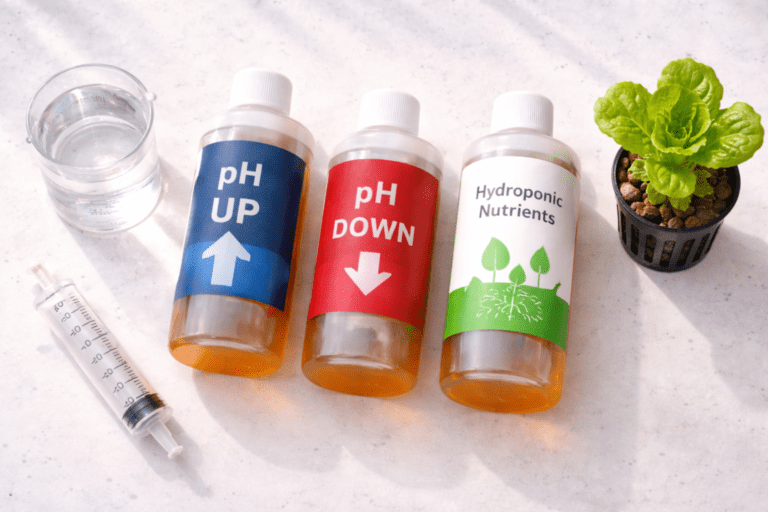
- Adjust carefully if required.
- Record the final EC and pH.
If you use separate Part A and Part B concentrates, do not mix the concentrated products directly together unless the manufacturer explicitly instructs you to. Add each component to the water separately and mix well.
Free Hydroponics Tools
Use these tools to take the guesswork out of common calculations.
EC vs PPM: What's the Difference?
EC measures electrical conductivity directly. PPM/TDS meters commonly estimate dissolved solids from conductivity using a conversion factor. Different conversion scales can therefore produce different PPM numbers for the same solution. EC is often simpler when comparing hydroponic recommendations.
Why Your Starting Water Matters
Tap water contains dissolved minerals that contribute to EC before nutrients are added. If your starting water reads 0.4 mS/cm and the final nutrient solution reads 1.6 mS/cm, the final number includes what was already in the water. This is one reason copying another grower's exact ml-per-litre recipe may not produce the same result.
See Can You Use Tap Water for Hydroponics? for more detail.
When Should You Top Up the Reservoir?
Do not assume that a falling water level automatically means you should add another full dose of nutrient. Check water level, EC and pH together. If the water level falls while EC rises, the remaining solution has become more concentrated and plain water may be appropriate. If water level and EC both fall substantially, nutrient uptake may be relatively high.
Over time individual nutrient ratios can drift even if overall EC appears reasonable, so periodic replacement can provide a known starting point again.
What About the Kratky Method?
As a Kratky reservoir falls, an air gap develops and part of the root system adapts to this oxygen-rich area. That does not mean a Kratky container can never be topped up, but an established reservoir should not automatically be filled to the original level in a way that submerges the air-root zone. See the complete Kratky method guide.
Signs the Nutrient Solution May Be Too Strong
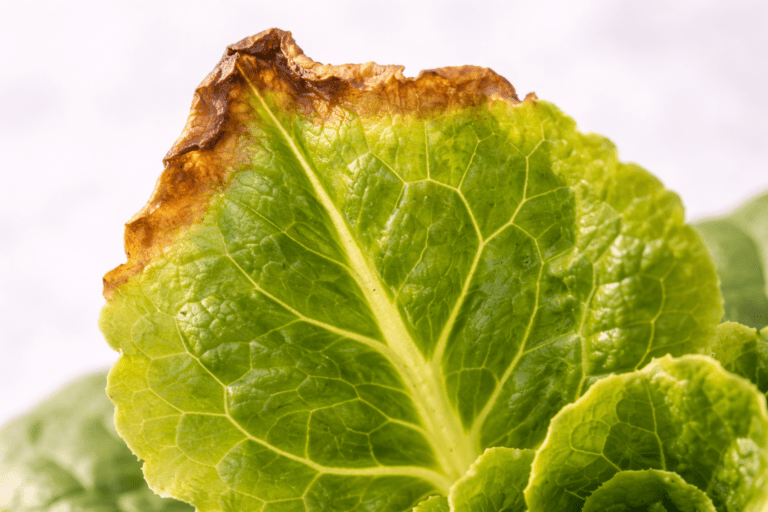
Possible signs include burnt leaf tips, browning margins, stressed growth and unusually high EC. Symptoms alone are not enough for a diagnosis because root problems, pH and environmental stress can look similar. Measure first, then see our hydroponic nutrient burn guide.
Signs Plants May Need More Nutrients
Pale growth, reduced vigour and deficiency patterns can occur when nutrition is inadequate, but do not automatically add more nutrients. Check pH, roots and growing conditions first. Our nutrient deficiency guide and yellow leaves guide can help with diagnosis.
Should You Automatically Add Cal-Mag?
Calcium and magnesium are essential, but every reservoir does not automatically need a separate Cal-Mag supplement. Your base nutrient and source water may already supply them. Check your nutrient formulation and water conditions before adding another product.
8 Common Hydroponic Feeding Mistakes
- Giving seedlings full-strength nutrients. Young plants generally start more gently.
- Feeding by calendar alone. Use growth stage and measurements as well as time.
- Adding nutrients every time water drops. Check EC first.
- Ignoring starting-water EC. Source water contributes to the final reading.
- Chasing tiny pH changes. Avoid unnecessary repeated chemical adjustments.
- Assuming yellow leaves always mean more food. Diagnose the cause first.
- Increasing strength too quickly. More nutrient does not automatically mean faster growth.
- Copying another grower's exact dose. Their water, product and environment may be different.
A Simple Nutrient Routine for Beginners
- Fill the reservoir.
- Measure starting EC.
- Add nutrients according to the product directions.
- Mix thoroughly.
- Measure EC.
- Check pH.
- Adjust carefully if required.
- Record the readings.
- Check the reservoir regularly.
- Watch the plant as well as the meter.
Keep a Hydroponic Feeding Record
A simple log of date, water level, EC, pH, nutrients added and plant condition can become more useful than blindly following somebody else's calendar. After several grows, you can see how plants behave in your own system and water.
Hydroponic Nutrient Schedule FAQ
How often should I add nutrients to hydroponics?
There is no single interval for every system. Monitor water level, EC and pH and follow the directions for your nutrient product rather than automatically adding a fixed dose every week.
Should seedlings receive full-strength hydroponic nutrients?
Usually not. Young seedlings generally start with a relatively weak solution, with concentration increased gradually as the plant develops.
What EC should hydroponic lettuce have?
For established lettuce, around 1.2–1.8 mS/cm is a useful published reference range. Cultivar and growing conditions can affect the ideal value.
What EC should basil have?
Around 1.0–1.6 mS/cm is a useful published reference range for established basil.
What EC should hydroponic tomatoes have?
Mature tomatoes generally use a stronger solution than leafy greens. Around 2.0–4.0 mS/cm is a useful published reference range.
Should I adjust pH before or after adding nutrients?
Generally, mix the nutrients first, establish the nutrient strength, and then measure and adjust pH if necessary. Follow the instructions for your specific products.
Can I use tap water for hydroponics?
Often yes, although water quality varies. Check starting EC and your local water quality where relevant.
Do I need an EC meter?
Simple systems can be run by carefully following a reputable nutrient manufacturer's instructions, but an EC meter provides much better information about changes in the reservoir.
Final Thoughts
A hydroponic nutrient schedule should be a starting framework, not a rigid recipe. Start gently, increase nutrient strength as the plant develops, and use EC, pH and plant health together to guide your decisions.
If something goes wrong, do not immediately reach for more nutrients. Check the water, EC, pH and roots first.