
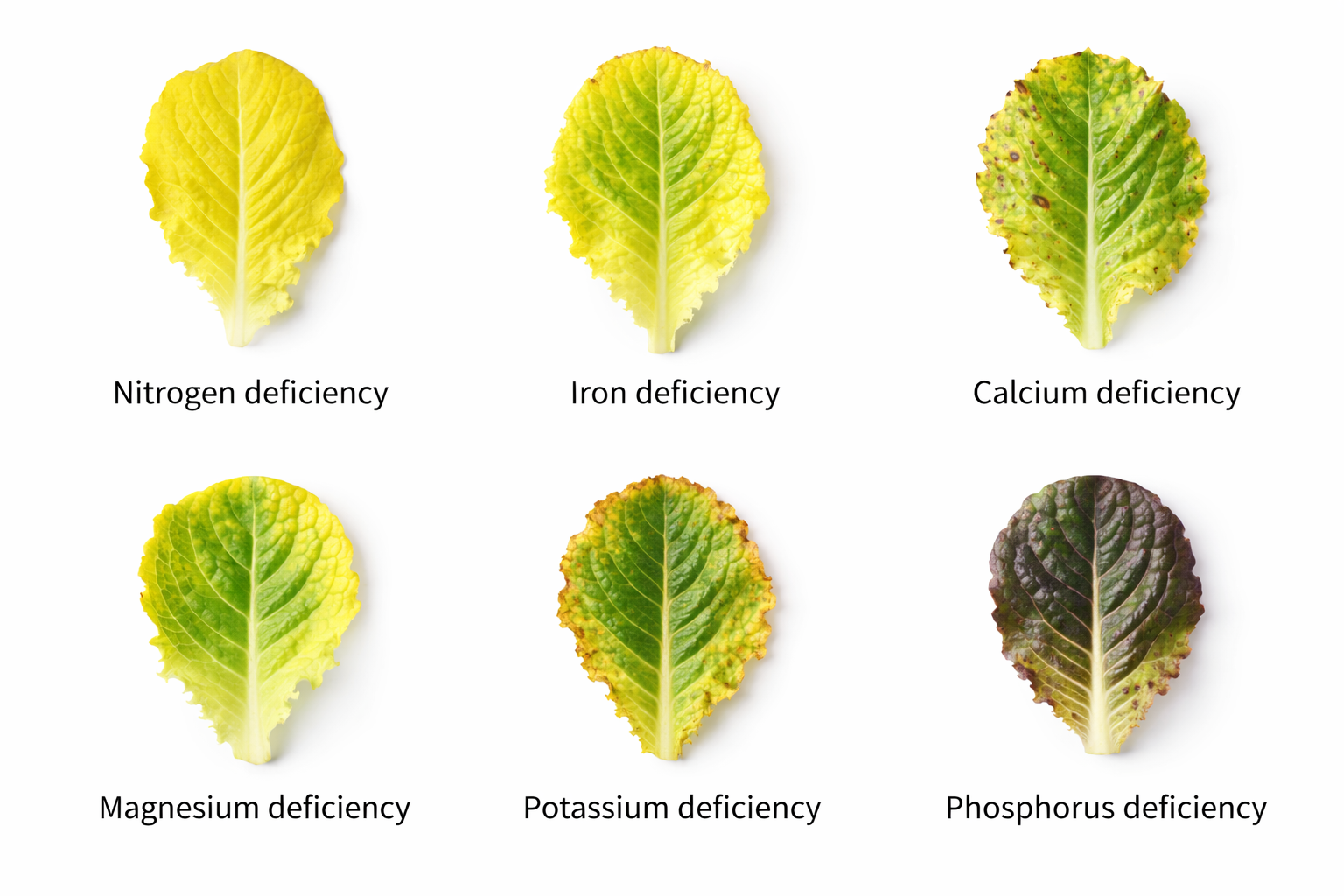
When something goes wrong with a hydroponic plant, the leaves tell you exactly what the problem is — if you know how to read them. Every hydroponic nutrient deficiency produces a specific, recognisable pattern on the leaves. Yellow leaves with green veins means iron. Brown crispy edges means potassium. Purple undersides means phosphorus. Each deficiency has its own visual signature.
This guide is a reference chart you can bookmark and return to whenever your plants show symptoms. For each hydroponic nutrient deficiency, you will find the visual symptoms, which leaves are affected first, the most common cause in hydroponic systems, and the exact fix.
⚠️ Check pH Before Diagnosing Anything
In approximately 70% of cases where growers suspect a nutrient deficiency, the real cause is pH being out of range (above 6.5 or below 5.5), which locks out multiple nutrients simultaneously. Correcting pH alone resolves the majority of apparent deficiencies without any supplements needed.
How to use this chart
Start by answering two questions about your plant’s symptoms:
| Question | What the Answer Tells You |
|---|---|
| 1. Which leaves are affected first? Old (lower) or new (upper)? |
Old leaves: Mobile nutrient deficiency (N, P, K, Mg) New leaves: Immobile nutrient deficiency (Fe, Ca, Mn) |
| 2. What does the damage pattern look like? Uniform yellow, interveinal yellow, spots, or edge browning? |
Each pattern points to a specific nutrient — use the cards below to match symptoms |
Why mobile vs immobile matters: mobile nutrients (nitrogen, phosphorus, potassium, magnesium) show symptoms on old leaves first because the plant moves them to feed new growth. Immobile nutrients (iron, calcium, boron, manganese) show symptoms on new leaves first because the plant cannot relocate them.
Mobile nutrients (symptoms appear on lower/older leaves first)
MobileNitrogen (N) deficiency
MobilePhosphorus (P) deficiency
MobilePotassium (K) deficiency
MobileMagnesium (Mg) deficiency
Immobile nutrients (symptoms appear on upper/newer leaves first)
ImmobileIron (Fe) deficiency
ImmobileCalcium (Ca) deficiency
ImmobileManganese (Mn) deficiency
The most important rule: check pH before diagnosing any deficiency
This point cannot be emphasised enough. The overwhelming majority of apparent hydroponic nutrient deficiency symptoms in home systems are caused by pH being out of range, not by actual nutrient shortage. Modern hydroponic nutrient formulations contain all necessary elements in the correct ratios. If you are using a reputable brand at the recommended strength, the nutrients are in the water. The question is whether the plant can access them.
At pH 6.0, virtually all nutrients are available. At pH 7.5, nitrogen, phosphorus, iron, manganese, and several other elements are partially or fully locked out. The solution looks the same, smells the same, and tests the same on an EC meter — but the plant is starving because the chemistry of the water prevents absorption.
Before reaching for supplements, before changing nutrient brands, before diagnosing specific deficiencies — test pH. If it is outside 5.5-6.5, correct it and wait 5-7 days. In most cases, the symptoms resolve without any other intervention. If your pH keeps drifting, see our pH keeps dropping in hydroponics guide for permanent fixes.
Quick reference: diagnostic lookup table
| Symptom Pattern | Affected Leaves | Likely Deficiency |
|---|---|---|
| Uniform pale yellow | Old (lower) first | Nitrogen |
| Dark green with purple undersides | Old (lower) first | Phosphorus |
| Brown crispy edges (starts at leaf tips) | Old (lower) first | Potassium |
| Yellow between green veins | Old (lower) first | Magnesium |
| Yellow between green veins (clear striped pattern) | New (upper) first | Iron |
| Distorted/curled leaves, brown spots, tip burn | New (upper) first | Calcium |
| Mottled yellow with brown specks | New (upper) first | Manganese |
| Overall pale/washed out look | All leaves at once | pH lockout (check pH first) |
| Brown crispy tips on all leaves | All leaves at once | Nutrient burn (dilute solution) |
Frequently asked questions about hydroponic nutrient deficiency
How quickly should deficiency symptoms improve after correcting pH?
Existing damaged leaves will not recover their original colour — that tissue is permanently affected. However, new growth should appear healthy and green within 5-7 days of correcting pH. If new growth is still showing deficiency symptoms after 7-10 days, pH may not be the full cause and you should investigate further (temperature, actual nutrient concentration, water source).
Can multiple deficiencies happen at the same time?
Yes, and this is actually very common when pH is out of range. High pH (7.0+) typically locks out iron, manganese, and phosphorus simultaneously. Low pH (below 5.0) locks out calcium, magnesium, and phosphorus. If you see a combination of symptoms on both new and old leaves, pH lockout is almost certainly the underlying cause.
Should I use plain water or dilute nutrients when topping up?
Use dilute nutrients (quarter strength) when topping up between reservoir changes, not plain water. Plain water dilutes the remaining nutrients and can trigger deficiency symptoms over time. Quarter-strength nutrient top-ups maintain balanced concentrations as the plant drinks.
Why do RO and soft water cause deficiencies more often than tap water?
Tap water contains small amounts of naturally dissolved calcium and magnesium that supplement the hydroponic nutrient formula. RO (reverse osmosis) and soft water have these removed, leaving the plant entirely dependent on what’s in the nutrient mix. Budget nutrient formulations often contain lower Cal-Mag levels, assuming some will come from the water. If you use RO water, a Cal-Mag supplement is essential, not optional.
How do I tell nutrient burn from potassium deficiency?
Both cause brown crispy leaf edges but the pattern differs: nutrient burn affects all leaves at once and starts at the very tip, while potassium deficiency starts on the oldest leaves only and works inward from edges. If all your leaves are affected including new growth, it’s burn (dilute your solution). If only older leaves are affected, it’s potassium deficiency (replace solution with fresh nutrients).
Is a nutrient deficiency a sign I should buy better nutrients?
Almost never. The vast majority of deficiency symptoms in home hydroponics come from pH problems or depleted solutions, not from poor nutrient formulations. A mid-range complete hydroponic nutrient (Formulex, General Hydroponics Flora Series, Canna Aqua) contains everything plants need. Switch brands only if you’ve verified pH is correct, solution is fresh, and deficiency symptoms persist across multiple grows.
Related posts you might find useful
- Hydroponic Plants Turning Yellow: Every Cause Explained — Deeper dive on yellowing patterns
- Hydroponic Nutrient Burn: Spot, Stop, Save Your Plants — The opposite problem (too much, not too little)
- pH Keeps Dropping in Hydroponics: Permanent Fixes — Solve the root cause of most deficiencies
- Hydroponic Root Rot: Identify, Fix, and Prevent — When roots are damaged, nutrients can’t be absorbed
- Algae in Hydroponic System: Complete Removal Guide — Algae competes with plants for nutrients
- Kratky Method Troubleshooting Guide — Kratky-specific deficiency issues
- 10 Easy Hydroponic Plants Almost Impossible to Kill — Start with forgiving crops
Diagnose Every Hydroponic Problem
Our 22-page ebook Hydroponic Troubleshooting Guide includes a full-colour printable nutrient deficiency chart, symptom photos, diagnostic flowcharts, and step-by-step fixes for every common problem.
✓ Printable deficiency chart · ✓ Visual symptom photos · ✓ Diagnostic flowcharts · ✓ Instant PDF download