
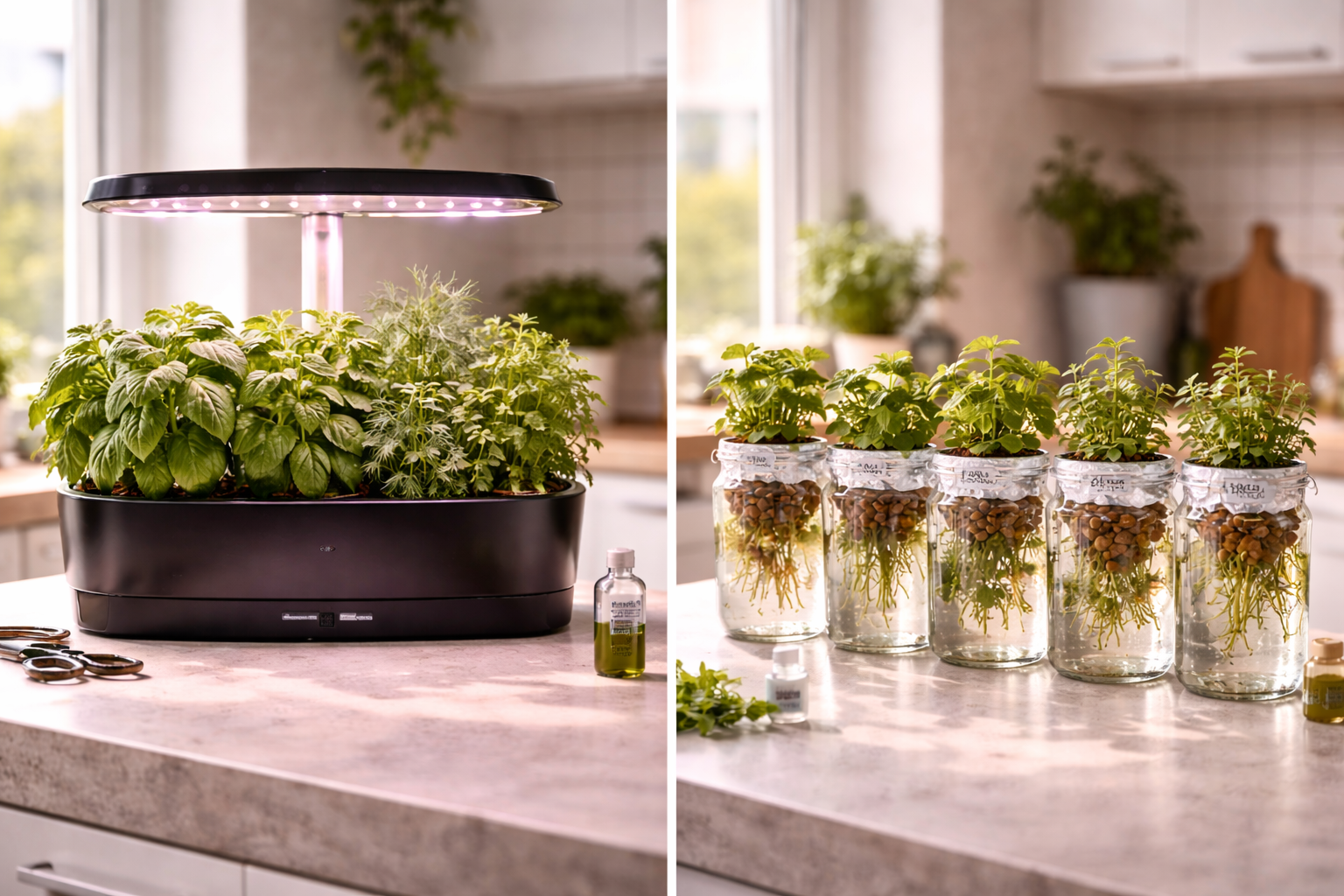
The AeroGarden vs DIY hydroponics debate is one of the most common questions new growers ask. On one side, AeroGarden offers polished, plug-and-play indoor gardens that require zero hydroponic knowledge. On the other side, DIY setups using mason jars or DWC buckets cost a fraction of the price and produce equivalent results — if you are willing to learn the basics. So which is genuinely better for beginners, and more importantly, which actually saves you money long-term?
This guide compares AeroGarden vs DIY hydroponics across every factor that matters: upfront cost, ongoing expenses, productivity, time investment, learning value, and long-term satisfaction. The answer might surprise you.
⚖️ The Quick Verdict
DIY hydroponics wins decisively on cost (£15-25 vs £80-200 upfront) and long-term value. AeroGarden wins on convenience, aesthetics, and zero learning curve. Choose DIY if you value money and skills. Choose AeroGarden if you value time and ease.
What is the AeroGarden vs DIY hydroponics cost difference?
The most striking difference in any AeroGarden vs DIY hydroponics comparison is the upfront cost. The numbers are dramatic enough that many beginners simply cannot justify the AeroGarden purchase once they see the alternative.
| Cost Type | AeroGarden Harvest | DIY Mason Jar |
|---|---|---|
| Initial purchase | £80-130 | £15-25 |
| Replacement pods/year | £60-120 | £5-10 |
| Nutrients/year | £15-25 | £10-15 |
| Electricity/year | £20-40 | £0 |
| Year 1 total | £175-315 | £30-50 |
| Year 3 cumulative | £400-700 | £60-100 |
The AeroGarden vs DIY hydroponics cost difference in year one is approximately £150-265 in favour of DIY. Over 3 years, the gap widens to £400-700 because pod replacement costs continue while DIY consumables stay minimal.
How does AeroGarden vs DIY hydroponics compare on productivity?
Productivity is where the AeroGarden vs DIY hydroponics comparison gets interesting. Both methods produce healthy plants, but they do it differently and with different yield ceilings.
🏠 AeroGarden productivity
An AeroGarden Harvest 6-pod can produce approximately 3-5 lettuce heads per growing cycle (every 4-6 weeks). The integrated LED lighting ensures consistent results regardless of natural light availability, but the fixed pod count caps maximum production. You cannot add more plants than the machine holds.
🛠️ DIY productivity
A row of 6-8 mason jar Kratky setups produces equivalent or better yields. The key advantage of DIY is scalability — you can add more jars indefinitely without buying new equipment. A windowsill that holds 6 jars can become a shelf that holds 20 jars without buying anything except more jars. For the complete Kratky approach, see our kratky method guide.
How does the AeroGarden vs DIY hydroponics learning experience compare?
This is where AeroGarden vs DIY hydroponics becomes a values question, not a math question. The AeroGarden teaches you almost nothing because everything is automated. The DIY approach teaches you genuine hydroponic skills.
🏠 What you learn with AeroGarden
- How to insert a pod
- How to add water when the indicator light turns on
- How to add proprietary nutrients on schedule
That is the complete learning experience. If your AeroGarden ever fails or you want to grow something not available as a pod, you cannot adapt because you never learned the underlying principles.
🛠️ What you learn with DIY
- How nutrients work and how to mix them — see hydroponic nutrients for beginners
- What pH means and how to test and adjust it — see how to adjust pH
- How to germinate seeds and identify healthy seedlings
- How to recognise plant problems and diagnose deficiencies
- How to scale, modify, and adapt your growing system
The DIY learning compounds over time. Within a few months, you can confidently grow any crop in any system because you understand the underlying biology and chemistry.
How does aesthetics affect the AeroGarden vs DIY hydroponics decision?
Aesthetics matter more than many growers admit. A foil-wrapped mason jar on a kitchen counter is functional but unattractive. An AeroGarden looks like a piece of modern kitchen furniture. For some buyers, this aesthetic difference alone justifies the price premium.
🎨 Improving DIY Aesthetics
DIY hydroponics can look attractive with minimal effort:
- Paint mason jars with chalk paint instead of using foil
- Use matching jars on a wooden tray for a coordinated look
- Build a neat shelf with consistent containers
- Add small label tags for each herb variety
Intermediate level: when AeroGarden actually wins
Despite DIY winning on cost, there are specific situations where AeroGarden vs DIY hydroponics genuinely tips toward AeroGarden being the better choice:
Scenario 1Gift purchases
AeroGarden is far more giftable than a box of jars and supplies. The polished packaging and immediate visual appeal make it perfect for housewarmings, birthdays, and Christmas gifts for people who might enjoy indoor growing but wouldn’t start from scratch themselves.
Scenario 2Office or shared spaces
The polished appearance fits professional environments better. An office break room or reception area benefits from an AeroGarden’s furniture-like aesthetic rather than rows of foil-wrapped jars.
Scenario 3Frequent travellers
Automated water reminders prevent forgotten plants. If you travel for work regularly, the AeroGarden’s reminder system is a genuine benefit over having to remember Kratky refill schedules or DWC pump maintenance.
Scenario 4Tech-loving users
Smartphone app integration appeals to gadget enthusiasts. If you enjoy data, notifications, and home automation integration, the tech-forward AeroGarden experience adds enjoyment beyond just growing plants.
Scenario 5Visual learners
The structured pod system makes initial success more visual and obvious. For people who learn best by seeing clear cause-and-effect rather than reading about pH and nutrients, AeroGarden’s “plug and grow” feedback loop is satisfying.
What is the time investment difference for AeroGarden vs DIY hydroponics?
Time matters as much as money for many busy households. Both AeroGarden vs DIY hydroponics require some weekly time investment, but the patterns are different. Understanding the time commitment helps you choose based on your lifestyle, not just your budget.
| Time Factor | AeroGarden | DIY Mason Jar |
|---|---|---|
| Initial setup time | 15 minutes | 30-60 minutes |
| Weekly maintenance | ~5 minutes | ~2-3 minutes per jar |
| Learning curve | None | 1-2 grow cycles |
| Annual time total | ~4-5 hours | ~6-8 hours (including setup) |
The time difference is small (2-3 extra hours per year for DIY), but the time pattern matters. AeroGarden time is steady weekly minutes. DIY time is concentrated in setup and harvest weeks with very little in between. Choose based on which pattern fits your life better.
How does AeroGarden vs DIY hydroponics affect your cooking?
This is the unexpected factor most reviewers miss. Both systems give you fresh herbs and greens, but they change your cooking habits in different ways. The convenience of an AeroGarden encourages frequent small harvests. The scale of multiple DIY jars encourages occasional large harvests for meal prep.
If you cook fresh meals daily and value picking individual leaves at the moment of cooking, AeroGarden suits this pattern well. If you batch cook on weekends and want larger quantities of fresh produce occasionally, DIY scales better. Neither approach is universally better — they suit different cooking styles.
What next? Combining both approaches
The smartest growers often run both systems simultaneously. Start with an AeroGarden for instant results and visual appeal, then add DIY systems alongside as you learn the fundamentals. This gives you the best of both worlds without committing entirely to either approach.
- Use AeroGarden for herbs you want immediate results with
- Build DIY systems for crops that AeroGarden cannot accommodate — see our 10 easy hydroponic plants guide
- Scale DIY for serious production once you have learned the basics
- Save money by refilling AeroGarden pods with your own seeds using reusable pod baskets
- Add proper grow lights for your DIY setups — see our best grow lights under £100
Frequently asked questions about AeroGarden vs DIY hydroponics
Can you save money by refilling AeroGarden pods?
Yes, but it voids the warranty and AeroGarden actively discourages it. Reusable seed pod baskets are available from third-party sellers on Amazon UK for £10-20 that fit AeroGarden systems. Combined with regular hydroponic nutrients, this can reduce ongoing costs by 70-80%.
Which produces better-tasting herbs, AeroGarden or DIY?
Both produce equivalent flavour quality because the plants themselves are identical. Any taste difference comes from variety selection, harvest timing, and freshness — not from the growing system. A basil plant is a basil plant regardless of whether it grew in an AeroGarden or a mason jar.
Is AeroGarden actually easier than DIY hydroponics?
Yes, for absolute beginners. AeroGarden requires zero learning while DIY requires mastering nutrient mixing and pH adjustment. However, the DIY learning curve is short — most beginners are confident within 1-2 successful grows. The “easier” advantage shrinks rapidly as you gain experience.
Can AeroGarden grow tomatoes and peppers?
The basic AeroGarden Harvest is too small for fruiting crops. The taller AeroGarden Bounty or Farm models can grow cherry tomatoes and small peppers, but for serious fruiting crop production, a DIY DWC bucket system with stronger lighting outperforms any AeroGarden. For crop-specific advice, see our hydroponic strawberries guide.
What happens if my AeroGarden breaks?
AeroGarden offers a 1-year warranty on parts. After warranty expires, repair costs often approach the price of a new unit. DIY systems have no electronic components to fail — they last indefinitely with no maintenance.
Which is better for kids learning about plants?
DIY hydroponics is significantly better for educational purposes. Children learn more from building and managing a mason jar system than from watching an AeroGarden run automatically. The DIY approach teaches biology, chemistry, and problem-solving simultaneously. See our teaching kids hydroponics guide for age-appropriate projects.
Is there a UK-specific AeroGarden alternative?
Yes — the UK market has strong alternatives including Click and Grow (available direct and via Amazon UK), LetPot, iDOO, and VegeBox. Some offer better UK customer support than AeroGarden, which primarily operates through Amazon distribution in the UK. For a full review, see our 7 best hydroponic starter kits guide.
Can I switch from AeroGarden to DIY later?
Absolutely. The skills transfer easily in the AeroGarden → DIY direction because you already know how to identify healthy plants, recognise problems, and time harvests. The only new skills you need are nutrient mixing and pH adjustment, both of which take 10-15 minutes to learn.
Related posts you might find useful
- 7 Best Hydroponic Starter Kits Tested — Full starter kit comparison including AeroGarden
- 5 Best Grow Lights Under £100 — Essential for DIY setups without built-in lights
- Smart Hydroponic Systems Reviewed — Premium tier beyond AeroGarden
- Best pH Meters for Home Hydroponics — Essential for DIY approach
- Kratky Method Hydroponics — The #1 DIY approach explained
- Kratky Jar Setup in Under 10 Minutes — Build a DIY system quickly
- Apartment Hydroponics Complete Guide — Context for both approaches
Master Hydroponic Equipment Choices
Our 21-page ebook Hydroponic Equipment Guide includes detailed comparisons of every system type, brand reviews, and recommendations for every budget and skill level.
✓ System comparisons · ✓ Brand reviews · ✓ Budget guides · ✓ Instant PDF download