
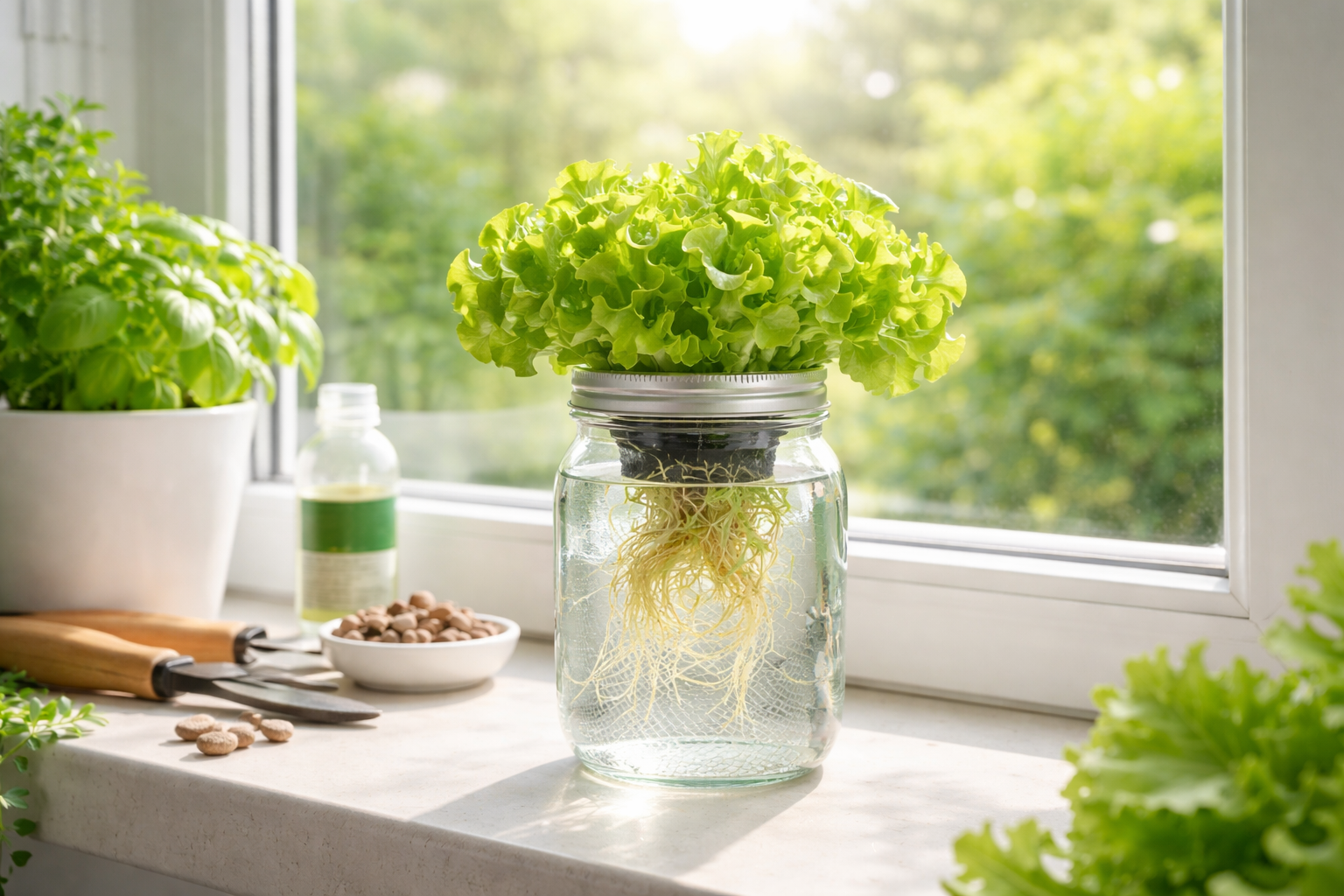
If you have ever placed a cutting from a houseplant into a glass of water and watched roots appear, congratulations: you have already done hydroponics. That is genuinely all it is at its simplest. Hydroponics is growing plants in water with dissolved nutrients instead of soil.
The word itself comes from two Greek words: hydro (water) and ponos (work). Water doing the work. That is the whole concept. Instead of a plant sending roots through soil searching for scattered nutrients, you deliver everything the plant needs directly to its roots through the water. It is faster, cleaner, and more efficient.
Yet despite this simplicity, hydroponics has a reputation for being complicated, expensive, and technical. It does not have to be. This guide explains hydroponics in plain English, with no jargon, no assumptions, and no chemistry degree required.
🌱 The Quick Definition
Hydroponics is growing plants in water with dissolved nutrients instead of soil. Plants grow 30-50% faster, use 90% less water, and can be scaled vertically. You can start for £15-25 and harvest fresh food in 30-45 days.
How does hydroponics actually work?
Plants need five things to grow: light, water, nutrients, air (specifically carbon dioxide for photosynthesis and oxygen for the roots), and physical support to stay upright. In soil gardening, the soil provides three of these: nutrients, water retention, and physical support. But soil itself is not essential. It is just a delivery system.
In hydroponics, you replace soil with a nutrient solution (water mixed with plant food) and a growing medium (like clay pebbles or perlite) that holds the plant upright. The roots grow directly into the nutrient solution, absorbing exactly what they need with far less effort than searching through soil.
Because the nutrients are delivered directly to the roots, hydroponic plants typically grow 30 to 50 percent faster than soil-grown plants. They also use up to 90 percent less water, because the water is recirculated rather than draining away into the ground.
The 6 main types of hydroponic systems
There are six main ways to set up a hydroponic garden. They range from completely passive (no electricity) to actively managed systems. Here is a brief overview of each:
#1Kratky method — The simplest
A plant sits in a container of nutrient solution. As it drinks, the water level drops, creating an air gap that provides oxygen to the roots. No pump, no timer, no electricity. This is the easiest starting point for beginners and costs less than five pounds to set up. See our Kratky method hydroponics guide for the complete breakdown.
#2Deep Water Culture (DWC) — Faster growth
Similar to Kratky but with an air pump that bubbles oxygen into the water. The roots are fully submerged in aerated nutrient solution. DWC grows plants faster than Kratky because the constant oxygenation supports more vigorous root growth. See our Kratky vs DWC comparison for the full breakdown.
#3Nutrient Film Technique (NFT) — Commercial standard
A thin film of nutrient solution flows through shallow channels. Plant roots sit in the channels, absorbing nutrients as the water passes over them. The solution is continuously pumped from a reservoir, flows through the channels, and returns to the reservoir in a loop.
#4Ebb and flow (flood and drain) — Balanced approach
A tray of plants is periodically flooded with nutrient solution, then drained. The roots absorb nutrients during the flood phase and oxygen during the drain phase. A timer controls the pump to cycle between flooding and draining.
#5Drip systems — Commercial efficiency
Nutrient solution is dripped onto the base of each plant through small tubes. Excess solution drains back into the reservoir. This is one of the most common commercial hydroponic methods and is highly efficient for larger setups.
#6Aeroponics — Maximum growth (advanced)
Plant roots hang in the air and are misted with nutrient solution at regular intervals. This provides maximum oxygenation and can produce the fastest growth rates, but it is also the most complex and expensive system. Not recommended for beginners.
Why is hydroponics better than soil gardening?
Hydroponics is not universally better than soil gardening. Both have their place. But for home growers, especially those with limited space, hydroponics offers several distinct advantages:
| Factor | Hydroponics | Soil Gardening |
|---|---|---|
| Growth speed | 30-50% faster | Standard |
| Water usage | Up to 90% less | High (much drains away) |
| Weeds | None | Constant battle |
| Pests | Minimal (indoor) | Common (slugs, deer, birds) |
| Year-round growing | Yes (with grow lights) | Seasonal |
| Space efficiency | Excellent (vertical stacking) | Requires garden area |
| Physical effort | Minimal | Digging, weeding, composting |
| Setup complexity | Higher upfront learning | Simpler start |
For the full head-to-head analysis, see our hydroponics vs soil growing guide.
What can you grow hydroponically?
Almost anything, but some crops are much better suited than others.
| Skill Level | Best Crops | Time to Harvest |
|---|---|---|
| Absolute Beginner | Lettuce, basil, mint, coriander | 21-45 days |
| Intermediate | Spinach, kale, pak choi, spring onions | 30-60 days |
| Advanced | Strawberries, tomatoes, peppers, cucumbers | 60-120 days |
The best advice for beginners: start with lettuce. It is forgiving, fast, and teaches you the fundamentals of pH, nutrients, and light management without the complexity of fruiting crops. For more beginner-friendly options, see our 10 easy hydroponic plants guide.
How much does it cost to start?
You can start hydroponics for less than you might spend on a takeaway dinner. Here are the four main budget tiers:
Tier 1Kratky jar (£15-25) — Absolute cheapest
A simple Kratky system (mason jar, net pot, clay pebbles, nutrients, pH drops, and seeds) costs approximately £15-25. The nutrients and pH drops last for months across multiple grows, so the cost per subsequent grow drops to £1-3. See our mason jar hydroponics guide for the complete step-by-step.
Tier 2DWC bucket (£25-45) — Faster growth
A DIY DWC bucket system with an air pump produces faster growth than Kratky. See our £30 hydroponic system guide for the full step-by-step build.
Tier 3Smart garden (£60-200) — Zero learning curve
Pre-built countertop systems like the Click and Grow Smart Garden 3 cost £60-100 and include everything you need, including built-in LED lights. These are the most hands-off option and make excellent gifts for curious beginners. See our 7 best hydroponic starter kits guide for detailed reviews.
Tier 4Full home setup (£100-300) — Maximum production
A multi-shelf growing station with grow lights and multiple systems. Vertical tower systems for serious growers range from £100 to £300. See our hydroponic cost breakdown guide for full cost analysis across all tiers.
Is hydroponics hard to learn?
No. Hydroponics has a reputation for complexity because of the terminology (pH, EC, NPK, nutrient lockout), but the actual practice is straightforward. You mix nutrients into water, check the pH, plant a seedling, and wait. The process takes about five minutes of setup time and a weekly check thereafter.
The most important thing to learn is pH management, and even that is simple: test the water after adding nutrients, add a few drops of pH Down or pH Up until the reading is between 5.5 and 6.5, and you are done. A pH test kit costs £4-6 and lasts for hundreds of tests. See our how to adjust pH guide for the complete walkthrough.
🔑 The Whole Concept in One Sentence
If you can follow a recipe, you can do hydroponics. Mix the ingredients (nutrients + water), check the pH, add the seedling, and wait. That is genuinely the entire process.
The best way to start: one jar, one plant
Do not buy an expensive system, do not watch a hundred videos, and do not overthink it. Buy a mason jar, a net pot, some clay pebbles, a small bottle of hydroponic nutrients, and pH drops. Wrap the jar in foil, fill it with nutrient solution, plant a lettuce seedling, and put it on your sunniest windowsill.
That is it. You will have your first hydroponic harvest in 30 to 45 days. From there, the hobby grows naturally because the results are so immediate and satisfying.
What to learn next
Now that you understand what hydroponics is, the next step is deciding which system to start with and what to grow. If budget is a priority, the Kratky method is unbeatable. If you want the fastest growth, DWC is the natural progression. And if you want zero-effort growing, a countertop smart garden handles everything for you.
Whatever path you choose, the fundamentals are the same: nutrients in water, correct pH, adequate light, and a little patience. The plants do the rest.
Frequently asked questions about hydroponics
Do I need special skills or knowledge to start hydroponics?
No. If you can follow instructions on a shampoo bottle, you can mix nutrient solution. The basic skills needed are measuring liquid (with a syringe), reading a pH colour chart, and planting a seedling. No chemistry knowledge, gardening experience, or technical background is required.
How much space do I need?
Remarkably little. A single Kratky jar fits on any windowsill (8cm x 8cm footprint). A complete 4-6 jar herb garden fits in less than 1 metre of windowsill space. Even a full DWC bucket needs only 30cm x 30cm. Hydroponics is ideal for small flats and apartments. See our apartment hydroponics guide.
Do hydroponic plants taste different from soil-grown plants?
In blind taste tests, most people cannot distinguish between properly grown hydroponic and soil-grown plants. Some hydroponic crops actually taste better because they are harvested fresher (minutes before eating vs days to weeks after supermarket picking). The taste depends on variety, harvest timing, and freshness — not whether soil was involved.
Is hydroponics organic?
Not technically, by most definitions. Traditional organic certification requires soil-based growing with organic matter. However, hydroponic growing can be “pesticide-free” and use organic-certified nutrients. The food is equally safe and nutritious — the distinction is mainly regulatory and philosophical.
Can children grow hydroponic plants safely?
Yes, and it is genuinely one of the best STEM activities for children. The nutrients are concentrated plant food, not toxic chemicals (though not to be consumed directly). Children aged 7+ can manage most aspects with adult supervision for pH adjustment. See our teaching kids hydroponics guide.
Do I need a greenhouse for hydroponics?
No. Most home hydroponic growing happens indoors, on kitchen windowsills or under small grow lights. A greenhouse is useful if you want to scale up to serious production or grow year-round in outdoor temperatures, but it is not needed for a few herb jars or lettuce heads.
What’s the single biggest reason hydroponic plants fail?
Incorrect pH. More hydroponic plants die from pH being outside the 5.5-6.5 range than from any other cause. Nutrient lockout (when plants can’t absorb nutrients because pH is wrong) causes yellowing, stunting, and death even when the nutrient solution is perfect. See our plants turning yellow guide for the full diagnostic.
Can I grow the same hydroponic plant forever?
No — most crops have natural lifespans. Lettuce is typically one-cycle (harvest once). Basil produces for 2-3 months then bolts. Mint can produce for 6-12 months. Strawberries can produce for 2-3 years. Plan rotations by starting new plants as old ones slow down.
Related posts you might find useful
- Is Hydroponics Hard to Learn? — Honest answer from someone who started at zero
- 7 Beginner Mistakes in Hydroponics — The pitfalls to avoid
- Hydroponics vs Soil Growing — Which is better for beginners
- How to Start Hydroponics with Mason Jars — The cheapest working method
- Hydroponic Nutrients for Beginners — The one concept you must learn
- Kratky Method Hydroponics — The easiest passive system
- 10 Easy Hydroponic Plants — Best first crops for beginners
The Complete Beginner’s Roadmap
Our 22-page ebook Hydroponics For Complete Beginners is a step-by-step roadmap from zero knowledge to your first harvest. Systems, nutrients, pH, plant selection, and troubleshooting — all in plain English.
✓ Zero-to-harvest roadmap · ✓ Plain-English explanations · ✓ Troubleshooting guide · ✓ Instant PDF download