
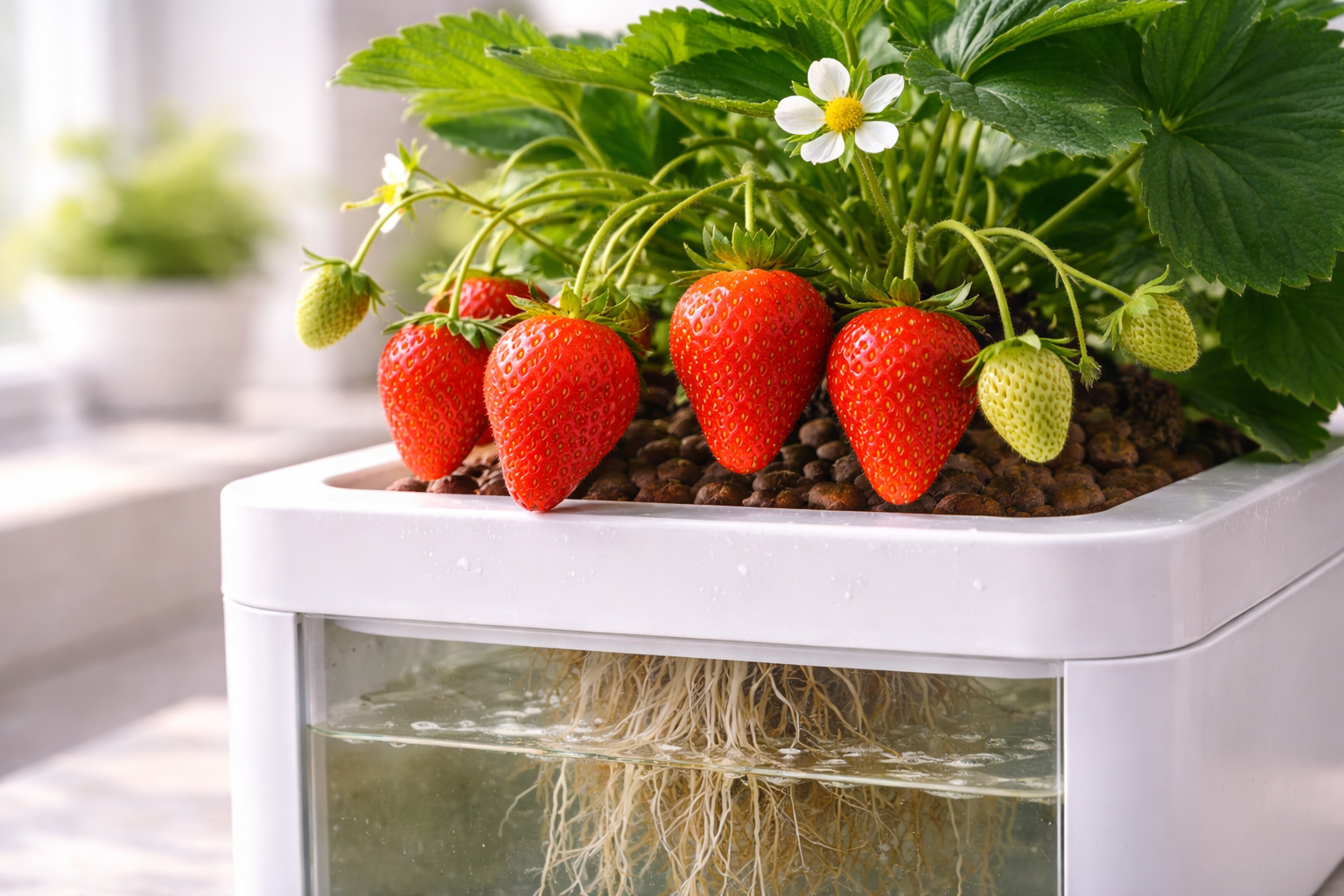
Hydroponic strawberries are one of the most exciting crops for home growers because they produce something genuinely special: fresh, sweet, ripe strawberries year-round, including in the dead of winter when supermarket strawberries are tasteless and expensive. The question every beginner asks is whether it actually works at home, and the answer is yes — but with important caveats.
This guide tells you the honest truth about growing hydroponic strawberries indoors: what works, what does not, what you need, and how to set realistic expectations for your harvest.
🍓 The Honest Truth
Hydroponic strawberries are real and they work, but they are not as easy as lettuce or herbs. Expect 2-3 strawberries per plant per week from a mature plant under good conditions. They require commitment, but the reward is genuinely fresh strawberries whenever you want them.
Are hydroponic strawberries actually worth the effort?
This is the first question you should ask yourself before investing time and money into hydroponic strawberries. The answer depends on what you value:
| Factor | Reality |
|---|---|
| Cost vs supermarket | Higher initial investment, but you get year-round fresh strawberries |
| Flavour difference | Dramatically better than out-of-season supermarket strawberries |
| Difficulty | Moderate – more demanding than herbs or lettuce |
| Time to first harvest | 8-12 weeks from established plants, longer from seed |
| Productivity | 2-3 berries per plant per week when fully established |
Why hydroponic strawberries are challenging
Before investing in hydroponic strawberries, understand why they are more demanding than other crops:
Challenge 1Light requirements are demanding
Strawberries need 8-12 hours of intense light daily to produce flowers and fruit. A windowsill alone is rarely sufficient unless you have very bright south-facing windows during summer. Most home growers need a dedicated grow light to produce hydroponic strawberries reliably year-round. Budget £30-80 for a quality LED grow light suitable for a 4-6 plant setup.
Challenge 2Pollination has to happen manually
Outdoors, bees and other insects pollinate strawberry flowers automatically. Indoors, there are no pollinators. You must hand-pollinate every flower by gently touching each one with a small paintbrush or cotton bud, transferring pollen between the male and female parts of the flower. This takes 30 seconds per plant per day during flowering.
Challenge 3They need more space than herbs
Hydroponic strawberries need a minimum container size of 2-3 litres per plant, ideally 5 litres. Their root systems are larger and more demanding than leafy greens. A typical setup growing 4-6 strawberry plants takes up significantly more space than a windowsill herb garden — plan for a dedicated corner rather than shared windowsill space.
Best varieties for hydroponic strawberries
Not all strawberry varieties perform equally well in hydroponic systems. The best choices are everbearing or day-neutral varieties that produce fruit continuously rather than in one large summer crop.
#1Albion — The most popular choice
Large fruit, excellent flavour, day-neutral. Albion is the most widely grown variety for indoor hydroponic production because it combines consistent continuous fruiting with genuinely impressive berry size and sweetness. Widely available from UK garden centres and online specialists.
#2Seascape — Heavy producer
Great for continuous harvests, day-neutral. Seascape produces slightly smaller fruit than Albion but in greater quantity, making it the best choice if you prioritise number of berries over size. Excellent flavour that holds up well in indoor conditions.
#3Mara des Bois — French variety with wild strawberry flavour
Intense wild strawberry flavour, everbearing. If flavour is your priority, this is the variety to choose. Mara des Bois produces smaller berries than commercial varieties but the taste is genuinely remarkable — closer to wild woodland strawberries than supermarket fruit. Worth the slightly lower yield for serious strawberry lovers.
#4Tristar — Compact for small spaces
Compact plants, ideal for space-limited setups, day-neutral. The smallest overall plant size of the four, making Tristar ideal for Kratky jar setups or where space is really tight. Yields are modest but reliable.
Setup for hydroponic strawberries
The simplest way to start with hydroponic strawberries is using a Deep Water Culture (DWC) bucket system or a vertical tower. Kratky works but is less ideal because strawberries are heavy drinkers and the passive system can struggle to provide consistent nutrients over the long fruiting period. For the full passive vs active comparison, see our kratky vs DWC guide.
Recommended DWC setup for hydroponic strawberries
| Component | Specification |
|---|---|
| Container | 5-gallon (20L) bucket per plant, or 20L tub with 4 plants |
| Net pots | 6-inch (larger than for lettuce or herbs) |
| Air pump | Reliable continuous oxygenation is essential |
| Light | 100W+ LED grow light, 12-14 hours per day |
| Nutrients | Complete hydroponic nutrient with bloom phase additives once flowering begins |
| pH | 5.8-6.2 (strawberries prefer the slightly acidic end) |
| Temperature | 18-24°C ideal |
Starting with established plants vs seeds
Strawberries are notoriously slow from seed (3-6 months before producing fruit). For your first hydroponic strawberries grow, buy established plants from a garden centre like Dobbies or order bare-root strawberry plants online from specialists like Suttons or Thompson & Morgan. These will start producing fruit within 8-12 weeks of transplanting into your hydroponic system, compared to 6+ months from seed.
The growth timeline for hydroponic strawberries
| Stage | Duration | What’s Happening |
|---|---|---|
| Establishment | Weeks 1-3 | Roots adapt, new leaves appear, runners may form |
| Vegetative growth | Weeks 3-6 | Plant builds size, develops crown |
| Flowering | Weeks 6-8 | First flower clusters appear, hand pollinate daily |
| Fruit set | Weeks 8-10 | Pollinated flowers develop into small green fruit |
| First harvest | Weeks 10-12 | First ripe red strawberries ready to pick |
| Continuous production | Months 3-12+ | 2-3 ripe berries per plant per week |
Common hydroponic strawberries problems
| Symptom | Likely Cause | Fix |
|---|---|---|
| Lots of leaves but no flowers | Insufficient light | Add or upgrade your grow light |
| Flowers appear but no fruit | Pollination not happening | Hand pollinate daily with small brush |
| Small or deformed fruit | Poor pollination or calcium deficiency | Add Cal-Mag supplement and improve pollination technique |
| Brown leaf edges | Nutrient burn or pH problems | Test pH and EC, dilute if needed — see our nutrient burn guide |
| Too many runners | Plant redirecting energy from fruit | Trim runners aggressively at the source |
| Yellowing leaves | pH drift or deficiency | Test pH first — see our plants turning yellow guide |
Realistic expectations for hydroponic strawberries
Setting realistic expectations is crucial. A well-maintained hydroponic strawberries setup with 4 plants under good conditions produces approximately 8-12 berries per week once mature. This is enough for a few special breakfasts, dessert toppings, or a handful of snacks per week. It is not enough to replace all your supermarket strawberry purchases or feed a large family.
The real value of growing hydroponic strawberries is not quantity — it is quality, freshness, and the ability to harvest ripe berries in the middle of winter when fresh strawberries are otherwise expensive and tasteless. For that, the effort is genuinely worth it.
Maximising your hydroponic strawberries harvest
Once you have a productive hydroponic strawberries setup running, several techniques can significantly increase your yields:
Tip 1Remove early flowers from new plants
For the first 4-6 weeks after transplanting, pinch off any flower clusters that appear. This forces the plant to focus energy on developing strong roots and leaves before producing fruit. Plants that establish well first produce far more fruit over their lifetime than plants rushed into early production. It feels counterintuitive but pays off dramatically.
Tip 2Trim runners aggressively
Hydroponic strawberries naturally produce runners — long horizontal stems that grow new daughter plants at the end. While runners are useful for propagation, they consume enormous amounts of energy that would otherwise go into fruit production. Cut them off at the source as soon as they appear unless you specifically want to grow new plants.
Tip 3Provide adequate calcium
Calcium deficiency is the leading cause of small, deformed, or pale strawberries. Most standard hydroponic nutrients contain calcium, but heavy fruiting crops often need more than the base formula provides. Adding a Cal-Mag supplement (£5-10 from any hydroponics shop or Amazon UK) during the flowering and fruiting phases dramatically improves fruit quality and size. For the complete deficiency diagnostic approach, see our nutrient deficiency chart.
Tip 4Maintain consistent temperatures
Strawberries are sensitive to temperature swings. Keep your growing area between 18-24°C consistently. Avoid placing the system near radiators that cycle on and off, or windows that get hot during the day and cold at night. Temperature stress causes plants to drop flowers and reduces fruit set.
Growing hydroponic strawberries year-round
The biggest advantage of hydroponic strawberries over outdoor growing is the ability to harvest fresh fruit in every season, including winter. Achieving year-round production requires three key elements: consistent light from grow lights, stable temperatures, and choosing day-neutral varieties that fruit independently of seasonal day length.
Day-neutral varieties like Albion, Seascape, and Tristar will continue producing flowers and fruit regardless of how many hours of daylight they receive, as long as you provide 12-14 hours of artificial light from a grow light. Traditional June-bearing varieties only fruit during specific seasons and are less suitable for year-round indoor production.
💡 The Winter Strawberry Strategy
For winter strawberries, start your hydroponic strawberries plants in late September. By December, you will have your first ripe winter berries — exactly when supermarket strawberries are at their worst quality and highest price. The contrast in flavour is genuinely remarkable.
Frequently asked questions about hydroponic strawberries
How do I actually hand-pollinate a strawberry flower?
Use a small artist’s paintbrush or cotton bud. Gently dab the centre of each open flower, rotating in a small circle to spread pollen across the stamens and stigma (strawberry flowers contain both male and female parts on the same flower). Do this daily during flowering — morning is best when flowers are freshest. Each flower needs pollination within 1-2 days of opening or fruit won’t form.
Can I grow hydroponic strawberries from supermarket strawberry seeds?
Yes, but it’s not recommended for your first attempt. Supermarket strawberry seeds germinate poorly (often under 30% success rate), take 3-6 months to produce fruit, and many are hybrids that don’t grow true to parent. Buy established plants or bare-root stock for your first grow — you can experiment with seeds once you’re comfortable with the basic setup.
Do hydroponic strawberries taste different from soil-grown strawberries?
Yes, and the difference depends on the comparison. Compared to out-of-season supermarket strawberries, hydroponic ones taste dramatically better — sweeter, more fragrant, and actually red all the way through. Compared to peak-season outdoor strawberries from a good garden, hydroponic berries are roughly equivalent with slightly less complex flavour. The real win is having that garden-quality fruit in November to March.
Can I use a Kratky jar for strawberries?
Technically yes, but only with small containers (2L+) and you’ll need to refill more often than with leafy greens. Strawberries drink much more water than lettuce and deplete Kratky solutions faster. DWC buckets with air pumps are significantly more reliable for strawberries. If you want the passive approach, use Kratky for a single compact variety like Tristar with a 3-5L container.
How long will a single strawberry plant keep producing?
In hydroponic systems, strawberry plants typically produce well for 12-18 months before yields decline. At that point, either replace the plant with a new one or propagate from the runners you’ve been trimming. Day-neutral varieties tend to have shorter productive lives (12-15 months) but produce more consistently during that time. Ever-bearing varieties last slightly longer but with more peaks and troughs in production.
Why are my strawberries pale and not turning red?
Three most common causes: (1) insufficient light for chlorophyll and pigment development, (2) being harvested too early — strawberries only ripen on the plant, not after picking, (3) cold temperatures below 18°C slowing the ripening process. Check your grow light intensity, wait until berries are fully red before picking, and keep the growing area warm.
Can I grow strawberries and lettuce in the same system?
Not usually — they have different pH preferences (strawberries 5.8-6.2, lettuce 5.5-6.5) and very different nutrient needs. Strawberries benefit from bloom nutrients high in potassium and phosphorus, while lettuce does best on vegetative-focused nutrients high in nitrogen. Use separate systems for each crop for best results on both.
Are fruiting strawberries a good first hydroponic project?
Honestly, no. Strawberries are one of the more demanding crops — if this is your first hydroponic grow, start with lettuce or herbs from our 10 easy hydroponic plants guide to learn the basics, then tackle strawberries as your second or third project when you understand pH management, nutrient dosing, and troubleshooting. You’ll have much better success.
Related posts you might find useful
- 10 Easy Hydroponic Plants Almost Impossible to Kill — Start here if you’re new to hydroponics
- Fastest Hydroponic Crops — Quick wins before tackling strawberries
- Hydroponic Herbs: Basil, Mint & Coriander — Easier long-term crop
- Hydroponic Lettuce: Week-by-Week Guide — Easier alternative in the same family
- Kratky vs DWC: Which System Is Better? — Choose the right system for strawberries
- Balcony Hydroponics Complete Guide — Outdoor option with natural pollination
- Hydroponic Nutrient Deficiency Chart — Diagnose the common strawberry issues
Master Strawberries and More
Our 27-page ebook Best Plants to Grow Hydroponically includes a complete chapter on growing fruit indoors, with detailed setups for strawberries, tomatoes, peppers, and more.
✓ Fruit-growing chapter · ✓ Variety comparisons · ✓ Troubleshooting guides · ✓ Instant PDF download