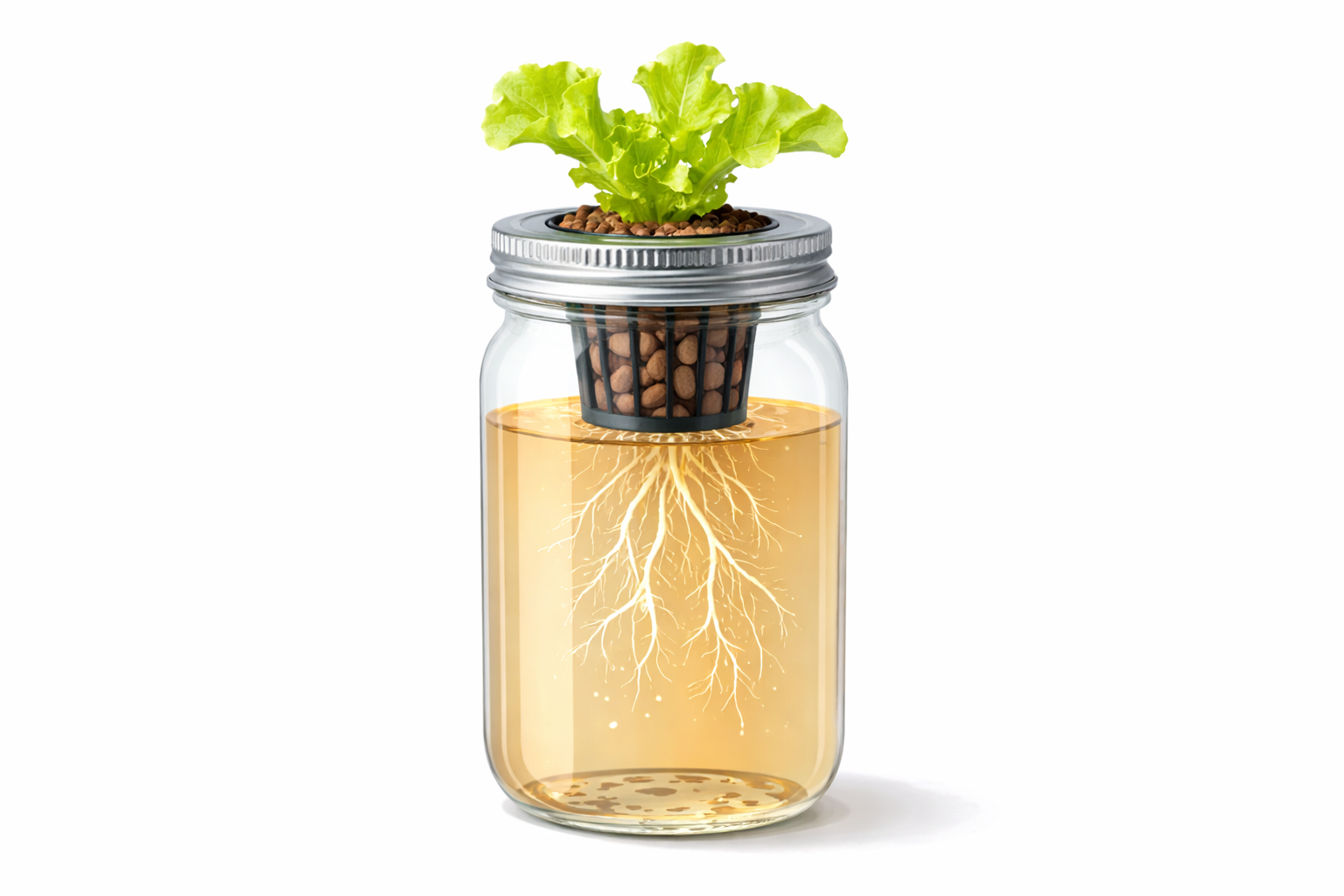
The kratky method hydroponics approach is the simplest way to grow food that exists. No pump, no timer, no electricity, no daily maintenance. You fill a container with nutrient solution, place a plant on top, and walk away. Six weeks later, you harvest fresh lettuce or herbs that you grew with barely any effort at all.
If that sounds too good to be true, it is not. The kratky method hydroponics system was developed by Professor B.A. Kratky at the University of Hawaii and has been validated by decades of research and thousands of home growers worldwide. It is the entry point that converts more curious beginners into committed hydroponic growers than any other method.
This guide explains exactly how kratky method hydroponics works, why it works, what you need to set it up, and how to grow your first crop from start to harvest.
What is the kratky method?
The kratky method is a form of passive hydroponics. Unlike Deep Water Culture (DWC), which uses an air pump to oxygenate the water, or Nutrient Film Technique (NFT), which uses a water pump to circulate solution through channels, the kratky method uses no equipment at all beyond a container and nutrient solution.
A plant sits in a net pot above a reservoir of nutrient-rich water. The roots grow down into the solution and absorb water and minerals. As the plant drinks, the water level drops. This creates an air gap between the water surface and the net pot. Roots that grow into this air gap absorb oxygen directly from the air, which is essential for healthy root function.
The genius of kratky method hydroponics is that this air gap replaces the air pump entirely. The system is self-regulating: as the plant grows bigger and needs more oxygen, it drinks more water, which enlarges the air gap, which provides more oxygen. No intervention required.
Why the kratky method is perfect for beginners
Most hydroponic methods involve at least some equipment and regular maintenance. The kratky method eliminates almost all of it. Here is why beginners love it:
- Zero electricity: No pumps, no timers, no grow lights required (though a grow light helps in winter). Your electricity bill does not change at all.
- Zero noise: With no pump running, the system is completely silent. Perfect for apartments, bedrooms, and shared spaces.
- Near-zero maintenance: Check once a week. That is the entire maintenance routine. Total weekly time investment: 2 minutes.
- Extremely cheap: A complete kratky method hydroponics setup costs £10-20 for the first jar. Subsequent jars cost £1-3 each.
- Very forgiving: The large volume of nutrient solution buffers against small mistakes in pH or nutrient concentration. Plants in kratky systems tolerate more error than in any other hydroponic method.
- No risk of pump failure: In DWC, if the air pump dies overnight, roots can suffocate within hours. In kratky method hydroponics, there is no pump to fail. The system is inherently resilient.
How the three root zones work
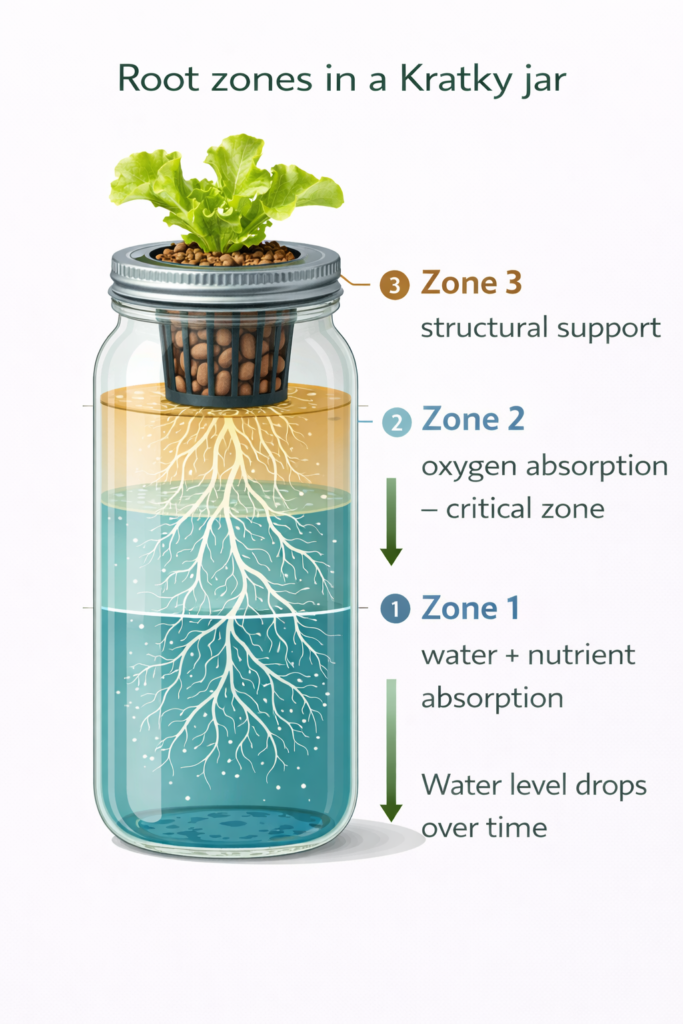
Understanding what happens inside the container helps you trust the process and avoid the most common mistake (interfering with a system that is working perfectly).
A mature plant in a kratky method hydroponics system develops three distinct root zones:
Zone 1 — Submerged roots (bottom): These roots stay permanently in the nutrient solution. They absorb water and dissolved minerals. Healthy submerged roots are white or cream-coloured and feel firm. Brown, slimy submerged roots indicate root rot, usually caused by the water being too warm or the air gap being too small.
Zone 2 — Air gap roots (middle): These roots grow in the moist air between the water surface and the bottom of the net pot. They absorb oxygen, which powers the plant’s metabolic processes. Air gap roots often look fuzzy with fine white root hairs. This fuzz is healthy and normal — it is not mould.
Zone 3 — Support roots (top): These grow through the clay pebbles in the net pot, anchoring the plant physically and providing structural support. They do not absorb significant nutrients.
This three-zone system is completely self-regulating. As the plant grows, it drinks faster, which lowers the water level, which expands the air gap, which provides more oxygen to support the increasingly large root system. It is a virtuous cycle that requires zero human intervention.
The equipment you need (and nothing more)
A complete kratky method hydroponics setup requires these items and only these items:
- An opaque container: Mason jar, food container, yoghurt pot, or bucket. Wrap in foil if transparent. Cost: £0-5.
- A 3-inch net pot: A small mesh basket that holds the plant. Cost: £0.50.
- Clay pebbles (LECA): Lightweight expanded clay balls that fill the net pot and support the seedling. Cost: £3-5 for a bag lasting 10+ jars.
- Hydroponic nutrients: Liquid or dry plant food dissolved in water. Cost: £8-12 for a bottle lasting months.
- pH test drops: To ensure the solution is in the 5.5-6.5 range. Cost: £4-6.
- pH Down: To lower pH if needed (almost always needed with UK tap water). Cost: £3-5.
- Seeds: Lettuce, basil, mint, or any herb. Cost: £1-2.
Total: approximately £15-20 for the first jar. The nutrients, pH drops, and pH Down last for months across many grows. Each subsequent kratky jar costs just £1-3.
Things you do NOT need: an air pump, a water pump, a timer, electricity, an EC meter, a grow tent, or any specialist equipment. The entire system runs on gravity and plant biology.
Step-by-step setup guide
Phase 1: Germinate your seeds (day 1-7)
Dampen a paper towel or rock wool cube. Place 2-3 seeds on the surface. For lettuce, do not cover the seeds because they need light to germinate. Place on a saucer, cover loosely with cling film, and put in a warm spot (20-25°C). Check daily and mist if the surface looks dry. Seeds germinate in 3-7 days for most herbs and lettuce. Wait until the seedling has its first true leaves (the second pair, after the round seed leaves) before transplanting.
Phase 2: Prepare the kratky jar (day 5-7)
Wrap your container in aluminium foil to block light. Fill with water to 1 centimetre below where the net pot will sit. Add nutrients at half the recommended strength. Stir well. Test pH and adjust to 5.5-6.5 using pH Down drops. The golden rule: always add nutrients BEFORE testing pH.
Phase 3: Transplant (day 7-10)
Fill the net pot one-third with rinsed clay pebbles. Place the seedling in the centre. Add more pebbles around it for support. Place the net pot in the container opening so the bottom touches the nutrient solution. Some solution should wick up through the pebbles to keep the young roots moist.
Phase 4: Position and wait (day 10 onwards)
Place on a sunny windowsill (south-facing is best in the UK). If light is limited, add a clip-on grow light (£10-15) set to 14-16 hours per day. Now leave it alone. Check once a week. Do not refill. Do not add nutrients. Do not move it around. The kratky method hydroponics system works best when you trust the process and resist the urge to interfere.
The number one mistake: refilling the container
This deserves special emphasis because it kills more kratky plants than any other error. As the water level drops, beginners see the shrinking reservoir and assume something is wrong. They refill the jar to the top, submerging the oxygen-absorbing air roots that developed in the gap.
These air roots suffocate within hours when submerged. The plant develops root rot and dies — not from lack of water, but from too much water destroying the air roots it depends on for oxygen.
The rule is simple and absolute: the dropping water level is how the kratky method hydroponics system is designed to work. It is not a problem to fix. Only add water if the level has dropped so far that no roots are touching the solution at all, and even then add only a small amount of pH-adjusted water. Never refill to the original level.
Best crops for kratky method hydroponics
The kratky method works best with fast-growing, compact plants that complete their life cycle before the nutrient solution runs out. The ideal crops are:
- Butter lettuce: 30-45 days. The perfect first kratky crop. Forgiving, fast, delicious.
- Basil: 21-28 days to first harvest. Continuous production for months with regular pinching.
- Mint: 30-40 days. Virtually indestructible. Grows aggressively in any container.
- Coriander: 21-30 days. Fast but bolts quickly in warm conditions.
- Pak choi: 30-45 days. Fast Asian green, excellent in stir-fries.
- Microgreens: 7-14 days. The fastest possible kratky harvest.
Avoid large fruiting crops (tomatoes, peppers, cucumbers) in small kratky jars. They drink too much water and need too many nutrients for a passive system. They can work in large kratky tubs (20+ litres) but are better suited to DWC for beginners.
Week-by-week timeline for kratky lettuce
Here is exactly what to expect and what to do each week when growing lettuce using the kratky method hydroponics approach:
Week 1: Seeds germinating on damp paper towel. Your job: keep it moist, wait.
Week 2: Seedling transplanted into kratky jar. Your job: nothing. Just observe.
Week 3: Roots growing into the nutrient solution. Growth above surface is slow. Your job: peek at roots through the foil if curious. They should be white.
Week 4: Visible leaf growth accelerating. Water level dropping noticeably. Your job: nothing. This is normal.
Week 5: Large leaves forming. Significant air gap visible. Your job: optional pH check.
Week 6: Harvest ready. Full head of lettuce grown with approximately 20 minutes of total effort across 6 weeks.
Scaling from one jar to a windowsill garden
Once your first kratky jar is growing successfully, the natural next step is starting more. The most effective approach is staggered planting: start a new jar every 5-7 days. After 4-5 weeks, you have jars at every growth stage. When you harvest one, start a new one in its place. This creates a permanent rotation of fresh food.
A standard windowsill holds 4-6 jars comfortably. A shelf with a grow light holds 8-12. A dedicated growing rack can hold 20+. The kratky method hydroponics approach scales horizontally by simply adding more containers. Each additional jar costs just £1-3 since you already own the nutrients and pH supplies.
Suggested 6-jar rotation: two lettuce (staggered 2 weeks apart), one basil, one mint, one coriander, one parsley. This provides continuous salad greens and cooking herbs for a fraction of supermarket prices.
Kratky vs DWC: when to upgrade
The kratky method is brilliant for beginners and remains useful even for experienced growers, but there are situations where DWC (adding an air pump) produces better results:
- Stay with kratky if you grow herbs and leafy greens, value simplicity and silence, have limited space, or want the lowest possible cost and maintenance.
- Consider DWC if you want faster growth rates, plan to grow larger plants like tomatoes or peppers, or want to maximise yield per plant.
Many growers use both: kratky jars on the windowsill for herbs and a DWC bucket for a larger crop. The skills are identical and transfer seamlessly between the two methods.
Get the complete kratky method guide
Our ebook ‘The Kratky Method: Hydroponics Without Electricity’ covers single jars, multi-plant tubs, nutrient schedules, a week-by-week calendar, troubleshooting, and advanced techniques. Download at hydrohomegarden.com/ebooks/