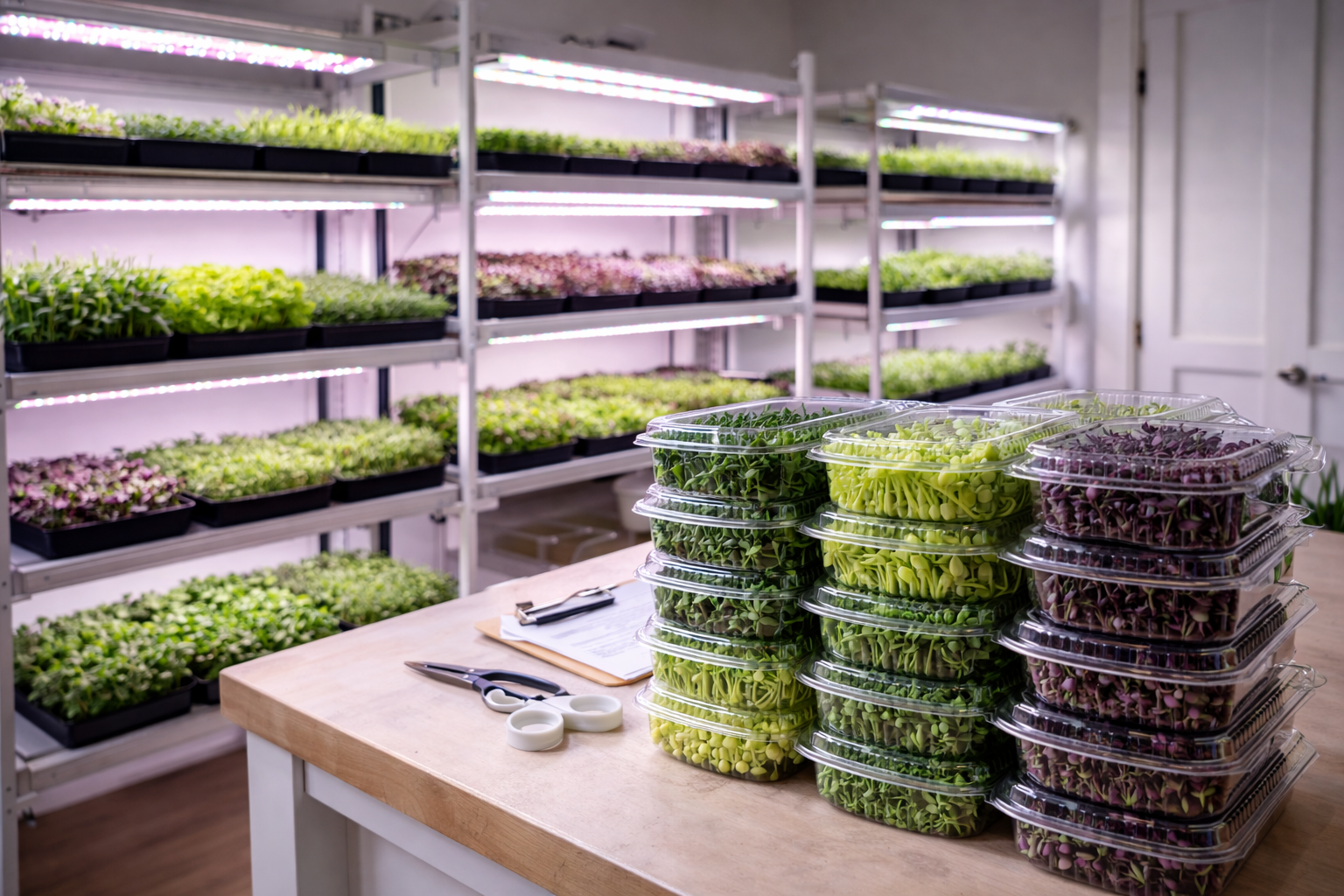
Starting a microgreens business from home is one of the most accessible food businesses you can launch. With under £200 in startup costs, a spare room or garage, and 5-10 hours per week of work, you can build a profitable side income selling fresh microgreens to local restaurants, farmers markets, and direct customers. The combination of fast growing cycles, premium pricing, and minimal space requirements makes microgreens uniquely suited to home-based food production.
This complete startup guide walks you through every step of launching a microgreens business from home: equipment, varieties, pricing, finding customers, and scaling profitably. By the end, you will have a clear roadmap for turning your home growing hobby into real income.
💰 The Income Reality
A well-run microgreens business from home with 20-30 trays in production typically generates £200-600 per week in revenue with 60-70% profit margins after seed and material costs. Scaling to 50+ trays can produce £1,000+ per week.
Why is microgreens hydroponics ideal for home businesses?
Several characteristics make a microgreens business from home dramatically easier than other food businesses to start and scale:
| Advantage | Why It Matters |
|---|---|
| Fast cycles | 7-14 day harvests mean fast cash flow |
| Small footprint | Profitable at 4 square metres of growing space |
| Premium pricing | £15-30 per pound at retail prices |
| Low startup cost | £150-300 covers complete startup equipment |
| Strong demand | Restaurants and chefs actively seek local suppliers |
According to insights from Upstart University, microgreens businesses can reach profitability faster than nearly any other food production model, often within 2-3 months of starting operations.
How much does it cost to start a microgreens business from home?
The complete startup cost for a microgreens business from home is surprisingly modest. Most growers can launch with under £200 in equipment, with serious operations costing £300-500 for premium setups.
💰 Complete Startup Shopping List
- Wire shelving unit (4-tier): £30-50 from Argos or B&Q
- 20 growing trays (1020 size): £20-30 from Hydrofarm
- LED grow lights (4 units, 20W each): £40-60
- Hemp growing mats (50-pack): £15-25
- Bulk seeds (4-5 varieties): £30-50 from True Leaf Market
- Plug-in timer: £5-10
- Spray bottles and harvest scissors: £10-15
- Clamshell containers (100-pack for sales): £15-25
Total startup cost: approximately £165-265 for a complete microgreens business from home setup capable of producing 20+ trays per week. After this initial investment, ongoing costs for seeds and materials run £40-80 per month.
How do you find customers for a microgreens business from home?
Finding customers is the biggest challenge for any new microgreens business from home. The good news is that there are several proven channels, and most growers find their first paying customers within 2-4 weeks of seriously trying.
Local restaurants and chefs
Restaurants pay the best prices for microgreens (£20-30 per pound) and often place repeat weekly orders. The approach is straightforward: identify 10-15 upscale local restaurants, walk in mid-afternoon (between lunch and dinner service) with a small sample tray, and ask to speak with the chef. Bring product cards with your contact info, prices, and varieties available.
Farmers markets
Farmers markets offer direct customer sales at retail prices (£15-25 per pound) and excellent visibility for building your brand. Most UK farmers markets cost £10-30 for a stall, and you can typically generate £100-300 in sales per market day from a small but well-presented display.
CSA (community supported agriculture) boxes
Partnering with local CSA box providers gives you reliable weekly orders. Many CSA operators welcome microgreens as a unique addition to their boxes. Typical arrangement: you supply 50-100 packs weekly at slightly below retail price, they handle distribution.
Direct delivery to home customers
Building a small direct customer base of 20-40 households for weekly home delivery creates the most stable income. Use social media (Instagram and Facebook work well for food businesses) and word-of-mouth to grow gradually. Charge £4-8 per pack for direct home delivery.
What should you charge for microgreens?
Pricing varies by region and customer type. These guidelines reflect typical UK pricing for a microgreens business from home in 2026:
| Customer Type | Price per Pound | Typical Order Size |
|---|---|---|
| Restaurants (wholesale) | £20-30 | 1-3 lb weekly |
| Farmers markets | £15-25 | 75g packs at £4-6 each |
| Direct home delivery | £20-30 | 75-150g packs at £4-8 |
| Specialty shops | £12-20 | Wholesale to retail markup |
Intermediate level: scaling your microgreens business from home
Once your initial microgreens business from home setup is profitable and you have established customer relationships, scaling productively requires careful planning. Most home-based growers can comfortably scale to 50-100 trays per week before space or time becomes the limiting factor.
Optimise your production schedule
Stagger plantings every 1-2 days so you always have something ready to harvest and never overwhelmed by a single huge harvest. Most successful microgreens businesses run 4-7 different varieties simultaneously with planting schedules carefully timed.
Track your numbers obsessively
Successful microgreens businesses know exactly what each tray costs to produce and what each customer is worth. Track seed costs, electricity, packaging, and time per tray. This data helps you identify your most profitable varieties and customers.
Build systems and processes
As you scale, document every step of your process so you could train someone to replace you. This makes it easier to expand, take vacations, or eventually sell the business. Resources like Upstart University offer courses on building scalable food business operations.
What next? Beyond home-scale microgreens
After establishing a profitable microgreens business from home, here are the natural growth paths committed growers eventually consider:
- Rent commercial growing space when home space becomes the bottleneck
- Add complementary crops like edible flowers, baby greens, or specialty herbs
- Expand into wholesale distribution by partnering with food distributors
- Develop a strong brand and consider franchising or selling the business
- Connect with other commercial growers through resources like Maximum Yield for industry insights
Frequently asked questions about microgreens business from home
Do I need a license to sell microgreens from home?
In the UK, you typically need to register as a food business with your local council (free in most areas) and follow basic food hygiene standards. Selling at farmers markets or to restaurants may require additional registrations. Always check current regulations with your local environmental health office before starting any microgreens business from home.
How much space do I need to start a microgreens business?
A profitable microgreens business from home can operate in as little as 4 square metres (a corner of a spare room or garage). A 4-tier shelf unit (1.2m x 0.5m footprint) holds 16-20 trays which is enough to generate £200-400 weekly with consistent production.
How long until a microgreens business becomes profitable?
Most microgreens businesses from home reach profitability within 2-3 months of serious operation. The first month covers startup costs, the second month establishes customers and consistent production, and from month three onward the business generates net profit. This is significantly faster than most food businesses.
Can I run a microgreens business as a side hustle?
Absolutely. Many successful microgreens businesses from home start as side hustles and remain part-time operations. Production work takes 5-10 hours per week for a 20-30 tray operation, mostly concentrated into 1-2 dedicated days. Many growers run microgreens as a weekend business alongside full-time employment.
What is the biggest challenge in running a microgreens business?
Customer acquisition is consistently the biggest challenge. Growing microgreens is relatively easy after a few weeks of practice, but finding and retaining customers requires persistent sales effort. Successful operators spend 30-40% of their time on marketing and customer relationships, not just growing.
Is it worth investing in expensive equipment for a microgreens business?
For most home-scale microgreens businesses, basic equipment delivers equivalent results to premium setups. Save your money on hardware and invest in better seeds, marketing, and customer relationships instead. Expensive equipment becomes worthwhile only when scaling beyond 100+ trays per week.
Related posts you might find useful
- Microgreens Hydroponics: Your First Harvest in 7 Days — Master the basics before scaling
- 10 Best Microgreen Varieties for Hydroponic Beginners — Choose profitable varieties
- 5 Best Grow Lights for Hydroponics Under £100 — Equipment recommendations for production
💰 Build a Profitable Microgreens Business
Our ebook ‘Microgreens Made Simple’ includes complete business setup guides, customer acquisition strategies, pricing templates, and scaling advice from successful home-based growers.
Buy your copy at hydrohomegarden.com/ebooks/microgreens/