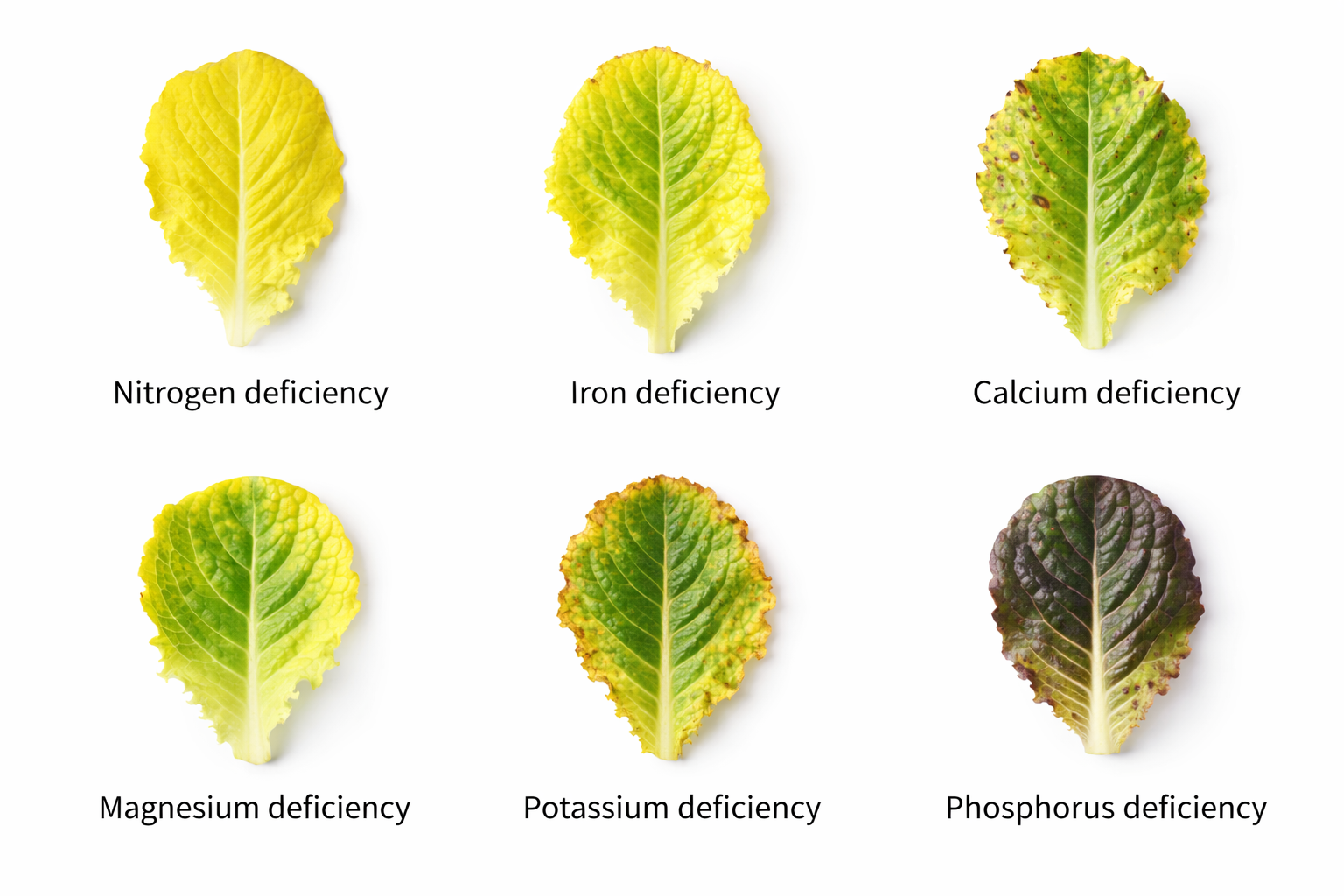
When something goes wrong with a hydroponic plant, the leaves tell you exactly what the problem is — if you know how to read them. Every hydroponic nutrient deficiency produces a specific, recognisable pattern on the leaves. Yellow leaves with green veins means iron. Brown crispy edges means potassium. Purple undersides means phosphorus. Each deficiency has its own visual signature.
This guide is a reference chart you can bookmark and return to whenever your plants show symptoms. For each hydroponic nutrient deficiency, you will find the visual symptoms, which leaves are affected first, the most common cause in hydroponic systems, and the exact fix.
Before you start diagnosing specific deficiencies, check pH first. In approximately 70 percent of cases where growers suspect a hydroponic nutrient deficiency, the real cause is pH being out of range (above 6.5 or below 5.5), which locks out multiple nutrients simultaneously. Correcting pH alone resolves the majority of apparent deficiencies without any additional supplements.
How to use this chart
Start by answering two questions about your plant’s symptoms:
- Which leaves are affected — old (lower) or new (upper)? This tells you whether the deficient nutrient is mobile or immobile. Mobile nutrients (nitrogen, phosphorus, potassium, magnesium) show symptoms on old leaves first because the plant moves them to feed new growth. Immobile nutrients (iron, calcium, boron, manganese) show symptoms on new leaves first because the plant cannot relocate them.
- What does the yellowing or damage pattern look like? Uniform yellowing, interveinal yellowing (yellow between green veins), spots, edge browning, and purple colouring each point to specific deficiencies.
Mobile nutrients (symptoms appear on lower/older leaves first)
Nitrogen (N) deficiency
Visual symptoms: Lower leaves turn uniformly pale yellow, starting from the oldest and working upward. The entire leaf yellows, not just edges or veins. Severely affected leaves may drop off. Upper leaves remain green but may be lighter than normal. Overall plant growth slows noticeably.
Most common cause in hydroponics: Nutrient solution too dilute, solution not changed frequently enough (nitrogen depletes first), or pH above 6.5 reducing nitrogen availability. In late-stage Kratky grows, nitrogen depletion near the end of the cycle is normal and expected.
Fix: Check and correct pH to 5.5-6.5. If pH is fine, replace the nutrient solution with a fresh batch at the recommended strength. For ongoing systems, increase the frequency of reservoir changes. Nitrogen deficiency resolves quickly — new growth should appear green within 5-7 days of correction.
Phosphorus (P) deficiency
Visual symptoms: Older leaves develop a dark green or bluish-green colour, sometimes with purple or reddish-purple tints on the undersides. Growth slows dramatically. Stems may appear thin and weak. In severe cases, leaves develop necrotic (dead) spots.
Most common cause in hydroponics: pH below 5.0 or above 7.0 locks out phosphorus. Cold nutrient solution (below 15°C) also reduces phosphorus uptake significantly. Actual phosphorus shortage in the nutrient solution is rare with modern hydroponic nutrients because they are formulated with adequate phosphorus.
Fix: Correct pH to 5.5-6.5 and ensure water temperature is above 18°C. These two corrections resolve the vast majority of phosphorus deficiency symptoms. If using a very basic or single-nutrient formula, switch to a complete hydroponic nutrient that contains phosphorus in the correct ratio.
Potassium (K) deficiency
Visual symptoms: Older leaf edges and tips turn brown and crispy (marginal necrosis). The damage starts at the outermost point of each leaf and works inward. The centre of the leaf may remain green initially while the edges deteriorate. Leaves may curl downward. Plants appear limp despite adequate water.
Most common cause in hydroponics: Nutrient solution depleted or too dilute. pH above 7.0 reduces potassium availability. Using plain water for top-ups repeatedly without adding nutrients can gradually dilute potassium concentration below usable levels. Note that potassium deficiency looks very similar to nutrient burn — the key difference is that burn affects leaf tips on all leaves simultaneously, while potassium deficiency starts on the oldest leaves first.
Fix: Replace the nutrient solution with a fresh batch at full recommended strength. Correct pH to 5.5-6.5. When topping up between reservoir changes, use very dilute nutrient solution (quarter strength) rather than plain water to maintain potassium levels.
Magnesium (Mg) deficiency
Visual symptoms: Interveinal chlorosis on older leaves — the tissue between the veins turns yellow while the veins stay green. This looks similar to iron deficiency but affects older leaves rather than newer ones. The pattern typically starts at the leaf edges and works inward between the veins. In severe cases, brown necrotic spots appear in the yellowed areas.
Most common cause in hydroponics: Soft water or RO (reverse osmosis) water that lacks natural magnesium. Some budget nutrient formulations contain insufficient magnesium. High potassium levels can also antagonise magnesium uptake.
Fix: Add a calcium-magnesium (Cal-Mag) supplement to the nutrient solution (available from any hydroponic supplier for £5-10). Follow the product instructions for dosage. If you are using RO or very soft water, a Cal-Mag supplement should be a permanent part of your nutrient regimen, not just a fix for deficiency.
Immobile nutrients (symptoms appear on upper/newer leaves first)
Iron (Fe) deficiency
Visual symptoms: New, young leaves display interveinal chlorosis — yellow tissue between dark green veins, creating a distinctive striped or netted pattern. This is one of the most visually recognisable hydroponic nutrient deficiency symptoms. In severe cases, new leaves emerge almost completely white or pale yellow with only faint green veining.
Most common cause in hydroponics: pH above 6.5. Iron availability drops dramatically at higher pH values. At pH 7.0+, iron lockout is almost guaranteed regardless of how much iron is in the solution. Cold root zone temperatures also reduce iron uptake.
Fix: Lower pH to 5.5-6.0. Iron is most available at the lower end of the optimal range. If symptoms persist after pH correction (give it one week), add a chelated iron supplement (Fe-EDDHA or Fe-DTPA) following the product instructions. Chelated iron remains available across a wider pH range than non-chelated forms.
Calcium (Ca) deficiency
Visual symptoms: New leaves are distorted, curled, or cupped. Brown necrotic spots appear on young leaves, particularly at the tips and edges. Growing tips may die back (tip burn). Roots appear brown and stunted. In fruiting crops, calcium deficiency causes blossom end rot (a brown, sunken patch at the bottom of tomatoes and peppers).
Most common cause in hydroponics: Using soft water, RO water, or distilled water that lacks natural calcium. pH below 5.0 reduces calcium uptake. High humidity environments reduce transpiration, which reduces calcium transport within the plant (calcium moves with water through the plant via transpiration).
Fix: Add a Cal-Mag supplement to the nutrient solution. Ensure pH is above 5.5. If growing in a very humid environment, improve air circulation around the plants with a small fan to increase transpiration and calcium transport. For fruiting crops showing blossom end rot, the Cal-Mag supplement is essential.
Manganese (Mn) deficiency
Visual symptoms: Similar to iron deficiency (interveinal chlorosis on new leaves) but typically less pronounced. The yellowing between veins is more mottled and uneven compared to iron deficiency’s clean striped pattern. Small brown necrotic spots may appear within the yellow areas.
Most common cause in hydroponics: pH above 6.5. Manganese and iron deficiencies often occur together because both nutrients become less available at high pH. If you see interveinal chlorosis on new leaves, correcting pH usually resolves both simultaneously.
Fix: Lower pH to 5.5-6.0. This is almost always sufficient to restore manganese availability. Specific manganese supplements are rarely needed in hydroponics when using a complete nutrient formula at the correct pH.
The most important rule: check pH before diagnosing any hydroponic nutrient deficiency
This point cannot be emphasised enough. The overwhelming majority of apparent hydroponic nutrient deficiency symptoms in home systems are caused by pH being out of range, not by actual nutrient shortage. Modern hydroponic nutrient formulations contain all necessary elements in the correct ratios. If you are using a reputable brand at the recommended strength, the nutrients are in the water. The question is whether the plant can access them.
At pH 6.0, virtually all nutrients are available. At pH 7.5, nitrogen, phosphorus, iron, manganese, and several other elements are partially or fully locked out. The solution looks the same, smells the same, and tests the same on an EC meter — but the plant is starving because the chemistry of the water prevents absorption.
Before reaching for supplements, before changing nutrient brands, before diagnosing specific deficiencies — test pH. If it is outside 5.5-6.5, correct it and wait 5-7 days. In most cases, the symptoms resolve without any other intervention.
Quick reference: the hydroponic nutrient deficiency diagnostic table
Old leaves affected first (mobile nutrients):
- Uniform yellow = Nitrogen
- Dark green with purple undersides = Phosphorus
- Brown crispy edges = Potassium
- Yellow between green veins (old leaves) = Magnesium
New leaves affected first (immobile nutrients):
- Yellow between green veins (new leaves) = Iron
- Distorted, curled, brown spots = Calcium
- Mottled yellow with brown specks = Manganese
All leaves affected simultaneously:
- Overall pale/washed out = pH lockout (check and correct pH)
- Brown crispy tips on all leaves = Nutrient burn (too concentrated — dilute)
Get the printable deficiency chart
Our ‘Hydroponic Troubleshooting Guide’ includes a full-colour printable nutrient deficiency chart you can pin next to your growing area for instant reference. Buy your copy at hydrohomegarden.com/ebooks/troubleshooting-guide/