Hydroponics vs aquaponics is the first big decision every UK home grower faces once they’ve decided to ditch soil. Both grow plants without dirt. Both save water. Both work year-round in British homes. But the differences in setup cost, maintenance effort and monthly running costs are bigger than most beginners realise.

This guide breaks down hydroponics vs aquaponics across 7 key differences that matter for UK growers — cost, space, yields, learning curve, failure modes, fish welfare and electricity bills — and gives you a clear winner for most British home setups.

🎯 Quick Answer

For most UK home growers, hydroponics wins on cost, simplicity and plant variety. Aquaponics wins on sustainability and the appeal of raising fish alongside vegetables. A basic hydroponic setup costs £40–£100, runs quietly on a single pump, and suits any British flat. A beginner aquaponic system costs £200–£500, requires fishkeeping knowledge, and works best in a garage, conservatory or outbuilding.

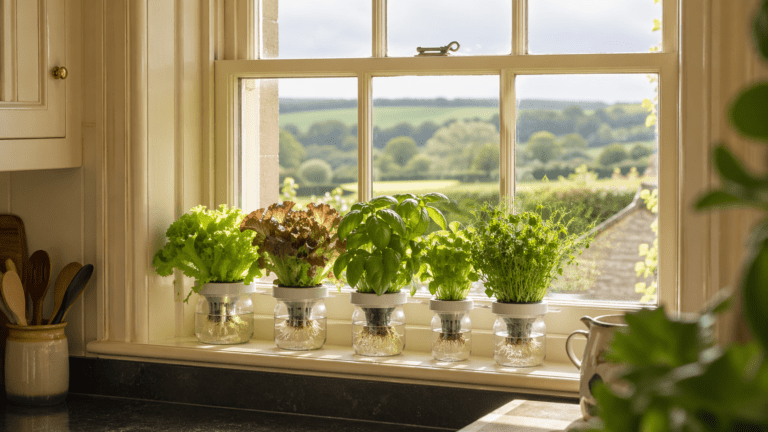
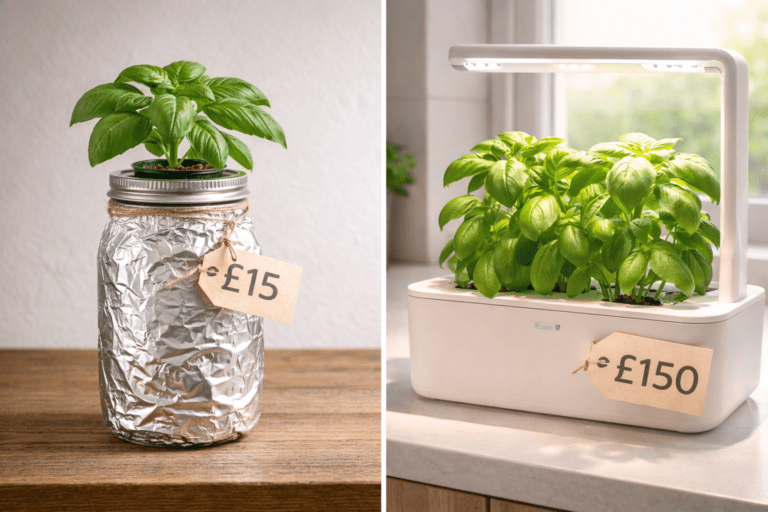
Hydroponics vs aquaponics comparison showing two home grower systems

Hydroponics vs aquaponics: definitions in plain English

Before comparing hydroponics vs aquaponics, you need a clear picture of what each one actually is. The names sound similar but the systems work on completely different principles.

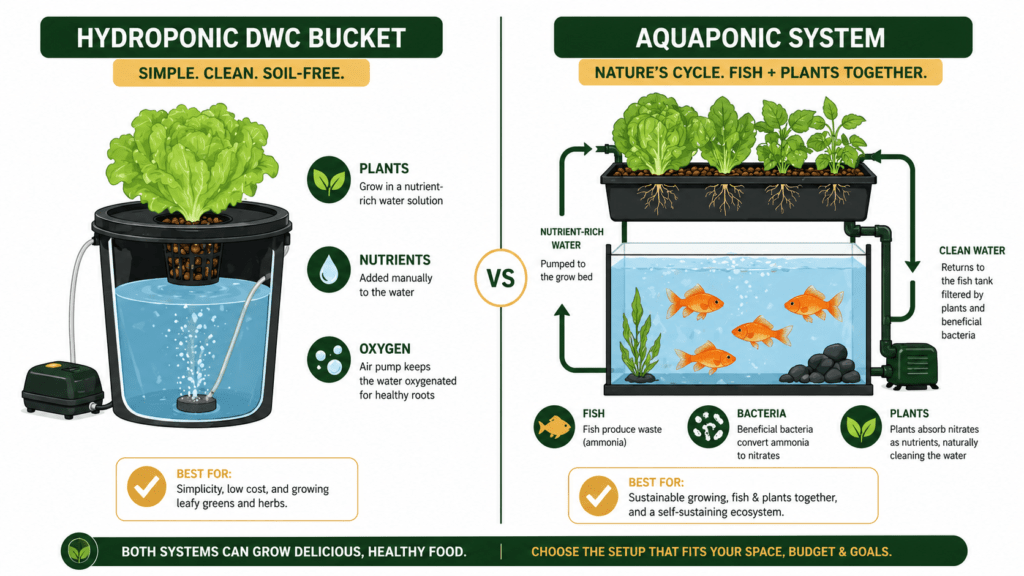
Hydroponics: growing plants in a nutrient-rich water solution without soil. You mix the nutrients yourself using commercial fertilisers and top up the reservoir as plants drink.

Aquaponics: growing plants and fish together in a closed loop. Fish waste feeds the plants; plants clean the water for the fish. You feed the fish, not the plants.

That one-sentence difference — you feed the fish in aquaponics, you feed the water in hydroponics — is the entire game. Everything else flows from it.

How hydroponics and aquaponics actually work

How hydroponics works

In a hydroponic system, plant roots sit in or are regularly fed with water that contains all the nutrients plants need — nitrogen, phosphorus, potassium, calcium, magnesium, plus trace elements like iron and zinc. You buy these as ready-mixed liquid nutrients (Formulex, General Hydroponics Flora Series, Canna) and dose them into your reservoir.

The grower’s job is to keep pH between 5.5–6.5, keep EC (nutrient strength) appropriate for the crop, and make sure roots get enough oxygen via an air pump or gravity-fed flow.

How aquaponics works

In an aquaponic system, fish live in a tank. You feed them normal fish food. They produce waste (ammonia) which would poison them if left. But beneficial bacteria in the system convert ammonia first into nitrites, then into nitrates — which are plant food.

Water from the fish tank flows past the plant roots. The plants absorb the nitrates, cleaning the water, which then returns to the fish. It’s a three-way partnership: fish → bacteria → plants → clean water → fish again.

Aquaponics vs hydroponics diagram showing nitrogen cycle with fish bacteria and plants

Watch: hydroponics vs aquaponics explained in 5 minutes

If you prefer reading, the differences below cover everything the video shows.

The 7 key differences between hydroponics and aquaponics

Here are the seven differences that actually matter when choosing between hydroponics vs aquaponics for a UK home.

#1Setup cost

Hydroponics: £40–£100 for a basic DWC or Kratky system. One bucket, one airstone, one bottle of nutrients, done.

Aquaponics: £200–£500 minimum. Fish tank, pump, grow bed, media, dechlorinator, fish, fish food, test kits — it all adds up before you’ve grown a single leaf.

#2Learning curve

Hydroponics: learn pH, EC, nutrient mixing. A beginner can be growing lettuce in 48 hours.

Aquaponics: you need to learn plant care and fishkeeping. A 4–8 week bacterial cycling period is required before you can add fish. It’s two hobbies stacked together.

#3Space requirement

Hydroponics: works anywhere — kitchen counter, windowsill, spare room, grow tent. Footprint as small as 30 × 30 cm.

Aquaponics: needs at least a 100-litre fish tank plus a grow bed. Footprint realistically 1 m² minimum. Better suited to conservatories, garages or outbuildings.

#4Crop variety

Hydroponics: grow anything — leafy greens, herbs, tomatoes, peppers, strawberries, microgreens, even root veg in some systems.

Aquaponics: best for leafy greens and herbs. Heavy feeders like tomatoes struggle because fish waste doesn’t deliver enough potassium naturally without supplementation.

#5Maintenance effort

Hydroponics: check pH and EC weekly, top up water every 2–4 days. Total time: 10–15 minutes per week.

Aquaponics: daily fish feeding, weekly water testing for ammonia/nitrite/nitrate, monthly partial water changes. Total time: 30–45 minutes per week minimum.

#6Failure modes

Hydroponics: if a pump fails, plants can survive 24–72 hours depending on system.

Aquaponics: if a pump fails, fish can die within hours. Power cuts are genuinely dangerous. Most serious UK aquaponic growers run battery backups.

#7Running costs

Hydroponics: one small air pump (4W) + nutrients (£2–£5/month). UK electricity roughly £1–£2/month.

Aquaponics: larger water pump (15–40W) running 24/7, heater (50–100W for tropical fish), plus fish food. UK electricity £8–£20/month.

Key takeaways: the 7 differences summed up

  • Hydroponics costs 3–5× less to set up than aquaponics
  • Aquaponics requires a 4–8 week cycling period before you can start growing
  • Hydroponics suits any UK home; aquaponics needs dedicated space
  • Hydroponics grows more crop variety than aquaponics, especially fruiting plants
  • Aquaponics takes 2–3× more maintenance time per week
  • Power cuts threaten fish in aquaponics but rarely kill hydroponic plants
  • UK running costs are roughly 8–10× higher for aquaponics

Hydroponics vs aquaponics cost comparison (UK 2026 prices)

Real UK numbers matter more than theory. Here’s what you’ll actually spend setting up either system as a beginner in 2026.

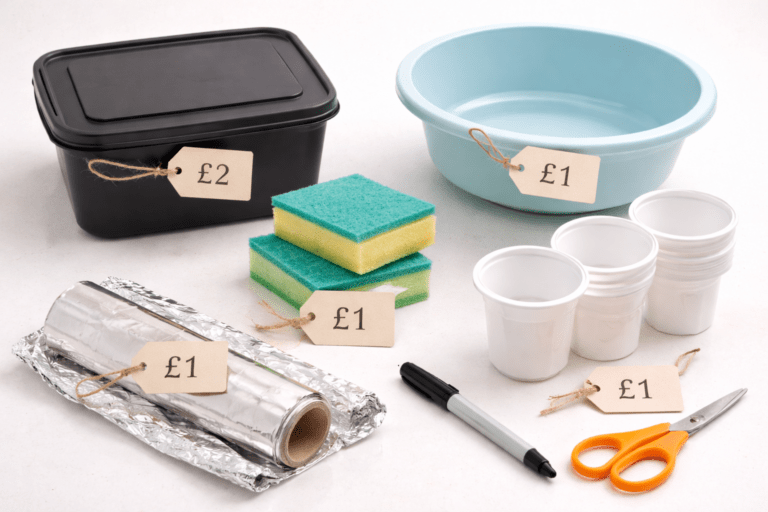
Hydroponics UK startup cost breakdown

Item Typical UK cost Source
20L bucket or reservoir £5–£8 B&Q / Screwfix
Air pump + stone £12–£18 Amazon UK
Net pot + clay pebbles £8–£12 HydroHobby / Amazon UK
Formulex 500ml nutrient £14 Growth Technology / Amazon UK
pH test kit £8–£15 Amazon UK
Seeds (basic herb/lettuce) £2–£4 Thompson & Morgan / Suttons
Total startup £49–£71

Aquaponics UK startup cost breakdown

Item Typical UK cost Source
100L fish tank £80–£120 Pets at Home / Swell UK
Water pump (400 L/h) £25–£40 Amazon UK
Aquarium heater (if tropical) £15–£25 Pets at Home
Grow bed + media (gravel/clay) £40–£70 B&Q / aquaponic suppliers
Dechlorinator £6–£10 Pets at Home
Water test kit (ammonia, nitrite, nitrate, pH) £25–£35 Amazon UK / API kit
Fish (tilapia / goldfish / koi) £15–£60 Local aquatics centre
Fish food (3 months) £10 Pets at Home
Seeds £2–£4 Thompson & Morgan
Total startup £218–£374

The numbers speak plainly. Hydroponics vs aquaponics on setup cost alone isn’t close — hydroponics is 3–5 times cheaper to start.

Hydroponics vs aquaponics UK cost comparison chart for home growers

Hydroponics vs aquaponics: yields and crop variety

What you can grow is the second thing most UK home growers care about. Here’s an honest comparison.

What hydroponics grows best

Excellent performers: lettuce, basil, mint, coriander, spinach, pak choi, kale, strawberries, cherry tomatoes, peppers, cucumbers, microgreens, chives.

Why hydroponics wins: you can fine-tune nutrients for each crop. Fruiting plants get the high phosphorus and potassium they need. Leafy greens get higher nitrogen. Strawberries get tailored calcium.

What aquaponics grows best

Excellent performers: lettuce, basil, mint, pak choi, watercress, chives, spring onions, spinach, parsley.

Where aquaponics struggles: tomatoes, peppers and strawberries often fruit poorly because fish waste is rich in nitrogen but low in potassium. Most serious UK aquaponic growers end up supplementing with liquid seaweed or potassium sulphate — which edges the system back toward hydroponics.

Hydroponics vs aquaponics: weekly maintenance reality

Maintenance is where aquaponics’ hidden cost shows up — not in money, but in time.

Task Hydroponics Aquaponics
Daily fish feeding None 2–5 minutes
Check water temperature Weekly Daily
Test pH Weekly (1 test) Weekly (1 test)
Test ammonia/nitrite/nitrate None Weekly (3 tests)
Top up water Every 2–4 days Weekly (small amount)
Partial water change Monthly reservoir refresh Monthly 10–20% change
Clean filters None (basic systems) Monthly
Weekly time 10–15 mins 30–45 mins

Hydroponics vs aquaponics: which is right for your UK home?

The honest answer depends entirely on what you’re trying to achieve. Here’s a simple decision guide.

Choose hydroponics if…

  • You live in a flat, small house or have limited space
  • You want first harvests within 4–8 weeks
  • Your budget is under £150
  • You want to grow tomatoes, peppers, strawberries or other fruiting crops
  • You’re short on time (under 20 minutes per week)
  • You don’t want pets or responsibility for live fish
  • You travel or go on holiday regularly

Choose aquaponics if…

  • You have a garage, conservatory, shed or dedicated space
  • You’re already into fishkeeping or want to learn
  • You care more about sustainability than cost
  • You mostly want to grow leafy greens and herbs
  • You’ve got time for 30–45 minutes of weekly maintenance
  • You enjoy the idea of a closed-loop ecosystem
  • You have a stable power supply (or a UPS backup)

Hydroponics vs aquaponics pros and cons at a glance

Hydroponics

✓ Pros ✗ Cons
Cheap to start (£40–£100) You pay for nutrients monthly
Fast results (lettuce in 4 weeks) Not as “natural” as aquaponics
Grows every common crop Reservoirs need periodic emptying
Low daily/weekly maintenance pH and EC need monitoring
Works in any UK home Nutrient runoff isn’t eco-neutral
Survives short power cuts Smaller ecosystem appeal

Aquaponics

✓ Pros ✗ Cons
No ongoing nutrient cost High startup cost (£200–£500)
Closed loop — very sustainable 4–8 week cycling before you can start
You also raise edible fish Fish can die from power cuts
Educational, fascinating system Needs more space (1 m² minimum)
No reservoir dumping Struggles with fruiting crops
Water use is minimal long-term Higher running costs (£8–£20/month)

[IMAGE: UK home aquaponic system in a conservatory with tilapia tank and lettuce grow bed. Alt text: Home aquaponics system vs hydroponics setup for UK growers]

🌱

Hydroponics For Complete Beginners

The complete UK beginner’s guide to hydroponics — 22 pages covering every system type, your first crop, nutrient mixing, and avoiding the mistakes that trip up 9 out of 10 new growers.

✓ Full system comparison · ✓ UK shopping lists · ✓ First-crop plan · ✓ Instant PDF download

Get The Ebook — £7.99 →

3 expert tips before you choose between hydroponics and aquaponics

  1. Try hydroponics first, even if aquaponics excites you more. The plant-growing skills transfer directly. You’ll learn pH, EC, nutrient balance and light management in weeks — knowledge you’ll need in aquaponics anyway.
  2. Factor in the cycling period. An aquaponic system can’t produce food for 4–8 weeks while bacteria colonies establish. If you want winter lettuce in November, start your aquaponic build in September at the latest.
  3. Don’t underestimate UK water hardness. Both systems suffer in hard water areas like London, Essex and the East of England. Hydroponics lets you adjust pH fast with a dropper; aquaponics requires slow, fish-safe adjustments over days.

Frequently asked questions about hydroponics vs aquaponics

Is hydroponics or aquaponics cheaper for UK beginners?

Hydroponics is significantly cheaper. A beginner hydroponic setup costs £40–£100 in the UK, while even a basic aquaponic system starts at £200–£500 once you include the fish tank, pump, grow bed, dechlorinator, test kits, fish and food.

Which grows faster — hydroponics or aquaponics?

Hydroponics grows plants slightly faster in the first 6 weeks because nutrient concentrations are higher and more consistent. After an aquaponic system matures (6+ months), growth rates often match hydroponics for leafy greens, though fruiting crops typically remain slower in aquaponics.

Can you grow tomatoes in aquaponics?

Yes, but not well without supplementation. Fish waste provides nitrogen but lacks the potassium and phosphorus tomatoes need for heavy fruiting. Most UK aquaponic growers supplement with liquid seaweed or mineral potassium. For pure tomato production, hydroponics is the better choice.

Is aquaponics legal in the UK?

Yes, home aquaponics is fully legal in the UK. Commercial aquaponic food production may require additional food hygiene registration with your local council if you sell produce. Keeping fish is subject to standard UK animal welfare law under the Animal Welfare Act 2006.

Do hydroponic plants taste different from aquaponic plants?

Most UK growers report the flavour is indistinguishable for leafy greens and herbs. Some find aquaponic tomatoes slightly sweeter, though the difference is often attributed to variety and ripening time rather than system type.

What fish are best for UK home aquaponics?

Goldfish and koi carp are the most popular in UK home aquaponics because they tolerate temperature variation well. Tilapia grow faster and produce more waste for plants but need a heated tank. Trout work in cool outbuildings but are trickier for beginners.

Can hydroponics and aquaponics be combined?

Yes — this is called “hybrid aquaponics” or “decoupled aquaponics”. You run the fish loop and plant loop separately and mix in supplemental nutrients where needed. It keeps the sustainability of aquaponics while fixing its yield weaknesses, but adds complexity.

Which uses less water — hydroponics or aquaponics?

Aquaponics uses less water over time because it’s a closed loop — water only leaves through plant transpiration. Hydroponics requires periodic reservoir changes. Both use roughly 90% less water than soil gardening.

Related posts for UK home growers choosing a system

Further reading from UK authorities

Hydroponics vs aquaponics: the final verdict for UK growers

Hydroponics vs aquaponics isn’t a fair fight for most UK home growers. Hydroponics wins on cost, simplicity, space, crop variety, maintenance time and running costs. Aquaponics wins on sustainability and the unique appeal of growing fish alongside food.

If you’re new to soilless growing, start with hydroponics. Get one crop of lettuce or basil under your belt. Then, if you still love the aquaponics idea six months later, build your fish system with real skill already in your pocket.

Your next step: if you’ve decided on hydroponics, start with the Kratky method for under £20. If aquaponics still calls, order a fish tank and start the bacterial cycling process this weekend.