
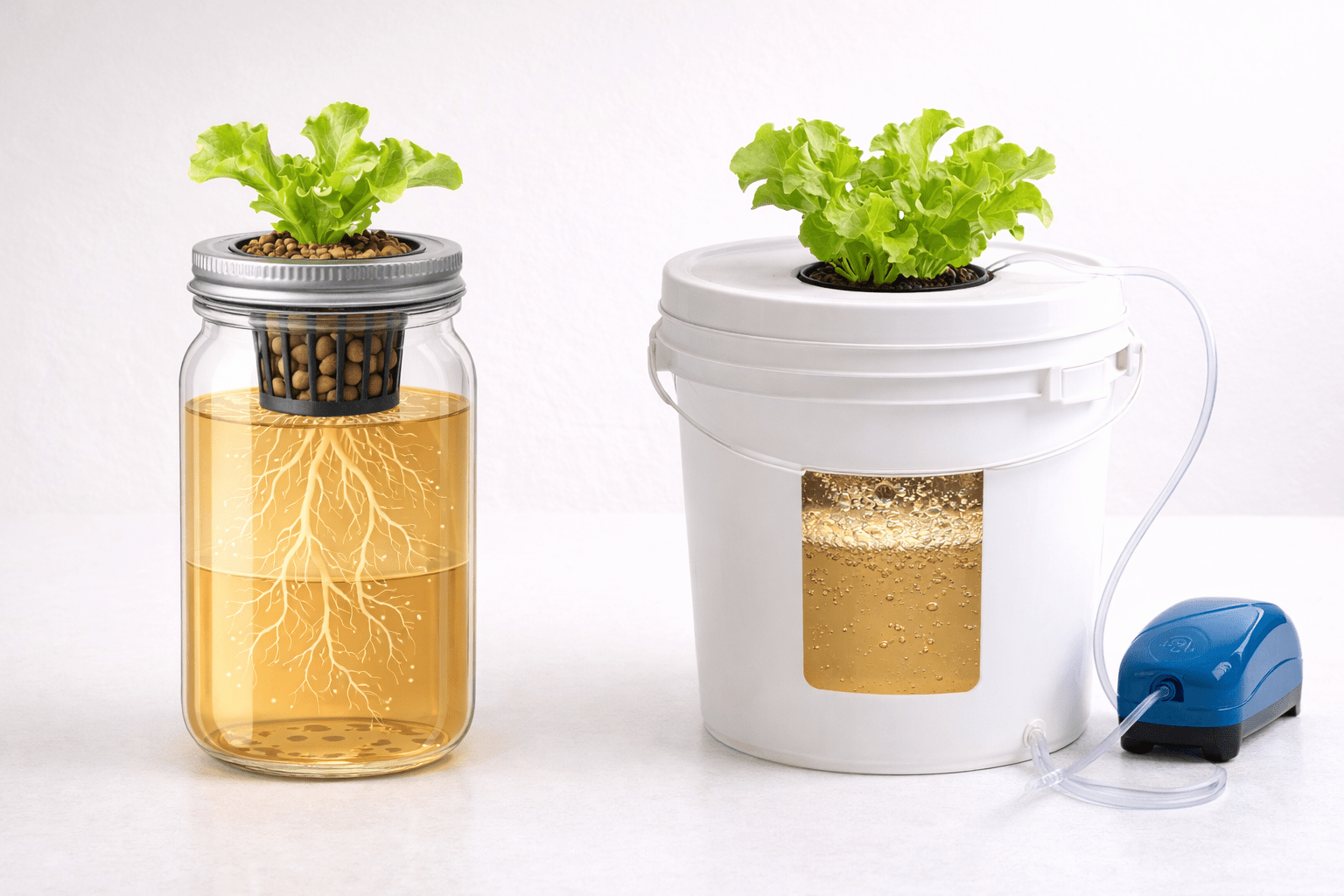
If you are researching your first hydroponic system, you have almost certainly encountered two methods that dominate every beginner recommendation list: the Kratky method and Deep Water Culture. The kratky vs DWC debate is one of the most common questions in hydroponic forums, and the answer is not as straightforward as most guides make it seem.
Both systems are excellent for beginners. Both grow healthy, productive plants. Both are affordable and relatively simple. But they work differently, suit different situations, and produce different results. This post compares kratky vs DWC across every factor that matters so you can choose the right one for your specific situation.
⚖️ The Quick Verdict
For absolute beginners the kratky vs DWC debate favours Kratky — cheaper, silent, no pump to fail, and completely hands-off. For growers who want faster growth, fruiting crops, or do not mind light maintenance, DWC produces larger harvests 15-25% faster.
The kratky vs DWC head-to-head comparison
Before diving into individual factors, here is the complete head-to-head comparison across the 8 points that matter most for beginners:
| Factor | Kratky | DWC | Winner |
|---|---|---|---|
| Setup cost | £10-20 | £25-45 | Kratky |
| Ongoing cost | £0 per month | £1-2 per month | Kratky |
| Growth speed | Standard | 15-25% faster | DWC |
| Maintenance | 2-3 min weekly | 10-15 min weekly | Kratky |
| Noise | Silent | Pump hum + bubbles | Kratky |
| Reliability | No failure points | Pump can fail | Kratky |
| Crop flexibility | Herbs & greens only | All crops including fruiting | DWC |
| Space required | Single jar footprint | Bucket + pump space | Kratky |
The scoreboard: Kratky wins 6 of 8 factors, with DWC taking the wins on growth speed and crop flexibility. For the vast majority of beginners, this makes Kratky the right starting point.
How each system works (the 60-second version)
Kratky method
A plant sits in a net pot above a sealed container of nutrient solution. Roots grow down into the water. As the plant drinks, the water level drops and an air gap forms. Roots in the air gap absorb oxygen. No pump, no electricity, no moving parts. The system is entirely passive and silent. For the complete explanation, see our kratky method hydroponics guide.
Deep Water Culture (DWC)
A plant sits in a net pot above a container of nutrient solution, just like Kratky. The critical difference is that an air pump pushes air through an air stone at the bottom of the container, creating bubbles that oxygenate the water continuously. The roots stay fully submerged in this oxygen-rich solution. The pump runs 24/7 and requires electricity.
The fundamental kratky vs DWC difference comes down to how the roots get oxygen. Kratky uses a passive air gap. DWC uses an active air pump. Everything else flows from this one distinction.
Cost comparison
When comparing kratky vs DWC on cost, the Kratky method wins convincingly:
💰 Cost Breakdown
| Kratky setup (mason jar, pebbles, nutrients, pH) | £10-20 |
| DWC setup (Kratky kit + bucket + pump + airline + stone) | £25-45 |
| Kratky monthly running cost | £0 |
| DWC monthly electricity | £1-2 |
| DWC air stone replacement (every 3-6 months) | £2-4 |
| Kratky is 40-60% cheaper overall | Winner: Kratky |
For growers on the tightest possible budget, or those who want to test hydroponics with minimal financial commitment, Kratky is the clear winner.
Growth speed comparison
This is where DWC takes the lead in the kratky vs DWC comparison. Because DWC continuously pumps oxygen into the nutrient solution, the roots receive a constant and abundant supply of dissolved oxygen. This drives faster cell division, more vigorous root growth, and ultimately faster plant development.
In practice, DWC plants typically grow 15-25 percent faster than comparable Kratky plants under the same light and nutrient conditions. A lettuce that takes 40 days in a Kratky jar might reach the same size in 30-35 days in a DWC bucket.
This speed advantage comes from the oxygen abundance. In a Kratky system, the air gap roots provide adequate oxygen, but the submerged roots in the solution itself receive less oxygen than they would in an actively bubbled DWC system. The plant grows well in Kratky — it just grows faster in DWC.
For most home growers producing herbs and salad greens, this 15-25 percent speed difference is nice but not transformative. You are talking about harvesting at day 32 instead of day 40. Both timelines are remarkably fast compared to soil growing.
Maintenance comparison
Kratky wins the kratky vs DWC maintenance comparison by a wide margin:
| Task | Kratky | DWC |
|---|---|---|
| Check frequency | Once per week | Every 2-3 days |
| Weekly time investment | 2-3 minutes | 10-15 minutes |
| Water top-ups | None (design feature) | Regularly |
| Reservoir changes | None until harvest | Every 1-2 weeks |
| Equipment monitoring | None | Check pump & bubbles daily |
| Maximum unattended time | 3-4 weeks | 3-4 days |
DWC is not high-maintenance by any reasonable standard, but it does require more regular attention than Kratky. The air pump is the primary maintenance concern: if it fails and you do not notice for 24-48 hours, the roots can begin to suffocate because they are fully submerged with no air gap to fall back on. This makes DWC less forgiving of neglect than Kratky.
Kratky systems, by contrast, can run unattended for weeks. A 20-litre Kratky tub growing lettuce can be left for 3-4 weeks without any intervention at all. This makes Kratky ideal for busy people, frequent travellers, or anyone who simply does not want to think about their garden every other day.
Noise comparison
This is a critical factor for apartment dwellers and anyone growing in living spaces, and it is often overlooked in kratky vs DWC comparisons:
Kratky noise level: Completely silent. Zero. There are no moving parts, no vibrating components, no humming motors. A Kratky jar makes less noise than a book sitting on a shelf.
DWC noise level: The air pump produces a constant low hum, and the bubbles create a gentle gurgling sound in the water. With a quality quiet pump placed on a folded towel, the noise is comparable to a quiet aquarium. With a cheap pump on a hard surface, it can be annoyingly loud, especially at night in a bedroom or studio apartment.
If noise is a concern — and in shared living spaces it absolutely should be — Kratky is the only option that produces zero sound. Some DWC growers report being kept awake by pump noise until they learned the towel trick or upgraded to a quieter pump model. This is a real quality-of-life consideration that pure growth-rate comparisons miss.
Reliability and risk comparison
The kratky vs DWC reliability comparison favours Kratky because it has no points of failure:
Kratky risks: The only real risk is the grower making an error — typically refilling the container to the top (drowning the air roots) or not blocking light (causing algae). There are no equipment failures possible because there is no equipment. For a complete list of kratky problems and their fixes, see our kratky method troubleshooting guide.
DWC risks: In addition to the same user errors, DWC adds equipment-related risks. If the air pump fails, the roots lose their oxygen supply. If the power goes out overnight, the same thing happens. If the airline tubing kinks or disconnects, air stops flowing. If the air stone clogs with mineral deposits, bubble output decreases gradually and root health suffers before you notice.
None of these DWC risks are catastrophic if caught quickly, but they add a layer of monitoring responsibility that Kratky simply does not have. For absolute beginners who may not yet recognise the early signs of oxygen deprivation in roots, Kratky’s inherent reliability is a significant advantage.
Plant size and crop suitability
This is where the kratky vs DWC comparison gets nuanced:
| Crop Category | Kratky | DWC |
|---|---|---|
| Lettuce & leafy greens | ✓ Excellent | ✓ Excellent (faster) |
| Herbs (basil, mint, coriander) | ✓ Excellent | ✓ Excellent (faster) |
| Microgreens | ✓ Excellent | ✗ Overkill |
| Cherry tomatoes | ✗ Not recommended | ✓ Good in large buckets |
| Peppers | ✗ Not recommended | ✓ Good in large buckets |
| Cucumbers | ✗ Too demanding | ✓ Good in large buckets |
| Strawberries | ✗ Not recommended | ✓ Good |
If you only want to grow herbs and salad greens, Kratky handles everything you need. If you eventually want to grow tomatoes or peppers, you will need to move to DWC (or a Kratky tub of 20+ litres, which can support larger crops but with less vigour than DWC). For a ranked list of what grows best in kratky specifically, see our best plants for kratky method guide.
Space and aesthetics
Kratky systems are more compact and visually discreet. A mason jar on a windowsill takes up less space than a coffee mug. A DWC bucket is larger (a 5-gallon bucket occupies approximately 30×30 centimetres of floor or counter space), and the air pump needs to sit nearby on a shelf or table with the airline tubing running between them.
For small apartments, kitchen counters, and windowsill growing, Kratky is more practical in terms of both space and appearance. For dedicated growing areas, spare rooms, or balconies where space and aesthetics are less of a concern, DWC’s size is not an issue.
The honest verdict: kratky vs DWC for beginners
✓ Start with Kratky if:
- You have never grown anything hydroponically before
- You want the cheapest possible starting point
- You live in an apartment or noise-sensitive space
- You want minimal maintenance and maximum simplicity
- You primarily want to grow herbs and salad greens
- You travel frequently or prefer set-and-forget systems
✓ Start with DWC if:
- You want faster growth and larger yields
- You plan to grow fruiting crops (tomatoes, peppers)
- You do not mind checking the system every 2-3 days
- Pump noise is not a concern in your growing space
- You are comfortable with basic equipment (connecting a pump to a stone)
The best approach: Start with one Kratky jar (£10-20). Grow one lettuce or basil plant from seed to harvest. This teaches you nutrients, pH, light, and plant observation with zero complexity. Our kratky jar setup guide walks you through the exact 10-minute build. Once you have that first successful harvest, decide whether you want the simplicity of more Kratky jars or the faster growth of a DWC bucket. Many growers eventually run both: Kratky jars on the windowsill for herbs and a DWC bucket for a larger crop.
The kratky vs DWC debate is not about which is objectively better. It is about which is better for you, right now, given your space, budget, experience level, and goals. Both systems grow excellent food. Both teach the fundamentals. And both cost less than a week of supermarket herbs.
Frequently asked questions about kratky vs DWC
Can I convert a Kratky jar into a DWC system later?
Yes, easily. To upgrade a Kratky jar to DWC, you just add an air pump, air stone, and airline tubing. Drill or burn a small hole in the lid or net pot for the airline to pass through. The same jar, net pot, clay pebbles, and nutrients all continue to work. This upgrade costs approximately £10-15 and takes 10 minutes.
Which system grows bigger plants, kratky or DWC?
DWC grows bigger plants than Kratky in comparable containers. The continuous oxygenation supports more vigorous root growth and therefore larger above-ground growth. A DWC bucket of lettuce typically produces 20-30% more harvestable mass than the same variety in a comparable Kratky container.
Does the Kratky method really not need any electricity?
Correct — zero electricity for the growing system itself. The only electrical cost in Kratky is optional supplemental lighting if your natural light is insufficient. If you grow on a sunny south-facing windowsill in spring and summer, you need no electricity at all. In winter or with limited light, a £10-15 LED grow bulb running 14 hours a day uses approximately 50p of electricity per month.
Is DWC harder to learn than kratky?
Only slightly. The growing principles (nutrients, pH, light, plant care) are identical between the two systems. DWC adds the small complexity of assembling and maintaining the air pump. Most beginners find DWC slightly more intimidating at first because of the equipment, but the actual additional learning is maybe 15-20 minutes of reading pump instructions.
Which system produces healthier roots?
DWC produces slightly healthier-looking roots because the continuous oxygenation supports more vigorous white root development. However, Kratky roots are also perfectly healthy — they just develop into the three-zone structure (submerged, air gap, support) rather than all being submerged. Both produce plants with normal, functional root systems.
Can I run DWC without electricity during a power cut?
For short periods yes. If the power goes out for under 4-6 hours, the plants are generally fine. For longer outages, you need to either add battery-powered aeration, manually agitate the water every hour or two, or simply accept that a severe extended outage may damage the crop. This is why many DWC growers keep a basic battery-operated air pump (£10-15) as backup.
Related posts you might find useful
- Kratky Method Hydroponics: Complete Guide — Full theory and background
- Kratky Jar Setup in Under 10 Minutes — Step-by-step jar assembly
- Best Plants for Kratky Method Ranked — Which crops grow best in kratky
- Kratky Method Troubleshooting Guide — Fix common problems
- Mason Jar Hydroponics for Beginners — Simplest Kratky starter method
- What Is Hydroponics? Plain English Explanation — Background reading
- 10 Easy Hydroponic Plants Almost Impossible to Kill — Beginner-friendly crops
Master the Kratky Method
Our 22-page ebook The Kratky Method: Hydroponics Without Electricity covers single jars, multi-plant tubs, nutrient schedules, a complete week-by-week calendar, troubleshooting, and advanced techniques.
✓ Week-by-week calendar · ✓ Multi-plant tub designs · ✓ Troubleshooting guide · ✓ Instant PDF download