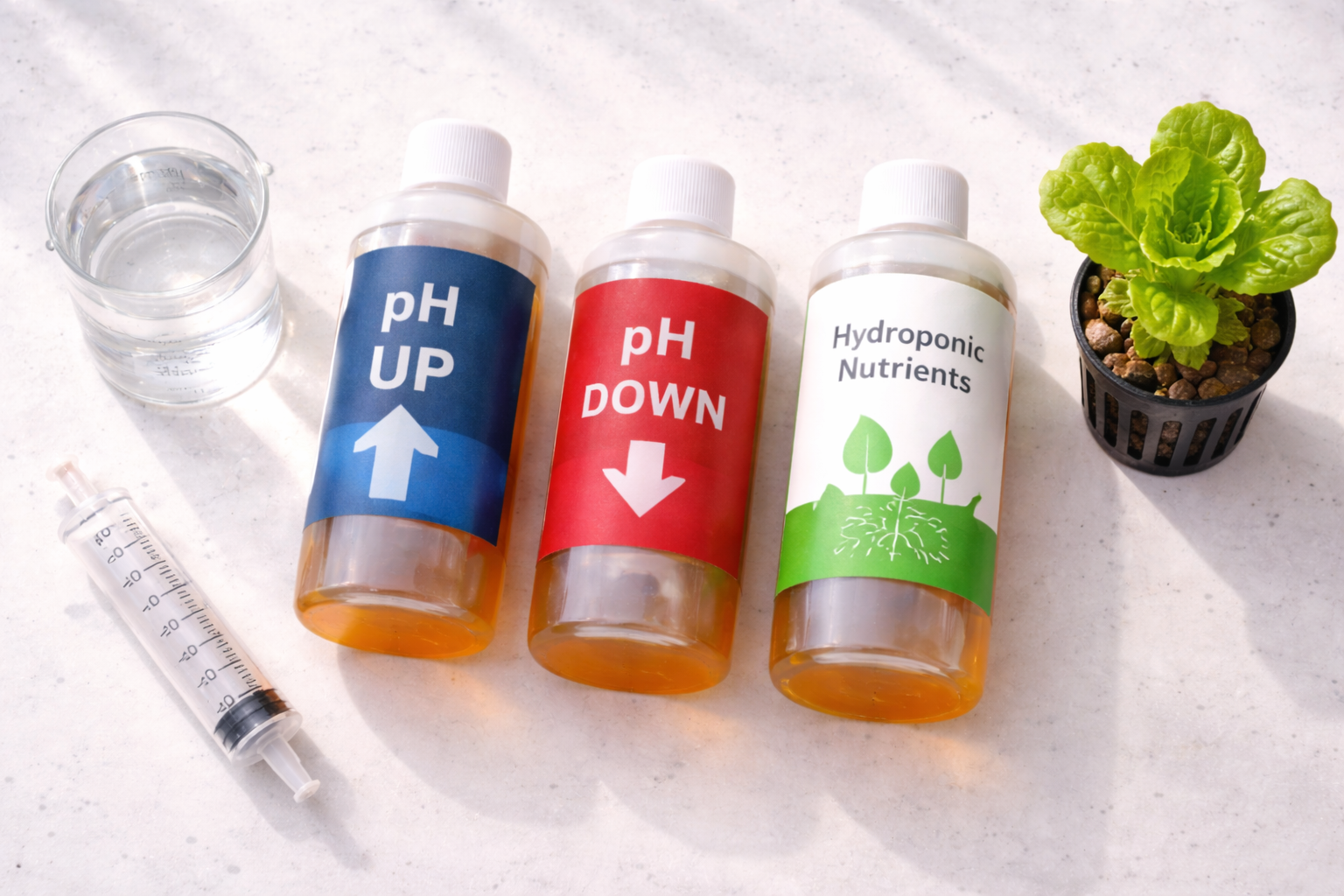
If you are new to soilless growing, hydroponic nutrients for beginners can feel overwhelming. There are dozens of brands, confusing acronyms like NPK and EC, complicated three-part nutrient systems, and conflicting advice everywhere. The truth is much simpler than it looks: you only need one bottle of nutrients to start growing successfully, and the basics can be learned in about ten minutes.
This guide covers everything a beginner actually needs to know about hydroponic nutrients — what they are, which ones to buy, how to mix them, and how to use them without overthinking. Skip the chemistry textbook approach. This is the practical version.
🌱 The 30-Second Summary
Hydroponic nutrients for beginners means buying one bottle of complete liquid nutrient (Formulex or General Hydroponics Flora Series, £8-12), measuring 2-5ml per litre of water using a syringe, stirring, testing pH, and adjusting to 5.5-6.5. That is the entire process.
What are hydroponic nutrients and why do plants need them?
Hydroponic nutrients are concentrated mineral solutions that provide everything a plant needs to grow when there is no soil involved. In traditional gardening, soil contains millions of years of decomposed plant and animal matter, weathered rock, and microbial activity that releases minerals slowly into the root zone. In hydroponics, you provide all of those minerals directly in the water.
Plants need exactly 17 essential elements to grow properly. Three of these come from air and water: carbon, hydrogen, and oxygen. The other 14 must come from the nutrient solution. The good news for anyone learning about hydroponic nutrients for beginners is that any reputable hydroponic nutrient product contains all 14 of these elements in the correct proportions. You do not need to mix them yourself.
What does NPK actually mean?
NPK is an abbreviation for the three macronutrients that plants need in the largest quantities: nitrogen (N), phosphorus (P), and potassium (K). Every nutrient bottle displays an NPK ratio on its label, like 4-3-6 or 3-2-4. These three numbers represent the percentage of each macronutrient by weight.
| Nutrient | What It Does | Deficiency Sign |
|---|---|---|
| Nitrogen (N) | Powers leaf growth and chlorophyll production | Pale, yellowing lower leaves |
| Phosphorus (P) | Supports root development and flowering | Dark green leaves with purple undersides |
| Potassium (K) | Improves disease resistance and fruit quality | Brown crispy leaf edges |
For beginner-friendly leafy greens like lettuce and herbs, an NPK ratio in the range of 3-1-2 to 4-2-6 works perfectly. You do not need to memorise this — just buy a “vegetative” or “all-purpose” hydroponic nutrient and the ratio will already be correct.
Which hydroponic nutrients should beginners actually buy?
Walking into a hydroponics shop or browsing Amazon reveals dozens of nutrient brands ranging from £5 to over £100. The good news for hydroponic nutrients for beginners is that the cheapest reputable options work just as well as the expensive ones for growing herbs and salad greens. Save your money and start simple.
🏆 Top 3 Beginner Nutrient Picks
- Formulex (£8-10): One bottle, one measurement. The simplest option for absolute beginners. Made by Growth Technology, used by professional growers worldwide. NPK ratio approximately 4-3-6. One 1-litre bottle lasts 6-12 months for windowsill growers.
- General Hydroponics Flora Series (£25-35): A three-part system (FloraGro, FloraMicro, FloraBloom) that gives you precise control over different growth stages. More versatile than Formulex but slightly more complex. The most popular hydroponic nutrient line in the world.
- Masterblend 4-18-38 (£15-20): A dry powder nutrient used with calcium nitrate and Epsom salts. Ridiculously cheap per litre once mixed (under 10p per gallon of solution). Slightly more involved to set up but saves serious money long-term.
For your first grow, Formulex is the recommended choice. It is the easiest hydroponic nutrient for beginners to use because it contains everything in one bottle, and the dosage is straightforward: 2.5ml to 5ml per litre depending on the growth stage.
How do you mix hydroponic nutrients correctly?
Mixing nutrients is the part beginners often overcomplicate. The actual process takes about two minutes and requires only basic measuring tools.
What you need to mix nutrients
- A clean container of room-temperature water (tap water is fine for most areas)
- Your nutrient bottle
- A measuring syringe (5-10ml capacity, free with most nutrient kits)
- A pH test kit (£4-6 from any hydroponics shop)
- pH Down solution (£3-5)
The five-step mixing process
- Fill your container with water. If the water smells strongly of chlorine, let it sit uncovered for 24 hours or use a dechlorinator.
- Measure your nutrients. For Formulex, use 2.5ml per litre for seedlings or 5ml per litre for established plants. Always use half-strength for your first grow to avoid nutrient burn.
- Add nutrients to the water. Pour the measured nutrients in, then stir for 30 seconds to dissolve completely.
- Test the pH. Use your pH test drops to check the current reading. UK tap water with nutrients added typically reads around pH 6.5-7.5.
- Adjust pH to 5.5-6.5. Add pH Down one drop at a time, stirring between drops, until you reach the target range. The ideal target is 5.8-6.0.
💡 The Golden Rule
Always add nutrients BEFORE testing pH. Nutrients change the pH of water significantly, so testing plain water first gives you an inaccurate reading. Mix nutrients into water, then adjust pH once.
How much nutrient should beginners use?
Beginners almost always make the same mistake: they assume more nutrients means faster growth. The opposite is true. Excess nutrients cause nutrient burn — brown crispy leaf tips that progressively damage the plant. Following the dosage chart carefully is one of the most important skills in learning hydroponic nutrients for beginners.
| Growth Stage | Formulex Dosage | Notes |
|---|---|---|
| Seedling | 2.5ml per litre | Half strength prevents burn |
| Young plant | 3.5ml per litre | Three-quarter strength |
| Mature plant | 5ml per litre | Full recommended strength |
Intermediate level: when to upgrade your nutrient knowledge
Once you have mastered the basics of hydroponic nutrients for beginners and successfully harvested 2-3 crops, you may want to upgrade your knowledge for better results with more demanding plants like tomatoes, peppers, or strawberries.
What is EC and should beginners care?
EC stands for electrical conductivity. It measures how much dissolved mineral content is in your nutrient solution. Higher EC means more concentrated nutrients. EC is measured in millisiemens per centimetre (mS/cm) or as PPM (parts per million).
For absolute beginners, EC monitoring is unnecessary — following the dosage on your nutrient label produces the correct concentration automatically. For intermediate growers wanting more precision, an EC meter (£15-30) lets you measure and adjust exactly. Lettuce and herbs grow best at EC 1.0-1.6 mS/cm. Tomatoes and fruiting crops prefer EC 2.0-3.5 mS/cm.
Why use a three-part nutrient system?
Three-part systems like General Hydroponics Flora Series let you adjust the ratio of macronutrients depending on the growth stage. More nitrogen during vegetative growth, more phosphorus and potassium during flowering and fruiting. This produces measurably better results with fruiting crops compared to single-bottle nutrients. For leafy greens, the difference is minimal and not worth the added complexity for beginners.
What next? Building advanced hydroponic skills
After mastering hydroponic nutrients for beginners and feeling confident with basic mixing and dosing, here is where to go next:
- Learn about Cal-Mag supplements: Calcium and magnesium are often deficient in soft water areas and can be added separately for better fruit production
- Try dry nutrients like Masterblend 2:1:2: The Masterblend 4-18-38 + calcium nitrate + Epsom salt formula is incredibly cost-effective at scale
- Experiment with bloom additives: Phosphorus-heavy bloom boosters improve flowering and fruiting in tomatoes and strawberries
- Explore beneficial microbes: Products like Hydroguard introduce beneficial bacteria that protect roots from pathogens
- Build a nutrient mixing log: Track what worked for each crop to refine your approach over time
Frequently asked questions about hydroponic nutrients for beginners
Can I use regular plant food in hydroponics?
No, regular soil plant food is not suitable for hydroponic growing. Soil fertilisers are designed to be released slowly by soil microbes and lack key elements like calcium and magnesium that hydroponic plants need from their water source. Always use a nutrient product specifically labelled as hydroponic.
How long do hydroponic nutrients last?
An unopened bottle of liquid hydroponic nutrient lasts 2-3 years if stored in a cool, dark place. Once opened, it typically remains viable for 12-18 months. Mixed nutrient solution in your hydroponic system should be used within 2-3 weeks before being replaced with a fresh batch.
Are organic hydroponic nutrients better than synthetic ones?
Both work, but synthetic nutrients are easier for beginners. Organic hydroponic nutrients require more careful pH management and are more prone to microbial issues in the reservoir. They are also more expensive. For your first year of growing, synthetic nutrients give better results with less hassle.
Why is my pH always rising after I mix nutrients?
This is normal. Most municipal tap water in the UK is alkaline (pH 7.0-8.0), and as plants absorb the more acidic nutrients from the solution, the remaining water becomes increasingly alkaline. Test pH every 2-3 days and adjust with pH Down as needed.
Can I make my own hydroponic nutrients at home?
Technically yes, but it is rarely worth the effort for beginners. The Masterblend 2:1:2 formula (Masterblend 4-18-38, calcium nitrate, and Epsom salt) is the closest thing to homemade hydroponic nutrients. It is significantly cheaper than commercial liquid nutrients but requires precise measuring with a kitchen scale. Buy commercial nutrients until you are confident with the basics.
How much do hydroponic nutrients cost per plant?
Approximately 5-15 pence per plant for the entire growing cycle. A £10 bottle of Formulex contains enough nutrient for 100-200 individual plant grows when used correctly. This makes hydroponic growing significantly cheaper than buying fresh herbs and lettuce from a supermarket over time.
Related posts you might find useful
- What Is Hydroponics? A Plain-English Explanation — Start here if you are completely new
- 7 Beginner Mistakes in Hydroponics — Avoid the common pitfalls that catch new growers
- Hydroponic Nutrient Deficiency Chart — Diagnose problems by leaf symptoms
🌱 Master Hydroponic Nutrients
Our ebook ‘Hydroponic Nutrients Made Simple’ covers everything from basic mixing to advanced bloom schedules, including the complete Masterblend 2:1:2 recipe and crop-specific feeding charts.
Buy your copy at hydrohomegarden.com/ebooks/hydroponic-nutrients/