
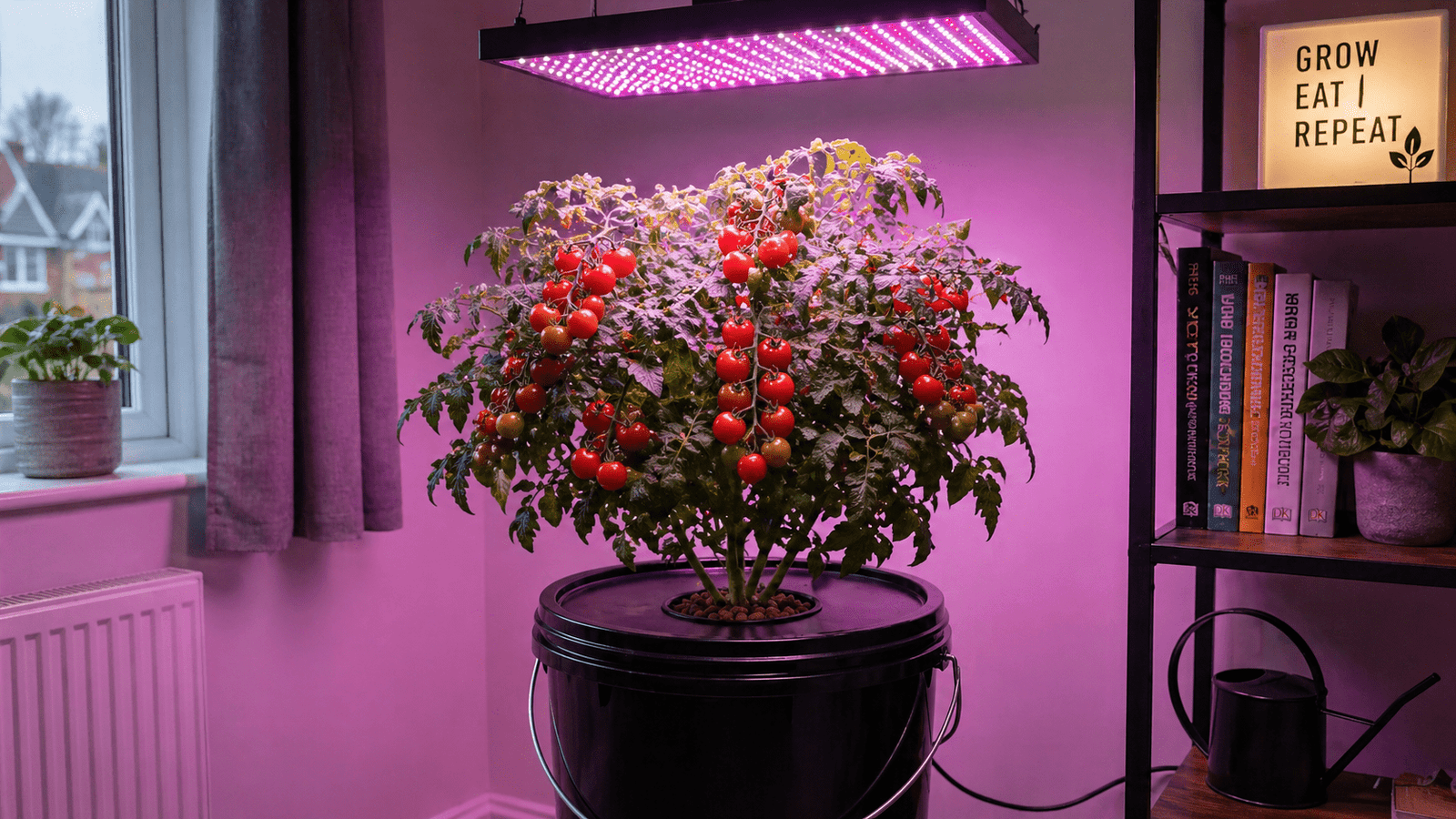
If you want to grow hydroponic tomatoes indoors in the UK, you’re picking one of the most rewarding — and most misunderstood — crops for a first indoor garden. Done right, a single dwarf cherry tomato plant can produce 2–3 kg of fruit over 5 months. Done wrong, you’ll get leggy, pale plants with three sad tomatoes.
This guide covers the entire process of growing hydroponic tomatoes indoors: the best UK varieties, exact EC and pH targets, lighting schedules, pollination (yes, you have to do it yourself indoors), and a realistic 90-day timeline from seed to first tomato.
🎯 Quick Answer
To grow hydroponic tomatoes indoors, use a Dutch bucket, DWC or NFT system with a dwarf or semi-determinate variety (Tiny Tim, Red Robin, Tumbling Tom). Maintain pH 5.8–6.3, EC 2.0–3.5 depending on growth stage, run LED grow lights for 14–16 hours, keep temperatures at 20–26°C, and hand-pollinate flowers daily. First harvest comes around 70–90 days from seed.
📖 In this guide
- Can you really grow hydroponic tomatoes indoors in the UK?
- The 6 best tomato varieties for UK indoor hydroponics
- Which hydroponic system works best for tomatoes?
- Step-by-step setup (what you actually need)
- Nutrients, EC and pH by growth stage
- Lighting requirements for indoor tomatoes
- Pollination: the step most beginners skip
- 90-day seed-to-harvest timeline
- 5 mistakes that kill UK hydroponic tomatoes
- Frequently asked questions
Can you really grow hydroponic tomatoes indoors in the UK?
Yes — and they’ll grow faster, cleaner and more reliably than anything you’d produce on a windowsill in soil. UK hydroponic tomato growers routinely report 30–50% faster growth compared to soil-grown plants, with the first harvests landing in 60–80 days from transplant instead of 90–110 days outdoors.
The trade-offs are honest ones. You need to invest in proper grow lighting, manage EC and pH weekly, and hand-pollinate every flower. Skip any of those and you’ll get plenty of green leaves but few actual tomatoes.
The upside: no slugs, no blight, no British weather. You can start a crop in January and harvest in April, or start now and be eating homegrown cherry tomatoes at Christmas.
Key takeaways
- Indoor hydroponic tomatoes grow 30–50% faster than soil-grown outdoor tomatoes
- Dwarf and semi-determinate varieties suit UK flats and small grow tents
- Expect to spend £80–£200 on a first setup including lights, nutrients and seeds
- First harvest arrives 70–90 days from seed with dwarf varieties
- Hand pollination is mandatory indoors — no bees, no wind
The 6 best tomato varieties for UK indoor hydroponics
Not every tomato variety suits indoor hydroponics. You want compact growth, short internodes, and fruit that ripens in under 90 days. These six are proven performers in UK grow tents, windowsills and Dutch bucket setups.
Height: 30 cm · Days to harvest: 55–65 from transplant · Type: Determinate dwarf
The classic UK dwarf cherry tomato. Thompson & Morgan and Suttons both stock Tiny Tim seeds at around £2.50 per packet. Perfect for windowsill hydroponics and small DWC buckets. No staking required. Yields 20–30 cherry tomatoes per plant.
Height: 30–45 cm · Days to harvest: 55–65 from transplant · Type: Determinate dwarf
Heavier yielding than Tiny Tim but just as compact. Produces dense clusters of sweet cherry tomatoes. Excellent for NFT channels and 10-litre DWC buckets. Widely available through Amazon UK and specialist seed suppliers.
Height: 30–60 cm cascading · Days to harvest: 70–80 from transplant · Type: Determinate trailing
Cascading growth habit makes it brilliant for hydroponic towers and hanging setups. Produces large quantities of sweet cherry tomatoes. A UK garden centre favourite — look for it at B&Q, Dobbies and online at Sarah Raven.
Height: 150–180 cm · Days to harvest: 75–85 from transplant · Type: Indeterminate cherry
If you have height (a grow tent at least 1.5 m tall), Gardener’s Delight delivers the best flavour-per-effort ratio of any UK cherry tomato. Needs pruning and a trellis. Huge UK availability — every seed supplier stocks it.
Height: 180–200 cm · Days to harvest: 70–80 from transplant · Type: Indeterminate cherry
Widely considered the sweetest cherry tomato money can buy. Exceptional in hydroponic systems where EC can be pushed to 3.0+ during fruiting. Requires a tall grow tent and serious staking. Thompson & Morgan and Mr Fothergill’s stock Sungold seeds at £3–£4 per packet.
Height: 15–20 cm · Days to harvest: 55–70 from transplant · Type: Micro dwarf
The tiniest tomato plant you can reliably grow. Developed by Thompson & Morgan and sold exclusively through their UK range. Perfect for countertop AeroGarden-style systems where height is 30 cm or less.
Which hydroponic system works best for indoor tomatoes?
Tomatoes are thirsty, heavy-feeding plants. They drink more water and nutrients than any other common indoor crop. This rules out some hydroponic systems and makes others perfect.
| System | Suitability for tomatoes | Best variety match | UK startup cost |
|---|---|---|---|
| Dutch Bucket | Excellent — the industry standard for hydroponic tomatoes | Indeterminate (Sungold, Gardener’s Delight) | £60–£120 |
| DWC (Deep Water Culture) | Very good for dwarf varieties in 20-litre buckets | Dwarf (Tiny Tim, Red Robin) | £40–£80 |
| NFT channels | OK for dwarf only — roots fill channels fast | Micro dwarf (Venus) | £100–£180 |
| Kratky method | Limited — works for one fruiting cycle only | Tumbling Tom in 10+ litre container | £10–£20 |
| Wick system | Poor — can’t deliver enough nutrients during fruiting | Not recommended | n/a |
| Aeroponic tower | Good for cascading dwarf varieties | Tumbling Tom | £150–£250 |
For most UK beginners, a single Dutch bucket or 20-litre DWC setup is the sweet spot — low cost, forgiving, and scales to two or three plants as you gain confidence.
Step-by-step setup for hydroponic tomatoes indoors
What you actually need (UK shopping list)
| Item | Specification | UK source & price |
|---|---|---|
| Bucket or reservoir | 20 L minimum per plant | B&Q / Screwfix (£5–£8) |
| Air pump + airstone | 4W, 240 L/h minimum | Amazon UK (£10–£15) |
| Net pot | 5–6 inch / 12–15 cm | Amazon UK (£5 for 10) |
| Growing medium | Clay pebbles (hydroton) | Amazon UK / HydroHobby (£12 for 10 L) |
| LED grow light | 100W+ full spectrum | Amazon UK Spider Farmer (£60–£100) |
| Hydroponic nutrients | Two-part tomato formula | Formulex or GH Flora Series (£15–£30) |
| pH test kit | Drops or digital meter | Amazon UK (£8–£25) |
| EC/TDS meter | Essential for fruiting | Amazon UK Bluelab or HM Digital (£20–£60) |
| pH Up / pH Down | 250ml bottles | General Hydroponics (£8 each) |
| Seeds | Dwarf variety packet | Thompson & Morgan / Suttons (£2.50–£4) |
Total startup for a single-plant DWC tomato setup: £140–£220. Every piece here is reusable for future crops.
Setting it up in 6 steps
- Germinate seeds in rockwool or peat plugs — tomato seeds germinate in 5–10 days at 20–25°C. A heated propagator speeds this up significantly.
- Transplant to net pot at 2-week true leaf stage — when the seedling has 2–3 true leaves and roots emerging from the plug, move it into your clay-pebble-filled net pot.
- Fill the reservoir and set up airstone — use standing tap water (24 hours) or filtered water. Start with EC 1.2–1.5 for young plants.
- Adjust pH to 5.8–6.3 — use General Hydroponics pH Down (usually needed with UK tap water).
- Position LED grow light 30 cm above plant — raise as the plant grows. Aim for 14–16 hours on, 8–10 off.
- Install support as plant grows — bamboo canes for dwarfs; trellis or string for indeterminates.
Nutrients, EC and pH by growth stage
Tomatoes are one of the few hydroponic crops where nutrient strength changes dramatically across the growth cycle. Feeding a flowering tomato with seedling-strength nutes will give you lush leaves and no fruit. Getting this right is the difference between 3 tomatoes and 300.
| Growth stage | EC (mS/cm) | PPM (500 scale) | pH range | Key nutrient focus |
|---|---|---|---|---|
| Seedling (0–2 weeks) | 0.8–1.2 | 400–600 | 5.8–6.2 | Low overall, higher N |
| Vegetative (2–6 weeks) | 1.5–2.0 | 750–1000 | 5.8–6.3 | Balanced N-P-K, higher N |
| Flowering (6–9 weeks) | 2.0–2.5 | 1000–1250 | 5.8–6.3 | Drop N, bump P and K |
| Fruiting (9+ weeks) | 2.5–3.5 | 1250–1750 | 6.0–6.5 | Heavy K, add calcium |
UK nutrient brands that work
Three hydroponic nutrient brands dominate the UK tomato scene:
- Formulex (Growth Technology, UK-made) — single-part liquid, foolproof for beginners, around £14 per 500ml
- General Hydroponics Flora Series — three-part system (Gro, Micro, Bloom), gives precise control for fruiting stage, around £45 for a starter trio
- Canna Aqua Vega + Flora — professional-grade Dutch brand with a dedicated fruiting formula, around £30 per bottle
Lighting requirements for UK indoor tomatoes
Tomatoes are high-light crops. Indoor without natural sunlight, they need 14–16 hours of full-spectrum LED lighting per day, minimum. Drop to 12 hours once the plant starts setting fruit to trigger ripening.
| Growth stage | Daily light hours | PPFD target | Wattage per plant |
|---|---|---|---|
| Seedling | 14–16 | 200–300 μmol | 40–60W |
| Vegetative | 16 | 400–600 μmol | 80–120W |
| Flowering | 14 | 600–800 μmol | 100–150W |
| Fruiting | 12–14 | 700–1000 μmol | 150W+ |
UK running costs: a 100W LED on 14 hours per day uses about 1.4 kWh/day. At 27p per kWh, that’s roughly £11.50 per month per plant — comparable to a single supermarket punnet of cherry tomatoes per week.
Hand pollination: the step beginners skip
Tomatoes are self-pollinating but they need movement to release pollen. Outdoors, wind and bees do this for free. Indoors, you have to do it yourself — and skipping this step is the #1 reason UK indoor growers end up with plants full of flowers but no fruit.
Three methods that work
- Flower shake — once flowers open, gently tap the main stem daily. 5 seconds per plant. Effective for dwarfs.
- Electric toothbrush — touch the vibrating back to each flower cluster for 2–3 seconds. Mimics bee buzz pollination perfectly.
- Small oscillating fan — set to low, positioned so flowers move gently. The hands-off option for indeterminate trusses.
Pollinate every day once flowering starts. Do it between 10am and 4pm when pollen is most active.
90-day seed-to-harvest timeline
This is a realistic timeline for a Tiny Tim or Red Robin dwarf tomato grown under 100W LED in a 20-litre DWC setup at 22°C.
What’s happening: Seed germinates in rockwool plug. Cotyledons (seed leaves) emerge by day 5–7.
Your job: Keep plug moist. Temperature 20–25°C. LED on 14 hours at 20 cm distance.
What’s happening: First true leaves appear. Roots fill the plug.
Your job: Transplant to net pot. Start feeding EC 1.2–1.5. pH 5.8–6.2.
What’s happening: Rapid leaf and stem growth. Plant triples in size.
Your job: EC 1.8–2.0. Install support cane. Prune any suckers (side shoots) on indeterminates.
What’s happening: First flower trusses appear. Plant shifts from leaves to flowers.
Your job: Switch to flowering nutrients. Bump EC to 2.2–2.5. Start daily pollination.
What’s happening: Tiny green tomatoes form behind fertilised flowers. First fruits swell.
Your job: EC to 2.8–3.0. Calcium supplement to prevent blossom end rot.
What’s happening: First fruits turn red (or gold, depending on variety). Harvest begins.
Your job: Pick ripe fruit every 2–3 days. Continue pollinating new flowers. Expect harvesting to continue for 6–12 weeks.
5 mistakes that kill UK hydroponic tomatoes
Mistake 1 — Skipping hand pollination
Plants full of flowers but no fruit is the #1 complaint from UK indoor tomato growers. The fix is free: tap, buzz or fan every flower daily.
Mistake 2 — Feeding seedling-strength nutrients during fruiting
Fruiting tomatoes need twice the EC of vegetative tomatoes. Without the bump, fruit stays small, pale and tasteless.
Mistake 3 — Under-lighting
A £20 Amazon LED desk lamp will not grow tomatoes. Aim for a minimum 100W of real full-spectrum LED per plant — not “LED equivalent wattage” marketing.
Mistake 4 — Ignoring calcium and blossom end rot
When the first fruits develop black sunken patches at the base, that’s calcium deficiency. Add a dedicated calcium supplement (Cal-Mag or similar) once flowering starts.
Mistake 5 — Choosing the wrong variety for the space
Growing 2m-tall Sungold in a 1m grow tent is the most common UK disaster. Match variety to vertical space before you sow a single seed.
3 expert tips for bigger indoor tomato yields
- Prune indeterminate varieties weekly. Remove side shoots (suckers) that form in the joint between stem and leaf. This redirects energy to fruit production, doubling yields in the same space.
- Top up the reservoir daily during fruiting. A fruiting tomato can drink 2+ litres of nutrient solution per day. Daily top-ups stop EC spiking as water evaporates.
- Run a small fan on low 24/7. Air movement strengthens stems, prevents fungal issues, and improves pollination. A £15 USB fan from Amazon UK does the job.
Best Plants to Grow Hydroponically
The complete UK hydroponic plant guide — 27 crops covered in detail, with variety-specific nutrient recipes, harvest timelines and troubleshooting for tomatoes, peppers, strawberries, leafy greens and more.
✓ 27 crops covered · ✓ UK varieties only · ✓ Harvest timing charts · ✓ Instant PDF download
Frequently asked questions about hydroponic tomatoes indoors
How long does it take to grow hydroponic tomatoes indoors?
From seed to first ripe tomato takes around 70–90 days for dwarf varieties (Tiny Tim, Red Robin) and 85–100 days for indeterminates (Sungold, Gardener’s Delight). Hydroponic tomatoes indoors grow 30–50% faster than soil-grown outdoor tomatoes thanks to direct root access to nutrients.
Can I grow hydroponic tomatoes indoors without grow lights?
Only during UK summer months (June–August) on a south-facing window, and even then yields will be half what they’d be under LEDs. For year-round indoor tomato growing, a 100W+ full-spectrum LED grow light is essential.
What EC do hydroponic tomatoes need?
EC targets change by growth stage: 0.8–1.2 for seedlings, 1.5–2.0 for vegetative, 2.0–2.5 for flowering, and 2.5–3.5 for fruiting. Using vegetative-strength feed during fruiting is the single most common UK mistake.
Do indoor hydroponic tomatoes need to be pollinated?
Yes. Tomatoes are self-pollinating but need movement to release pollen. Indoors there’s no wind or bees, so you must pollinate manually — either by shaking flower trusses, using an electric toothbrush on each flower, or running a small fan.
How many tomatoes does one indoor hydroponic plant produce?
A dwarf variety like Tiny Tim yields 20–40 cherry tomatoes per plant. A well-grown indeterminate like Sungold can produce 2–3 kg of fruit across a 3–4 month harvest window. Commercial hydroponic tomatoes reach 4–6 kg per plant under optimal conditions.
What is the best hydroponic system for tomatoes?
Dutch buckets for indeterminate varieties (best overall), DWC for dwarfs, and NFT only for micro dwarfs. Avoid wick systems and pure Kratky for long-term fruiting plants — they can’t deliver enough nutrients during fruit set.
Can you grow cherry tomatoes hydroponically in winter in the UK?
Yes, with the right setup. Use LED lights for 14–16 hours, keep room temperature above 18°C, and choose dwarf varieties that complete a full cycle in 70–80 days. UK growers often start indoor tomato crops in October for February–April harvests.
Why are my indoor hydroponic tomato leaves curling?
Leaf curl in indoor tomatoes usually means heat stress (above 28°C), over-feeding (EC too high), or inconsistent watering. Check reservoir temperature first, then EC, then top-up frequency. See our hydroponic leaves curling guide for full diagnosis.
Related posts for UK tomato growers
- Hydroponic Strawberries: Can You Really Grow Them Indoors? — another fruiting crop for indoor growing
- Hydroponic Nutrients for Beginners — understanding N-P-K for fruiting plants
- Hydroponic Nutrient Schedule: Week-by-Week Feeding Chart — detailed feeding calendar
- Fastest Hydroponic Crops: Top 8 Plants Ready in Under 30 Days — quicker wins while your tomatoes mature
- Hydroponic Plants Turning Yellow — troubleshooting nutrient deficiencies
- 7 Best Smart Hydroponic Systems with App Control in 2026 — systems that grow tomatoes well
Further reading from UK authorities
- RHS guide to growing tomatoes — Royal Horticultural Society’s complete tomato reference
- Thompson & Morgan tomato seeds — UK-grown varieties including Venus Micro Dwarf and Tiny Tim
- Suttons tomato seed range — established UK seed supplier with hydroponic-friendly varieties
Start your indoor hydroponic tomatoes this week
Hydroponic tomatoes indoors are the crop that separates casual growers from proper ones. They need more attention than lettuce, more light than herbs, and more nutrient management than strawberries — but the payoff is a steady 5-month supply of cherry tomatoes that taste like nothing you’ll ever find in a UK supermarket.
If you start a dwarf variety this week, you’ll be harvesting the first tomatoes by the end of July. Start with one plant. Nail the pollination, the EC schedule, and the lighting. Then scale.
Your next step: order a packet of Tiny Tim or Red Robin seeds from Thompson & Morgan, set up a 20-litre DWC bucket, and germinate this weekend.