
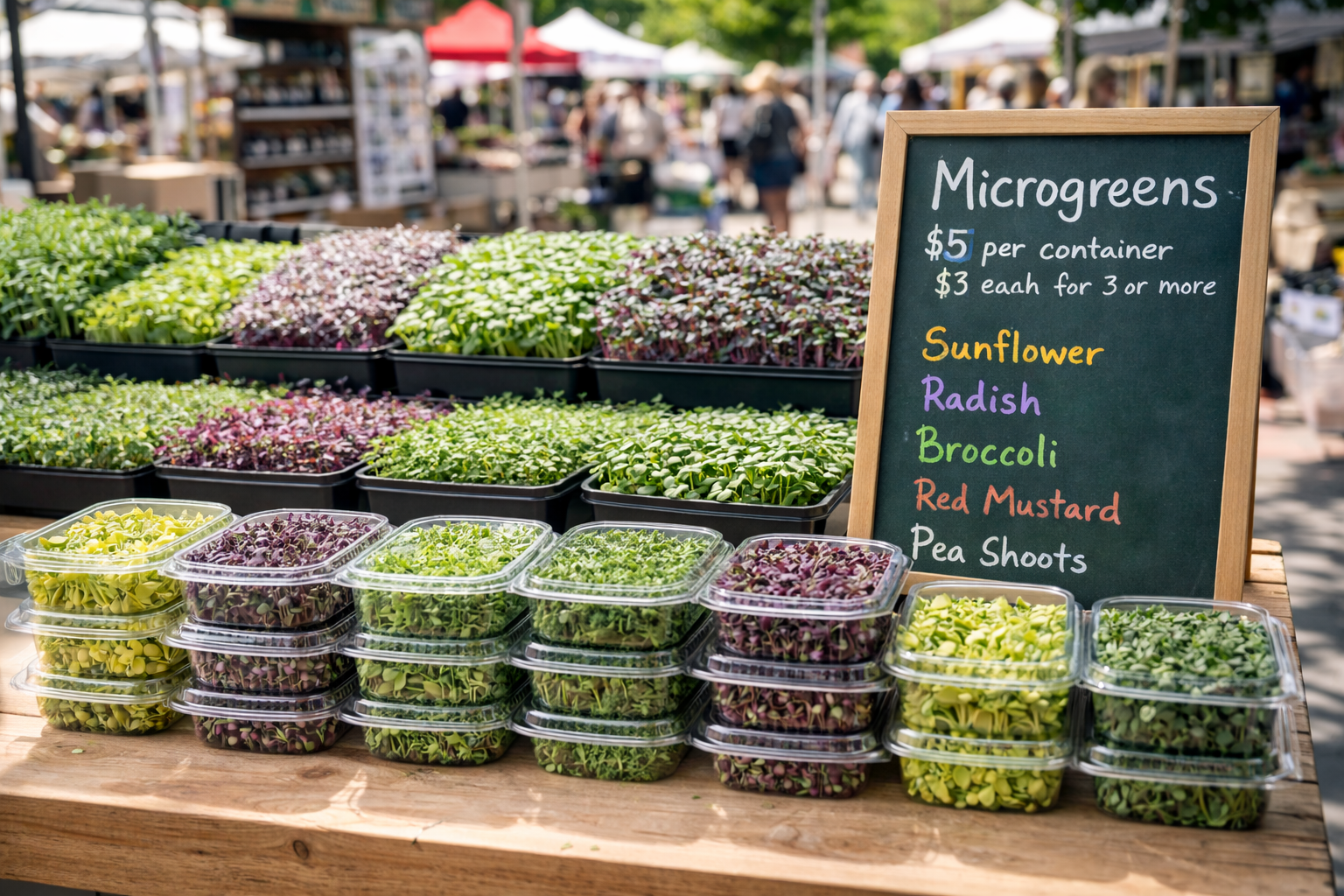
Selling microgreens at farmers markets is one of the most rewarding ways to turn your home growing hobby into real income. Direct customer contact, immediate cash sales, and the chance to build a loyal local following make farmers markets ideal for new microgreen producers. But success at farmers markets is not automatic — many growers waste months struggling with poor sales because they make basic mistakes in pricing, presentation, and customer interaction.
This guide covers 7 proven tips for selling microgreens at farmers markets successfully, based on insights from established growers who consistently sell out their tables every market day. By the end, you will know exactly how to set up, price, present, and sell microgreens for maximum profit.
💰 The Income Reality
Selling microgreens at farmers markets typically generates £100-300 in sales per market day for new vendors and £300-700 for established sellers with regular customers. Most successful growers attend 1-2 markets per week as a side business.
Why are farmers markets ideal for selling microgreens?
Farmers markets offer several unique advantages that make them perfect for selling microgreens at farmers markets compared to other sales channels. Understanding why helps you maximise the opportunity:
| Advantage | Why It Matters for Microgreens |
|---|---|
| Direct customer contact | You can educate customers unfamiliar with microgreens |
| Premium audience | Market shoppers value freshness and pay premium prices |
| Immediate cash flow | No waiting for invoices or chasing payments |
| Brand building | Regular weekly presence builds local recognition |
| Customer feedback | Direct conversations reveal what works and what does not |
For the complete picture of running the operation behind your stall, see our microgreens business from home startup guide — it covers the production side while this post focuses on selling.
What is the number 1 tip for selling microgreens at farmers markets?
Tip 1Always bring live growing trays for visual impact
The single most powerful tactic for selling microgreens at farmers markets is bringing live growing trays alongside your packaged products. Most shoppers have never seen microgreens growing and the visual impact stops them in their tracks. A vibrant tray of dense radish microgreens or pea shoots draws far more attention than packaged products alone.
Bring 2-3 trays at different growth stages so customers can see the full lifecycle. This creates conversation opportunities, demonstrates freshness, and dramatically increases foot traffic to your table compared to vendors with only packaged products.
Tip 2Offer free samples generously
Free samples are absolutely essential for selling microgreens at farmers markets. Most customers have never tasted microgreens and assume they are bland like supermarket lettuce. The first taste of intensely flavoured radish or sunflower microgreens is often a revelation that converts curious browsers into immediate buyers.
Set up a small sampling area with toothpicks and a small bowl of harvested microgreens. Encourage everyone to try at least one variety. The cost of free samples is minimal compared to the conversion rate they generate. Our 10 best microgreen varieties guide covers which varieties produce the strongest flavour-first impression for sampling.
Tip 3Price for value, not for cheapness
Selling microgreens at farmers markets requires confident premium pricing. Microgreens are nutritionally dense premium products, not commodity vegetables. Successful farmers market microgreen vendors typically charge £4-8 per 75g pack, equivalent to £25-50 per pound.
| Pack Size | Suggested Price | Notes |
|---|---|---|
| 50g pack | £3-5 | Entry size for first-time buyers |
| 75g pack | £4-6 | Standard size for regulars |
| 100g pack | £6-8 | Larger size for enthusiasts |
| Variety pack | £8-12 | 3 varieties in single container |
Tip 4Educate customers with simple recipe cards
Many potential customers walk away because they do not know how to use microgreens. Selling microgreens at farmers markets becomes much easier when you proactively educate people about uses. Print simple recipe cards (£10-20 for a few hundred at a local print shop) showing 3-5 ways to use microgreens in everyday meals.
Effective recipe ideas include: avocado toast topping, sandwich enhancement, salad mix-in, omelette garnish, and pasta finisher. Hand a card to every customer who shows interest, even if they do not buy that day. Many will return next week ready to purchase after trying ideas at home.
Tip 5Create an attractive, professional display
Your stall presentation directly affects sales when selling microgreens at farmers markets. Invest in a few key items that elevate your display from amateur to professional:
🛒 Display Essentials
- Wooden table or rustic crate display: More appealing than bare folding tables
- Chalkboard sign with prices: Eye-catching and easy to update
- Branded labels on packaging: Build brand recognition
- Tablecloth in a memorable colour: Helps regulars find you
- Business cards or QR code: For customers to find you online
Tip 6Build relationships, not just transactions
The most successful approach to selling microgreens at farmers markets is treating every sale as a relationship-building opportunity. Learn customer names, remember their preferences, ask about how they used last week’s purchase, and treat regulars like friends. Markets reward consistency and personal connection more than any other sales channel.
This relational approach creates loyal customers who return weekly, recommend you to friends, and forgive occasional issues like sold-out varieties. According to research compiled by Epic Gardening, repeat customers typically generate 60-80% of mature farmers market vendor revenue.
Tip 7Plan your inventory carefully
Selling out is good — running out of your bestsellers in the first hour is bad. Track sales over multiple market days to learn what each variety sells. Adjust production schedules to match demand. Most successful microgreen vendors find that 60-70% of their sales come from just 3-4 varieties, so focus production on these proven winners while still offering 6-8 varieties for customer choice.
Intermediate level: scaling your farmers market presence
After establishing yourself successfully at one farmers market, several techniques help expand your business sustainably.
Add a second market location
Most growers add a second weekly market once they consistently sell out their first market. This doubles your weekly revenue with the same production effort. Choose markets in different neighbourhoods to avoid customer overlap.
Take pre-orders for special varieties
Once you have regular customers, offer pre-orders for unusual varieties or larger quantities. This guarantees sales before you even harvest and lets you grow specifically for known buyers.
Develop a subscription model
Some successful market vendors offer weekly subscription packages where customers pre-pay for 4-12 weeks of regular pickup. This creates predictable revenue and reduces unsold inventory waste.
What next? Beyond farmers markets
After mastering selling microgreens at farmers markets, here are the natural next growth steps:
- Add restaurant accounts for predictable wholesale revenue alongside market sales
- Build a small home delivery route for customers who cannot attend markets
- Partner with local CSA box providers for additional weekly volume
- Develop value-added products like microgreen-based pesto or finishing salts
- Scale your production operation using our complete microgreens business startup guide
- Connect with the growing community through resources like Maximum Yield for industry insights
Frequently asked questions about selling microgreens at farmers markets
How much does it cost to rent a farmers market stall?
UK farmers market stall fees typically range from £10-40 per market day depending on location and market popularity. London markets and high-traffic locations charge more. Most markets require advance booking and some have waiting lists for vendors. Your local council website usually lists farmers markets in your area.
Do I need special licensing for selling microgreens at farmers markets?
Yes. UK food vendors must register with their local council as a food business (free in most areas) at least 28 days before starting to sell. You may also need basic food hygiene training and public liability insurance. Always check current requirements with your local environmental health office before your first market. The Food Standards Agency has up-to-date guidance on home food business registration.
How many trays should I bring to my first market?
Start small with 8-12 packaged units and 2-3 live demonstration trays for your first market. This minimises waste if sales are slow and gives you experience without financial pressure. Adjust upward in subsequent weeks based on actual demand.
What is the best day for selling microgreens at farmers markets?
Saturday markets typically have the highest foot traffic and best sales. Sunday markets are second best. Weekday markets generally have lower attendance and lower sales potential. If you can only do one market, choose the busiest Saturday market in your area.
Should I accept cash, card, or both?
Accept both. Many market shoppers prefer card payments now, and missing sales because you only take cash is costly. A simple card reader from providers like Square or SumUp connects to your phone for £20-30 with low transaction fees. Keep some cash on hand for change.
What happens if my microgreens do not sell at the market?
Unsold microgreens stay fresh for 3-5 days in proper storage, so you can offer them through other channels (restaurants, direct customers) or use them yourself. Microgreens never have to go to waste because of their versatility and short shelf life management.
Related posts you might find useful
- Hydroponic Microgreens Business from Home Startup Guide — Build the business that supplies your stall
- 10 Best Microgreen Varieties for Hydroponic Beginners — Choose profitable varieties
- Microgreens Hydroponics: Your First Harvest in 7 Days — Master production basics first
- Microgreens vs Full Size Plants — Why microgreens win for market selling
- 10 Easy Hydroponic Plants Almost Impossible to Kill — Complementary crops for your stall
- Fastest Hydroponic Crops: Top 8 Plants Under 30 Days — Fast-turnover crops beyond microgreens
- Teaching Kids Hydroponics — Educational resource families love at market stalls
Master Microgreens Sales
Our 23-page ebook Microgreens: Hobby to Side Income includes complete farmers market guides, customer acquisition strategies, professional display templates, and pricing worksheets for new vendors.
✓ Market setup checklists · ✓ Pricing worksheets · ✓ Display templates · ✓ Instant PDF download