
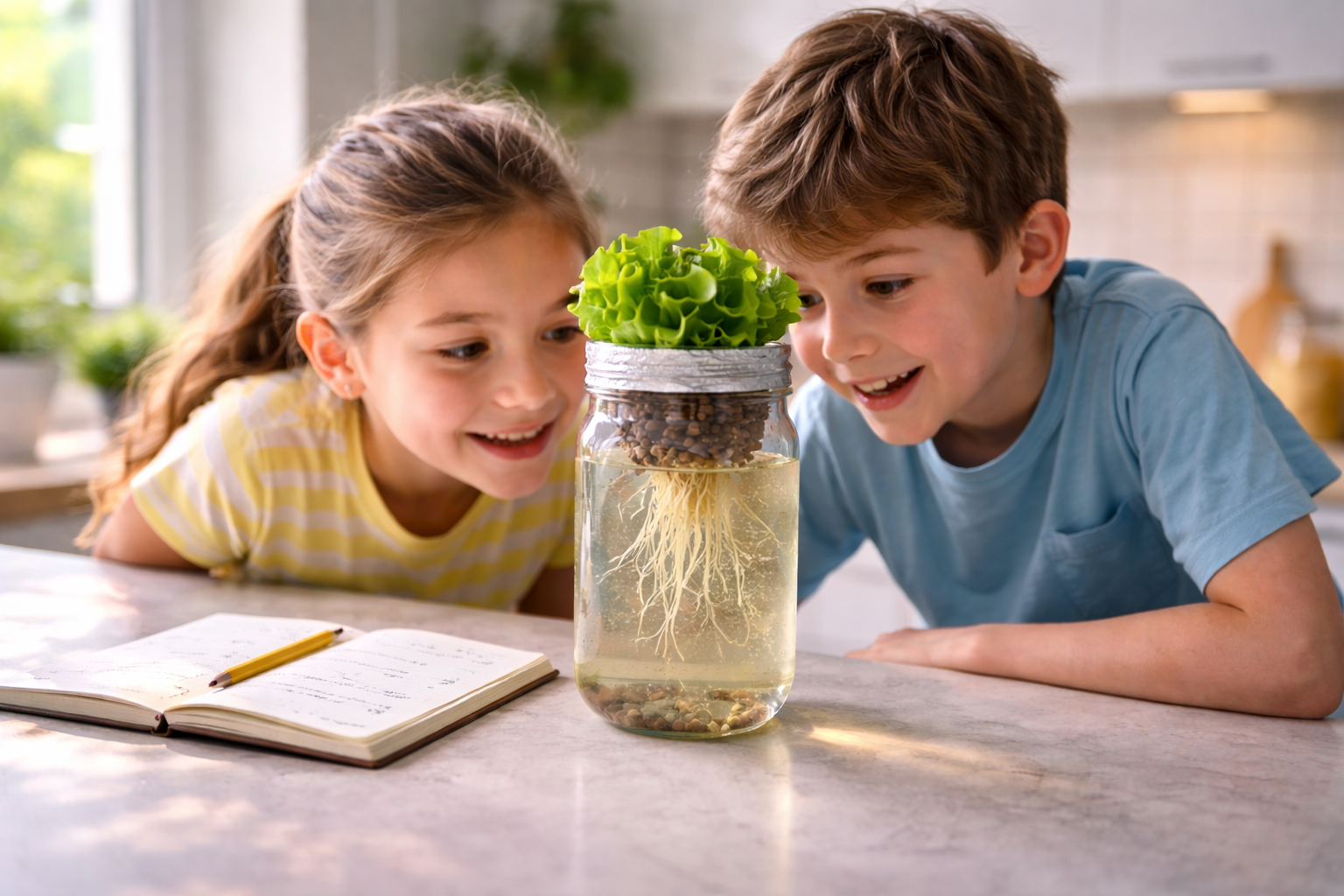
Teaching kids hydroponics might be the most rewarding educational project you can introduce to children at home or in the classroom. Unlike most STEM activities that produce abstract results or single-use models, hydroponics gives children real, edible food they grew with their own hands while teaching biology, chemistry, math, and patience along the way. It is also one of the few hands-on projects that genuinely competes with screens for kids’ attention because the daily growth changes are visible and exciting.
This guide explains exactly how to introduce children to hydroponics, what they will learn, age-appropriate tasks, and how to keep their interest engaged from sowing seeds through harvest day. By the end, you will have a complete plan for using hydroponics as a powerful educational tool with kids of any age.
🌱 The 30-Second Pitch
Teaching kids hydroponics combines biology, chemistry, math, and patience into a single project that produces real food in 4-6 weeks. The daily visible growth competes successfully with screens for children’s attention while teaching life skills they will remember forever.
Why is teaching kids hydroponics better than other STEM projects?
Most STEM activities produce abstract results, single-use models, or experiments children quickly forget. Teaching kids hydroponics is different in several important ways that make it uniquely engaging and educational.
| Factor | Why It Matters |
|---|---|
| Real outcomes | Children eat the food they grow, creating tangible reward |
| Daily changes | Visible progress every 1-2 days maintains engagement |
| Cross-curricular | Teaches biology, chemistry, math, observation, and patience |
| Forgiving | Children can mostly succeed even with imperfect technique |
| Low cost | Complete setup under £20 makes it accessible to any family |
| Real-world relevance | Connects to food, agriculture, and global sustainability |
According to educational research compiled by Science Buddies, hands-on growing projects significantly improve children’s understanding of plant biology and create lasting interest in science compared to textbook learning alone. NASA has even funded research into hydroponic growing for space missions, making it a topic with genuine scientific weight that fascinates children when framed correctly.
What ages can start teaching kids hydroponics?
Teaching kids hydroponics works for almost any age, though the level of involvement and understanding varies significantly. Here is what each age group can handle:
| Age | What They Can Do | What They Learn |
|---|---|---|
| 3-5 years | Watch, water, harvest with help | Plants need water and light to grow |
| 6-8 years | Plant seeds, observe roots, draw pictures | Plant lifecycle, basic biology |
| 9-11 years | Mix nutrients, test pH, keep journal | Chemistry basics, scientific observation |
| 12-14 years | Run full systems, design experiments | Scientific method, data analysis |
| 15+ years | Independent projects, complex experiments | Real research skills, sustainability |
If you are working with younger children specifically, our guide on how to explain hydroponics to a child covers age-appropriate language and analogies for different developmental stages.
What is the best first hydroponic project for kids?
The ideal first project for teaching kids hydroponics is a simple Kratky mason jar with a single lettuce or basil plant. This is the easiest entry point because there are no pumps to fail, no electricity needed, and the daily changes are highly visible through the clear glass. See our complete mason jar hydroponics guide for the full step-by-step build.
What you need for a kids hydroponics starter kit
🛒 Complete Kids Setup Shopping List
| Wide-mouth glass jar (1L) From any homeware shop |
£1-3 |
| 3-inch net pot Amazon or garden centres |
£0.50 |
| Clay pebbles (small bag) Garden centres or online |
£3-5 |
| Hydroponic nutrients One bottle lasts a year |
£8-10 |
| pH test kit Drops easier than digital for kids |
£4-6 |
| Lettuce or basil seeds Any garden centre |
£1-2 |
| Observation notebook At home or any stationer |
£0-2 |
| Total Cost | £20-28 |
After this initial investment, ongoing costs for new seeds and small amounts of nutrients are just £2-3 per grow cycle. If you prefer a ready-made option instead of sourcing parts, our review of 7 best kid friendly hydroponic kits compares the top pre-built options for families and classrooms.
How do you actually start teaching kids hydroponics?
The first 30 minutes of any hydroponics project sets the tone for the entire experience. Make it exciting and hands-on rather than lecture-heavy. Children learn best by doing, observing, and asking questions.
Step 1: Start with the why, not the how
Begin by asking children what they think plants need to grow. Discuss soil, water, sunlight, and nutrients. Then explain that hydroponics removes the soil entirely — plants can grow with just water and the right nutrients. This often blows children’s minds and creates immediate curiosity. The Royal Horticultural Society has excellent free resources for explaining plant biology to children at age-appropriate levels.
Step 2: Let them do the hands-on work
Children should physically handle every step: filling the jar with water, measuring nutrients (with adult supervision for very young children), placing seeds, and arranging the setup. Adults should guide but not take over. The sense of ownership is essential for sustained engagement.
Step 3: Set up an observation routine
Establish a simple daily check-in ritual where children look at their plant, note any changes, and record observations in their notebook. This 2-minute routine builds scientific observation skills and keeps engagement high through the entire grow cycle.
Step 4: Connect to bigger ideas
As the plant grows, introduce related concepts: how plants make food from sunlight (photosynthesis), why pH matters (chemistry), how astronauts grow food in space (NASA hydroponics research), and how vertical farms could help feed cities sustainably.
What will kids actually learn from teaching kids hydroponics?
The educational value of teaching kids hydroponics extends far beyond just growing a plant. A complete grow cycle teaches concepts from multiple subject areas in a way children remember because they experienced it directly.
📚 Subjects Covered by One Grow Cycle
| Biology | Plant lifecycle, photosynthesis, root systems, leaf development |
| Chemistry | pH measurement, nutrient mixing, chemical balance |
| Math | Measuring volumes, calculating ratios, tracking growth rates |
| Scientific method | Observation, hypothesis, experimentation, conclusions |
| Sustainability | Water efficiency, food production, environmental science |
| Life skills | Patience, responsibility, attention to detail |
Intermediate level: making teaching kids hydroponics more challenging
Once children have completed their first successful grow, several techniques deepen the learning experience and keep them engaged for further projects. Our guide to 5 simple hydroponic experiments for kids ages 6-12 covers tested experiments that introduce variables and controls at each age level.
Run controlled experiments
Set up two identical jars but change one variable: different light levels, different nutrient strengths, or different plant varieties. Have children predict what will happen, observe over time, and explain the results. This introduces real scientific method thinking.
Track measurements over time
Older children can measure plant height every few days and graph the results. This produces visual data that connects abstract math to real observations and demonstrates exponential growth patterns.
Try different plants and compare
Once one variety works, expand to growing 3-4 different plants simultaneously. Children can observe how lettuce, basil, mint, and microgreens all grow differently from the same basic setup, learning about plant variety and adaptation.
What next? Expanding from teaching kids hydroponics basics
After completing the first grow cycle, here are natural next steps for keeping children engaged with hydroponics learning:
- Try microgreens hydroponics for faster results in 7-14 days that maintain younger children’s interest
- Enter a hydroponic science fair project using what they have learned
- Set up a small grow shelf with multiple jars and a basic LED grow light
- Visit a local hydroponic farm if one exists in your area for inspiration
- Watch educational videos from National Geographic Kids about modern food production
- Connect with school gardens if local schools have hydroponic programs
Frequently asked questions about teaching kids hydroponics
Is teaching kids hydroponics safe for young children?
Yes, when done with appropriate supervision. Hydroponic nutrients are concentrated plant fertilisers — not toxic chemicals — but they should not be ingested directly. Store nutrient bottles out of reach of small children and always supervise when measuring. The growing plants themselves are completely safe for kids to handle.
How long does a hydroponic project take from start to harvest?
A complete first project takes 4-6 weeks from sowing to harvest for lettuce or 3-4 weeks for fast crops like basil. Microgreens are even faster at 7-14 days. Choose the timeframe that matches your children’s attention span — younger kids do better with faster crops.
Will my child actually stay interested for the full grow cycle?
Most children stay engaged for the entire cycle because the daily visible changes maintain interest. To maximise engagement, set up daily observation routines, take photos of progress, and celebrate small milestones. The harvest day is particularly memorable.
Can teaching kids hydroponics help with picky eating?
Yes, often dramatically. Children who refuse to eat vegetables they bought from a supermarket frequently happily eat the same vegetables they grew themselves. The sense of ownership and pride in growing their own food often overcomes existing food preferences.
Is teaching kids hydroponics suitable for classroom use?
Absolutely. Many teachers use hydroponic projects to teach plant biology, chemistry, and the scientific method. A single classroom setup of 6-10 jars provides hands-on learning for an entire class. Resources from Science Buddies include classroom-ready hydroponics curriculum.
What if our hydroponic project fails?
Failures are valuable learning opportunities, not disasters. Discuss what went wrong, hypothesise why, and try again with adjustments. This is how real scientists learn. Occasional failures actually teach resilience and problem-solving better than projects that always succeed.
Related posts you might find useful
- What Is Hydroponics? A Plain-English Explanation — Background reading for parents and teachers
- How to Explain Hydroponics to a Child — Age-appropriate language and analogies
- 5 Simple Hydroponic Experiments for Kids Ages 6-12 — Tested experiments with variables
- 10 Best Hydroponic Science Fair Project Ideas — Award-winning project ideas
- 7 Best Kid Friendly Hydroponic Kits for 2026 — Pre-built options compared
- Microgreens Hydroponics: First Harvest in 7 Days — The fastest project for young kids
- Mason Jar Hydroponics for Beginners — Simplest setup method
Master Teaching Kids Hydroponics
Our 25-page ebook Teaching Kids Hydroponics includes age-appropriate experiments, UK curriculum links, observation worksheets, and step-by-step lesson plans for parents and teachers.
✓ 15 tested experiments · ✓ UK curriculum aligned · ✓ Printable worksheets · ✓ Instant PDF download