
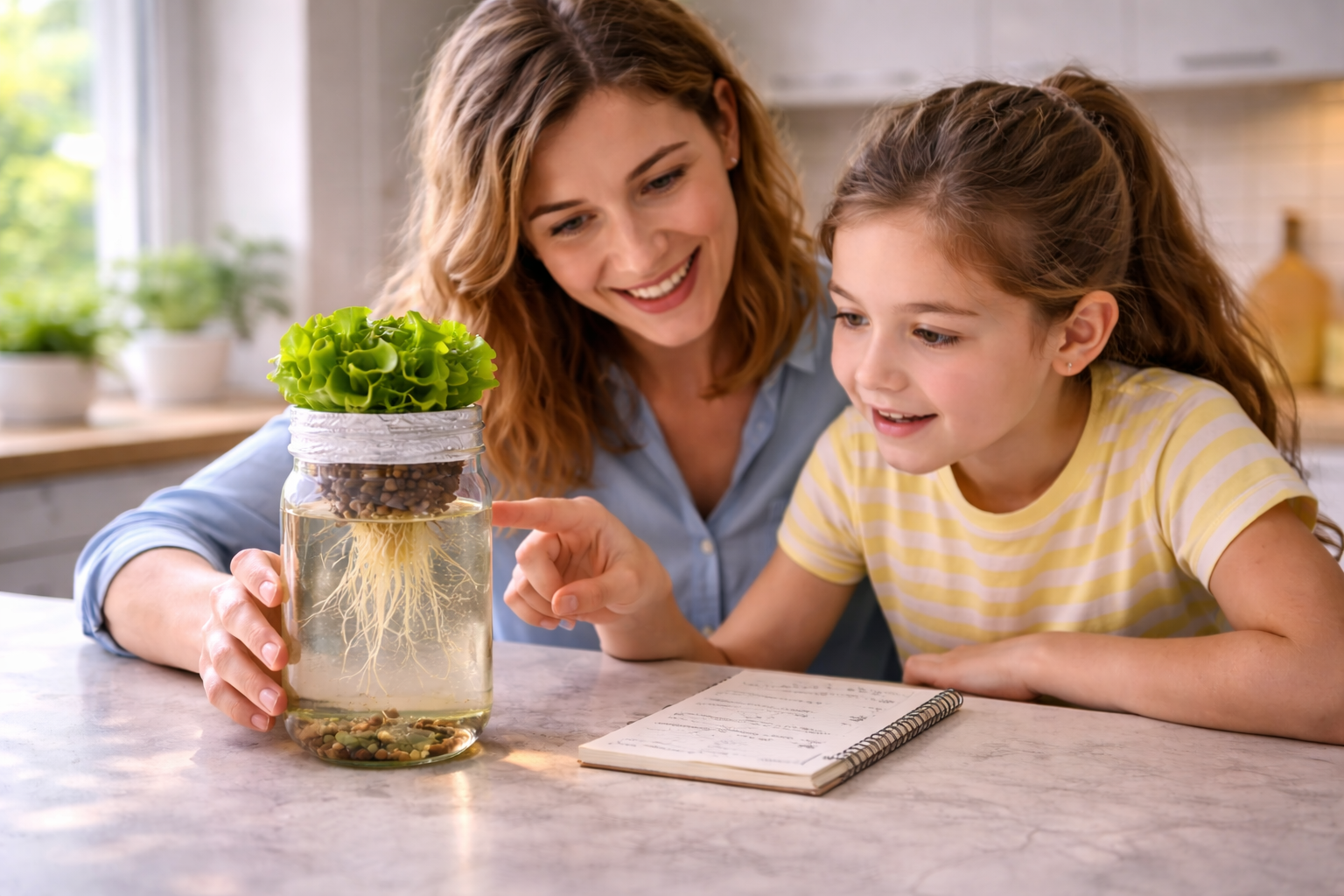
Learning how to explain hydroponics to a child can feel surprisingly difficult. Hydroponics involves abstract concepts like nutrients, pH, photosynthesis, and root systems that adults often struggle to articulate clearly even when they understand them well. The good news is that children grasp the core idea of hydroponics easily when you use the right analogies, age-appropriate language, and hands-on demonstrations. This guide gives you exactly the words to use, the analogies that work, and the fun facts that make children genuinely excited about plant science.
Whether you are a parent introducing your own child to growing food at home or a teacher explaining hydroponics to a classroom, this guide provides everything you need to make the concepts click for kids of any age.
🌱 The 30-Second Explanation
Hydroponics is growing plants in water instead of soil. Plants normally get food from dirt, but in hydroponics we put the food directly in the water so plants can grow anywhere — even on a kitchen counter, in a tall building, or even in space.
What is the simplest way to explain hydroponics to a child?
The simplest way to explain hydroponics to a child is to start with what they already know: plants normally grow in soil. Then introduce the surprising twist: hydroponics removes the soil entirely and gives plants their food through the water instead. This single sentence captures the core concept and immediately raises follow-up questions children want to ask.
Avoid technical terms like “nutrient solution,” “EC,” or “pH” in your first explanation. Save these for later conversations once the child has grasped the basic concept. According to educational research from Science Buddies, children learn complex topics best when they start with simple core concepts and gradually add detail through follow-up questions and hands-on experience.
What are the best analogies to explain hydroponics to a child?
Analogies work better than direct explanations because they connect new ideas to things children already understand. These five analogies have been tested with real children and consistently produce that satisfying “aha!” moment.
| Analogy | Explanation |
|---|---|
| Smoothie for plants | Hydroponic water is like a healthy smoothie containing all the food plants need |
| No-dirt garden | Like a regular garden but without any messy soil |
| Plant swimming pool | Plant roots float in water full of food, like swimming in a pool of vitamins |
| Astronaut food garden | How astronauts grow vegetables on the International Space Station |
| Building food up | Vertical farms stack plants up tall buildings instead of spreading them across fields |
How do you explain hydroponics to a 5 year old?
For very young children aged 4-6, keep the explanation extremely simple and focused on the most magical aspect: plants growing without dirt. Use these specific phrases:
👶 Words for Ages 4-6
- “This plant is growing without any dirt at all!”
- “The plant drinks special water that has all its food in it”
- “Look at the roots — they’re swimming in plant smoothie”
- “In a few weeks we can eat this lettuce that we grew!”
- “It’s like the plant is doing magic with water”
At this age, focus on showing rather than explaining. Let children see the roots through a clear jar, touch the leaves, and watch the plant grow over days. The hands-on experience teaches more than any verbal explanation. Our mason jar hydroponics guide shows you exactly how to set up the clear-jar demonstration that works so well with young children.
How do you explain hydroponics to a 7 year old?
By age 7, children can handle slightly more complex explanations and start asking “why” questions. This is the perfect age to introduce some real science vocabulary while keeping concepts accessible.
Start with the dirt question
Ask the child: “Why do you think plants need dirt?” Most children will say something about food, water, or holding the plant up. Use their answer to introduce hydroponics: “You are right that plants need food. In a regular garden, plants get food from the dirt. But what if we could give them food in the water instead? Then they would not need any dirt at all. That is hydroponics!”
Introduce the photosynthesis idea
Once they understand the no-dirt concept, introduce a simplified version of photosynthesis: “Plants are amazing because they can make their own food from sunlight, water, and air. They use their leaves like solar panels to collect sunlight, and their roots to drink water. When we give them special water with extra nutrients, they grow really fast and healthy!”
Show real-world connections
Children at this age love impressive facts. Share that astronauts grow plants this way on the International Space Station (real research from NASA). Explain that some buildings now grow food on every floor like vertical farms. These connections make hydroponics feel exciting and modern, not just a school project.
How do you explain hydroponics to a 10 year old?
By age 10, children can handle more sophisticated explanations including basic chemistry and biology concepts. They are also old enough to appreciate the practical benefits of hydroponics over traditional farming.
Introduce real scientific concepts
Older children can understand that plants need 17 different elements to grow properly. Three come from water and air (carbon, hydrogen, oxygen) and the other 14 normally come from soil. In hydroponics, we put all 14 directly into the water as a balanced “nutrient solution.” This is more accurate than the simplified “smoothie” explanation younger children use.
Discuss why hydroponics matters
10-year-olds can engage with bigger questions about why hydroponics is important. Discuss water shortages around the world, the challenge of feeding growing cities, climate change effects on traditional farming, and how hydroponics uses 90% less water than soil farming according to research from the Royal Horticultural Society. These connections make hydroponics relevant to real problems they care about.
Encourage questions and experimentation
At this age, children should be designing their own experiments. Ask: “What would you want to test about how plants grow?” Use their questions to introduce the scientific method and start hands-on hydroponic experiments together. Our guide to 5 simple hydroponic experiments for kids ages 6-12 provides tested experiments ranked by age and complexity.
What fun facts work best when explaining hydroponics?
Surprising facts grab children’s attention and make hydroponics memorable. These facts have been tested with real children and consistently produce excited reactions:
🤯 Fun Facts Kids Love
- Hydroponic plants grow up to 50% faster than soil plants
- Astronauts on the space station grow lettuce, radishes, and even tomatoes hydroponically
- Some buildings have indoor farms that grow food on every floor
- Hydroponics uses 90% less water than regular farming
- A single Kratky jar can grow a full head of lettuce in 6 weeks with no electricity
- The word “hydroponics” comes from Greek words meaning “water working”
Intermediate level: answering tough questions kids ask
Once children understand hydroponics basics, they often ask tough follow-up questions. Here are answers to the most common ones, simplified for kids:
“Why do plants need dirt at all if they can grow in water?”
“Great question! Soil naturally contains all the food plants need plus tiny organisms that help break it down. In hydroponics, we just skip the soil and give plants the food directly in their water. Plants do not need soil specifically — they need what is in the soil. We can provide that in other ways.”
“How do plants get oxygen if their roots are in water?”
“Plant roots actually need oxygen to stay healthy. In hydroponics, we either add oxygen through bubbles (like a fish tank) or we leave a small air space above the water for the roots to breathe. This is one of the most important things to get right when growing hydroponic plants.”
“Can we grow really big plants like trees this way?”
“Most hydroponic systems are best for small plants like lettuce, herbs, tomatoes, and peppers. Growing trees would need a really big system because trees have huge root systems. But scientists are working on growing small fruit trees in big hydroponic containers!”
“Is hydroponic food healthier than regular food?”
“It can be just as healthy, and sometimes healthier because the plants get exactly the nutrients they need. Hydroponic food is also fresher because it can grow right where people eat it — no long trips from far-away farms.”
What next? Going beyond explaining the basics
After children understand how to explain hydroponics to a child fundamentals, here are natural next steps for deepening their interest and learning:
- Start an actual hydroponic project together — nothing teaches better than doing. Our teaching kids hydroponics guide covers the complete setup process
- Enter a science fair using real data — see our 10 best hydroponic science fair project ideas for inspiration
- Buy a ready-made kit if DIY feels overwhelming — our 7 best kid friendly hydroponic kits review compares the top options
- Read kids’ books about food and farming from libraries or National Geographic Kids
- Watch documentaries about vertical farming and modern agriculture
- Visit local hydroponic farms if any exist in your area
Frequently asked questions about how to explain hydroponics to a child
What age can children understand hydroponics?
Children as young as 4 can understand the basic concept of plants growing in water instead of dirt. By age 7-8, they can grasp the role of nutrients and basic plant biology. By age 10-12, they can understand the scientific method and design their own hydroponic experiments. The earlier you start, the more naturally they absorb the concepts.
How long does it take a child to understand hydroponics?
The basic concept clicks within 5-10 minutes when paired with a hands-on demonstration. Deeper understanding develops over weeks of running an actual hydroponic project. The “aha!” moment usually comes when children see real roots growing in water through a clear jar — this image is hard to forget.
Should I use scientific words or simple language with kids?
Start with simple language and gradually introduce scientific vocabulary as children show interest. Forcing technical terms too early creates frustration. Once children grasp the basic concept, they often become curious about the proper words — that is the time to introduce them.
What if my child does not seem interested in hydroponics?
Different children respond to different approaches. If verbal explanation does not engage them, try hands-on activities first. If hands-on does not work, try fascinating facts about astronauts or vertical farms. If nothing sticks, that is fine — not every child needs to love every subject. Try again in a year or two when their interests may have changed.
Are there picture books that explain hydroponics to children?
Several children’s books cover hydroponics and modern farming including “How Does My Garden Grow?” and “From Seed to Plant.” Most public libraries have these in their children’s gardening section. National Geographic Kids also publishes related articles online.
How can I explain why hydroponics matters in the world?
Frame hydroponics as part of solving big problems children care about. Discuss how growing food close to cities means less pollution from trucks, how using less water helps places where water is scarce, and how vertical farms can grow food in places where soil farming is impossible. These connections make hydroponics feel meaningful and exciting.
Related posts you might find useful
- Teaching Kids Hydroponics: The Best STEM Project — Complete educational guide
- 5 Simple Hydroponic Experiments for Kids Ages 6-12 — Hands-on learning activities
- 10 Best Hydroponic Science Fair Project Ideas — Award-winning project ideas
- 7 Best Kid Friendly Hydroponic Kits for Families — Equipment recommendations
- What Is Hydroponics? A Plain-English Explanation — Adult-focused background reading
- Mason Jar Hydroponics for Beginners — Simplest setup method
- Microgreens Hydroponics: First Harvest in 7 Days — Fast results for younger kids
Master Teaching Plant Science
Our 25-page ebook Teaching Kids Hydroponics includes age-appropriate explanations, conversation starters, lesson plans, and practical activities for introducing children to plant science at any age.
✓ 15 tested experiments · ✓ UK curriculum aligned · ✓ Printable worksheets · ✓ Instant PDF download