Learning how to adjust pH in hydroponics is the single most important skill in hydroponic growing. Get pH right and your plants thrive even with cheap equipment and basic nutrients. Get pH wrong and even the most expensive setup produces yellow, struggling plants. The good news is that adjusting pH is incredibly simple — it takes 30 seconds, costs pennies per test, and works with tools you can buy for under £10.
This guide explains exactly how to adjust pH in hydroponics using cheap, beginner-friendly tools. No fancy equipment required. By the end, you will know how to test, adjust, and maintain perfect pH for any hydroponic crop.
🧪 The Quick Method
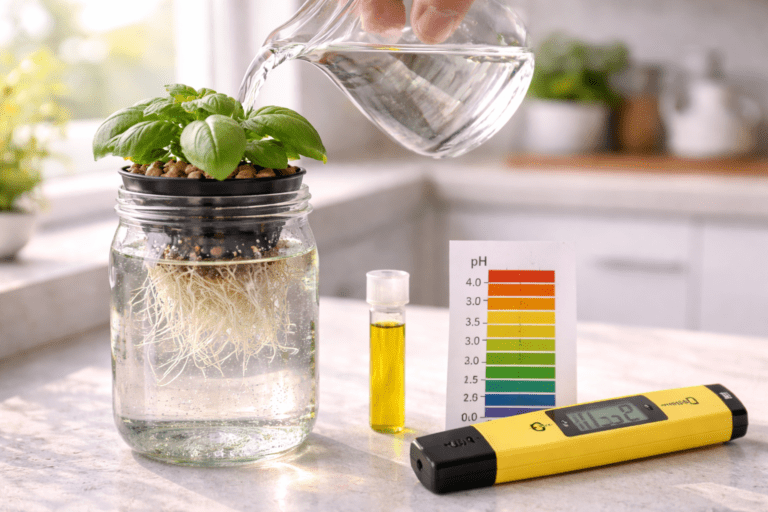
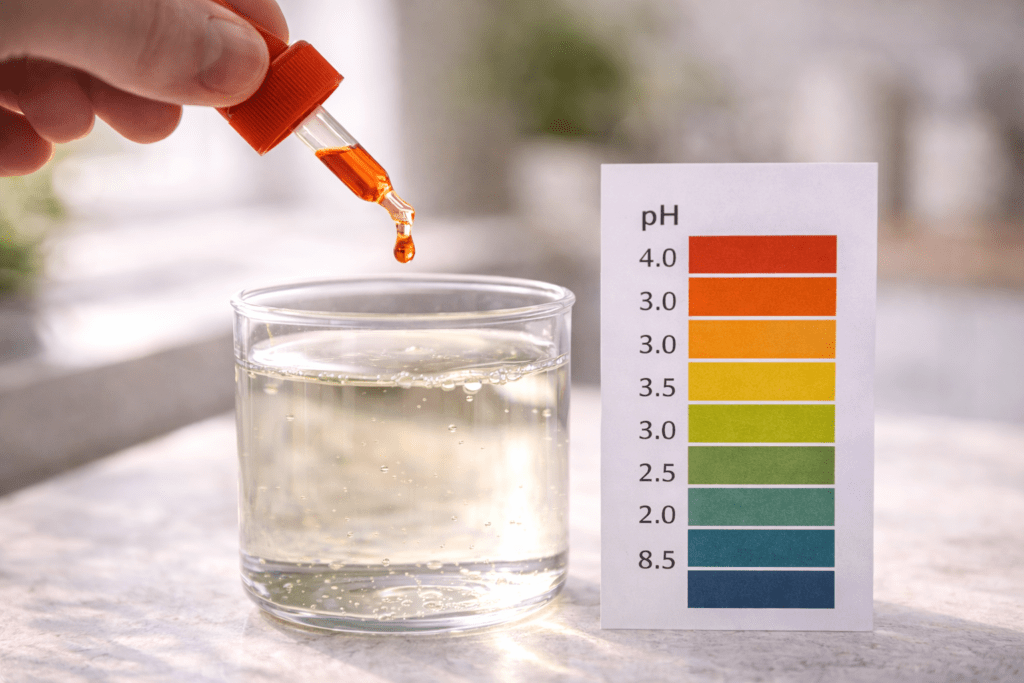
Mix nutrients into water, drop indicator solution into a test tube of the mix, compare the colour to the chart, add pH Down one drop at a time until you hit 5.5-6.5. Total time: under 60 seconds.
Why does pH matter so much in hydroponics?
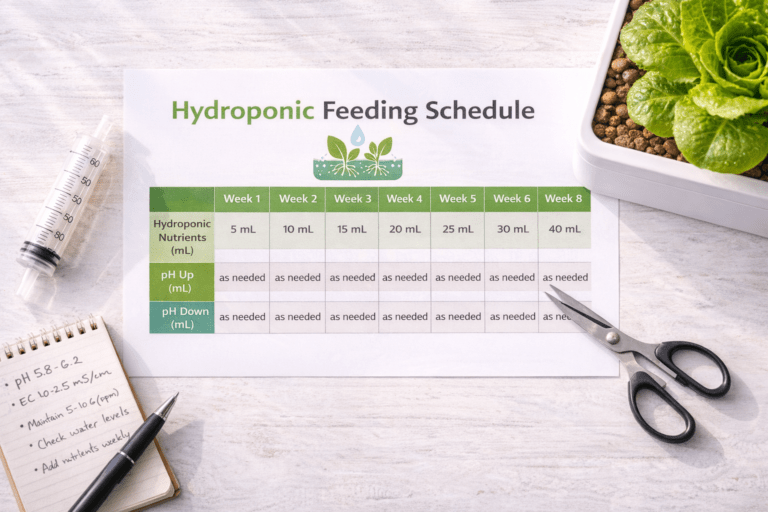
pH measures how acidic or alkaline your nutrient solution is, on a scale from 0 (extremely acidic) to 14 (extremely alkaline). Pure water sits at 7, the neutral point. The reason pH matters is that it controls whether nutrients are chemically available to plants. The ideal range for hydroponic crops is pH 5.5-6.5, with 5.8-6.0 being the sweet spot for most plants.
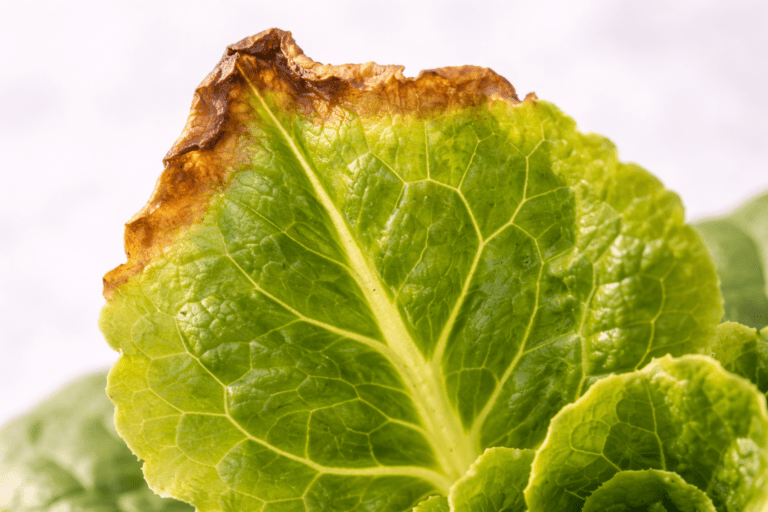
When pH drifts outside this range, nutrients become locked out — they remain physically present in your water, but plant roots cannot absorb them. The plant essentially starves while surrounded by food. This is why learning how to adjust pH in hydroponics is non-negotiable: without it, no other technique matters.
What tools do you need to adjust pH in hydroponics?
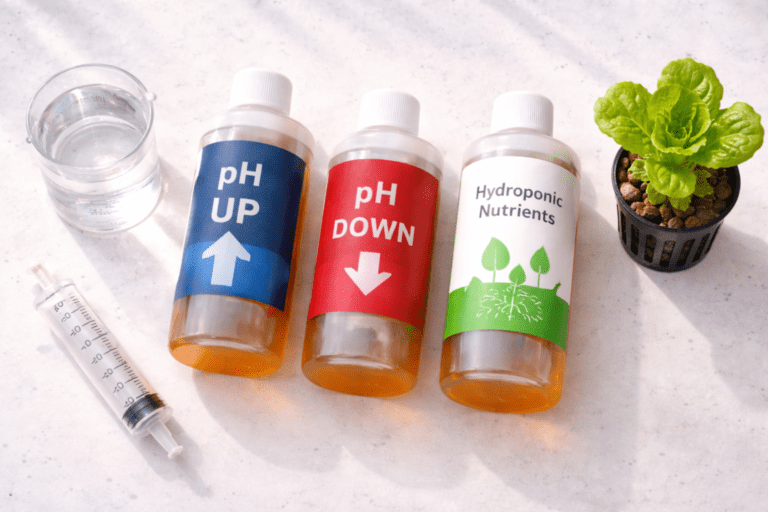
You need exactly three things to test and adjust pH in hydroponics. None of them are expensive.
| Tool | Cost | Lifespan |
|---|---|---|
| pH test kit (drops + chart) | £4-6 | 200+ tests |
| pH Down solution | £3-5 | 6-12 months |
| pH Up solution (rarely needed) | £3-5 | 12+ months |
Total cost to start: £7-11. The General Hydroponics pH Test Kit is the most popular beginner option with thousands of positive reviews. It includes the indicator drops, the colour chart, and a small test tube — everything you need.
Do you need a digital pH meter?
Not as a beginner. Digital pH pens (£15-40) are more precise but require regular calibration with calibration solutions (£5-10 per bottle), they need replacement probes every 1-2 years, and they can drift if not stored properly. For most home growers, the £4-6 drop test kit is more reliable, simpler, and cheaper. Upgrade to a meter only when you scale up to multiple systems.
How do you test pH step by step?
Testing pH is the first half of learning how to adjust pH in hydroponics. The process is genuinely simple.
The 5-step pH testing process
- Mix your nutrient solution first. Always add nutrients to water before testing pH because nutrients change the pH significantly.
- Take a small sample. Use the test tube included with your kit to draw approximately 5ml of nutrient solution from your reservoir.
- Add 3 drops of indicator solution. The included dropper bottle delivers consistent drop sizes.
- Cap and shake gently. Mix the indicator into the water sample for 5 seconds.
- Compare to the chart. Hold the test tube against the colour chart in good lighting (natural daylight works best). Read the closest matching colour.
The colour scale typically ranges from yellow (acidic, around pH 4) through green (neutral, around pH 6) to deep blue (alkaline, around pH 8). Your target is in the green-yellow range, around pH 5.8-6.0.
How do you actually adjust pH once you know the reading?
Once you know your starting pH, adjusting it to the target range is simple. The key principle when learning how to adjust pH in hydroponics is making small adjustments and retesting frequently. It is much easier to gradually lower pH than to overshoot and need to raise it again.
If pH is too high (above 6.5)
This is the most common situation in UK growing because tap water typically starts at pH 7.0-8.0. Add pH Down one drop at a time, stir for 10 seconds, retest after every 2-3 drops. A typical 1-litre nutrient mix needs 3-8 drops of pH Down to reach the target range.
For larger volumes, the dosage scales proportionally: a 5-litre mix typically needs 15-40 drops, a 10-litre mix needs 30-80 drops. Start with smaller amounts than you think — overshooting wastes pH Up correcting your correction.
If pH is too low (below 5.5)
This is uncommon in fresh nutrient mixes but can happen in established systems where active plant uptake or organic decay has driven pH downward. Add pH Up one drop at a time using the same gradual approach. pH Up is rarely needed for new mixes.
💡 The Stir-and-Wait Trick
After adding pH adjustment drops, stir for at least 10 seconds and wait 30 seconds before retesting. The water needs time to fully mix and stabilise. Testing immediately gives inaccurate readings that lead to overshooting.
Are there natural alternatives to pH Down?
Yes, several household items can be used to adjust pH in hydroponics if commercial pH Down is unavailable. These work but are less precise and harder to dose accurately than dedicated pH adjustment products.
- White vinegar: Lowers pH effectively but is less stable — pH may drift back up within days. Use approximately 1ml per litre as a starting dose.
- Lemon juice: Similar to vinegar but less consistent because acidity varies between lemons. Use 1-2ml per litre.
- Phosphoric acid (food grade): What commercial pH Down typically contains. Available cheaply from beer brewing suppliers.
- Citric acid: Available in baking sections, more stable than vinegar. Use approximately 0.5g per litre dissolved in a small amount of water first.
For occasional emergency use, vinegar is fine. For regular hydroponic growing, dedicated pH Down is more reliable, easier to dose, and doesn’t introduce extra organic acids that can cause complications.
Intermediate level: how often should you test pH?
Once you understand how to adjust pH in hydroponics, the question becomes how often to test. The answer depends on your system type.
| System Type | Test Frequency |
|---|---|
| Kratky (passive) | Once at setup, optionally once mid-grow |
| DWC (active) | Every 2-3 days |
| NFT (recirculating) | Daily or every other day |
| Drip systems | Every 2-3 days |
What next? Mastering pH stability
Once you can reliably adjust pH in hydroponics, the next step is preventing the need for constant adjustments through better stability practices:
- Use larger reservoirs — bigger volumes are more pH-stable than small jars
- Maintain consistent nutrient strength — sudden concentration changes cause pH swings
- Keep water temperature stable — cool water holds pH better than warm water
- Replace solution regularly — old nutrient solution drifts more than fresh batches
- Consider buffered nutrients — some premium brands include pH buffers that resist drift
Frequently asked questions about adjusting pH in hydroponics
What is the perfect pH for hydroponics?
The optimal range is 5.5-6.5 for most crops, with 5.8-6.0 being ideal. Lettuce and herbs prefer 5.8-6.2. Tomatoes and fruiting crops prefer 5.5-6.0. Strawberries prefer 5.8-6.2. Within this range, all major nutrients remain available to plant roots.
How long does pH adjustment last?
In a freshly mixed nutrient solution, pH typically stays stable for 2-3 days before drifting. As plants absorb nutrients and release hydrogen ions, pH gradually shifts (usually upward in most home systems). This is why regular testing matters more than how often you adjust.
Why is my pH going up after I lower it?
pH naturally drifts upward in most hydroponic systems because plants absorb nutrients faster than water, leaving the remaining solution more alkaline. This is normal. Test every 2-3 days and add small amounts of pH Down to keep within range. Drifting upward by 0.3-0.5 points per few days is completely normal.
Can I use baking soda to raise pH in hydroponics?
Yes, but with caution. Baking soda raises pH effectively but adds sodium to your solution, and high sodium accumulates over time and can harm plants. For occasional emergency use it is fine, but dedicated pH Up is better for regular use.
Why is my pH meter reading different from my drop test kit?
If they consistently differ by more than 0.3, your pH meter likely needs calibration. Buy calibration solutions (£5-10) and follow the meter instructions. If the difference is less than 0.3, both readings are within normal margin of error and either is acceptable.
Does pH adjustment affect nutrient strength?
Slightly. Each drop of pH Down or pH Up adds tiny amounts of phosphoric acid or potassium hydroxide to your solution, which marginally increases EC. For typical doses (5-30 drops in a litre), the effect is negligible. For very precise growing with EC monitoring, account for this by using slightly less starting nutrient concentration.
Related posts you might find useful
- Hydroponic Nutrients for Beginners — Learn how to mix nutrients before adjusting pH
- Tap Water for Hydroponics — Understand your starting water before treating it
- pH Keeps Dropping in Hydroponics — Diagnose and fix pH problems in established systems
🧪 Master pH and Nutrients
Our ebook ‘Hydroponic Nutrients Made Simple’ includes a complete pH troubleshooting chapter, calibration guides, and the science of why pH controls plant nutrition.
Buy your copy at hydrohomegarden.com/ebooks/hydroponic-nutrients/