
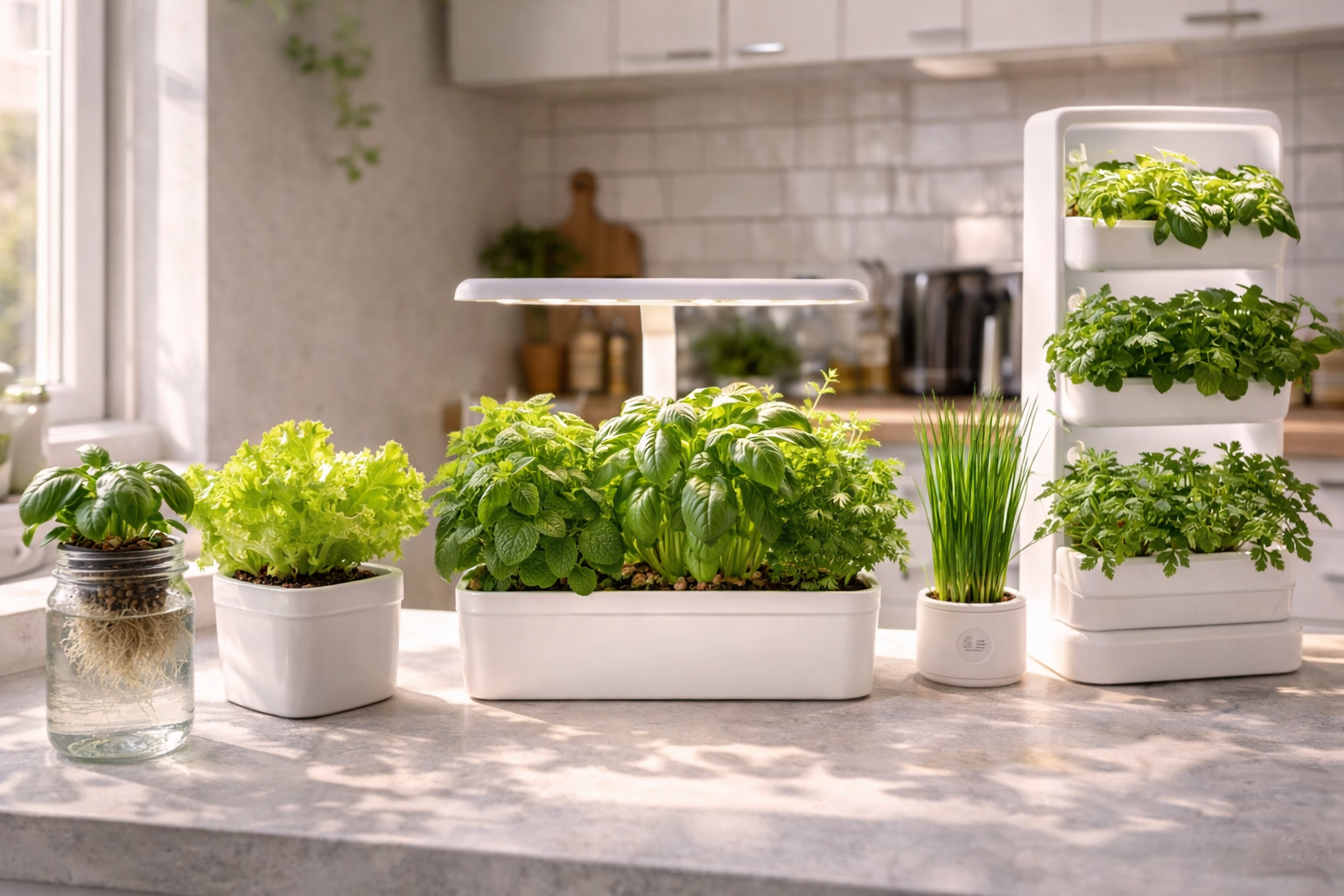
Choosing the best hydroponic systems for small apartments requires balancing several factors: space requirements, cost, ease of use, productivity, and how the system fits into your daily life. Some options take up just 8 centimetres of windowsill space, while others occupy a full corner of a room. This guide ranks the 5 best hydroponic systems for small apartments based on extensive testing in real spaces, with honest assessments of what each one can and cannot do.
Whether you live in a 25-square-metre studio or a one-bedroom flat, there is a hydroponic system on this list that fits your space, budget, and goals.
🏆 Our Top Pick
The best hydroponic systems for small apartments overall winner is the Kratky mason jar setup at £15-25. It costs the least, takes the least space, requires no electricity, makes no noise, and produces fresh herbs and lettuce reliably. Start here, then expand if you want more.
How did we choose the best hydroponic systems for small apartments?
To make this list relevant for real apartment dwellers, every system was evaluated against 6 criteria that matter most in small spaces:
| Criteria | Why It Matters |
|---|---|
| Footprint | Square centimetres of floor or counter space used |
| Cost | Total price including all needed accessories |
| Noise level | Critical for studio flats and shared spaces |
| Productivity | How much food per square foot per month |
| Ease of use | Setup complexity and ongoing maintenance time |
| Aesthetics | How it looks in a living space |
What is the number 1 best hydroponic system for small apartments?
#1Kratky mason jar setup (£15-25) — Best overall
The Kratky mason jar is the undisputed winner among the best hydroponic systems for small apartments. It is the cheapest option, the smallest footprint, the easiest to set up, completely silent, and produces excellent results for herbs and leafy greens. A single jar takes up the space of a coffee mug. A row of 5-6 jars on a windowsill provides enough fresh produce to noticeably reduce your shopping bill.
| Specification | Detail |
|---|---|
| Footprint | 8 x 8 cm per jar |
| Cost | £15-25 |
| Noise | Silent |
| Productivity | 1 plant per jar, 6 jars per windowsill |
| Best for | Beginners, herbs, lettuce, tight budgets |
Pros: Cheapest option, no electricity, completely silent, beginner-friendly, scalable.
Cons: One plant per jar, slower growth than DWC, limited to compact crops.
For the complete 10-minute build, see our kratky jar setup guide.
#2Click and Grow Smart Garden 3 (£60-100) — Zero learning curve
For people who want zero learning curve, the Click and Grow Smart Garden 3 is one of the best hydroponic systems for small apartments. It includes integrated LED lights, automatic watering, and pre-seeded plant pods. You plug it in, add water, drop in a pod, and harvest in 3-4 weeks. No mixing nutrients, no testing pH, no learning required.
The downsides are higher upfront cost and ongoing pod expenses (£10-15 for a 3-pack of replacement pods). Still, for absolute beginners who value convenience over economy, this is genuinely excellent.
#3Compact DWC bucket system (£25-45) — Best productivity per pound
A single 5-gallon DWC bucket is one of the most productive best hydroponic systems for small apartments per pound spent. The bucket sits in a corner or on the floor, taking up approximately 30×30 cm of floor space. With an air pump providing constant oxygen, plants grow 30-50% faster than in Kratky systems. One bucket can grow 4-6 herbs or one large plant like a tomato.
For the complete comparison between passive (Kratky) and active (DWC) systems, see our kratky vs DWC guide.
#4Vertical tower garden (£100-300) — Maximum plants per square metre
For growers who want maximum production in minimum floor space, vertical tower systems like the Lettuce Grow Farmstand or AeroGarden Farm grow 12-32 plants in less than 1 square metre of floor space. These are the most productive of the best hydroponic systems for small apartments by a wide margin, though they require the largest upfront investment.
Vertical towers work best for growers who already know they want a serious indoor garden and have the budget to invest. They are overkill for a beginner just wanting fresh herbs. For the complete review including DIY build instructions, see our vertical hydroponic tower guide.
#5Window-mounted growing rack (£20-40) — Best for no counter space
A simple wire rack designed to fit in a window frame can hold 4-8 small Kratky jars or net pots, taking advantage of natural light without using any counter space. These rarely come as complete kits and usually need to be assembled DIY-style from parts available at Amazon UK and hardware shops, but the result is one of the most space-efficient best hydroponic systems for small apartments.
Which system should you actually buy?
The right choice from our list of best hydroponic systems for small apartments depends on your specific situation:
🎯 Quick Recommendation Guide
| Tightest budget | Kratky mason jars (£15-25) |
| Zero learning curve | Click and Grow Smart Garden (£60-100) |
| Max productivity per pound | DWC bucket system (£25-45) |
| Max plants in min floor space | Vertical tower (£100-300) |
| No counter space available | Window-mounted rack (£20-40) |
Intermediate level: combining systems for best results
Once you have experience with one system, the best hydroponic systems for small apartments often work best in combination. Many experienced apartment growers run multiple system types simultaneously to get the benefits of each.
A common setup combines Kratky jars on the windowsill for herbs (silent and easy) with a DWC bucket in a corner for larger crops like tomatoes or strawberries (faster growth, larger plants). This gives you variety without overwhelming any single space.
What next? Scaling beyond the basics
After mastering one of the best hydroponic systems for small apartments, here are natural next steps:
- Add a grow light to extend growing into winter months and dimmer rooms
- Build a multi-tier shelf garden using wire shelving and LED strip lights
- Try fruiting crops like cherry tomatoes once your basic system runs reliably
- Experiment with vertical towers if you want to maximise production — see our vertical tower complete guide
- Move outdoor if you have a balcony — see our balcony hydroponics guide
- Learn about EC and PPM for precision nutrient management
Frequently asked questions about hydroponic systems for small apartments
What is the smallest hydroponic system available?
A single 500ml mason jar Kratky setup is the smallest practical hydroponic system. It has a footprint of approximately 8×8 centimetres and grows one herb or small lettuce. This is the entry point for the absolute smallest spaces and tightest budgets.
How much electricity do hydroponic systems use?
Kratky systems use zero electricity. DWC systems with air pumps use approximately £0.50-1.50 per month in electricity. Smart gardens with LED lights use £2-5 per month. Vertical towers with multiple grow lights can use £5-15 per month. All are negligible compared to other household appliances.
Can hydroponic systems damage flooring or surfaces?
Properly maintained systems do not damage surfaces. Place jars and buckets on a small tray or coaster to catch any condensation. Avoid placing systems on bare wood furniture for extended periods. Ceramic, plastic, glass, and stone surfaces are unaffected.
How much weight do hydroponic systems add to apartment furniture?
A 1-litre Kratky jar weighs approximately 1.2 kg when full. A 5-gallon DWC bucket weighs approximately 20 kg when full. Always check that your shelf or surface can support the weight, especially for multiple buckets in one location.
Are there hydroponic systems specifically designed for studio flats?
Yes. Wall-mounted vertical systems and window-mounted growing racks are designed specifically for spaces where floor and counter space are at a premium. Gardyn Home Kit is one example of a vertical system explicitly marketed for small apartments.
What if I rent and cannot make holes in walls?
All five systems on this list work without any wall modifications. Mason jars and buckets sit on existing surfaces. Smart gardens are freestanding. Vertical towers are floor-standing. Window-mounted racks use suction cups or removable tension fittings rather than screws.
Which system is best if I travel frequently?
Kratky jars are the clear winner for frequent travellers. They require no electricity, no pump monitoring, and can run unattended for 3-4 weeks at a stretch. DWC buckets need pump checking every 2-3 days. Smart gardens and vertical towers both fail quickly if power goes out while you’re away.
Can I grow tomatoes in any of these systems?
Tomatoes work best in a DWC bucket (system #3) due to the larger root space and continuous oxygenation. They can grow in vertical towers but add significant weight and need staking. Kratky jars are too small for tomatoes. Window-mounted racks can support cherry tomatoes but struggle with larger varieties.
Related posts you might find useful
- Apartment Hydroponics: 7 Easy Ways to Grow Fresh Food — Broader strategies for apartment growing
- Kitchen Herb Garden in 30 Minutes — Detailed setup for the easiest system
- Vertical Hydroponic Tower: Worth It? — Full tower review and DIY build
- Balcony Hydroponics Complete Guide — Outdoor apartment options
- Kratky Method Hydroponics: Complete Guide — The #1 system explained in depth
- Kratky vs DWC: Which Passive System Is Better? — Choose between #1 and #3
- 10 Easy Hydroponic Plants Almost Impossible to Kill — Best crops for any system
Master Small Space Growing
Our 16-page ebook Apartment Hydroponics includes detailed system comparisons, complete shopping lists for every option, and advanced setups for maximum production in minimum space.
✓ System comparisons · ✓ Complete shopping lists · ✓ Space-maximising setups · ✓ Instant PDF download