
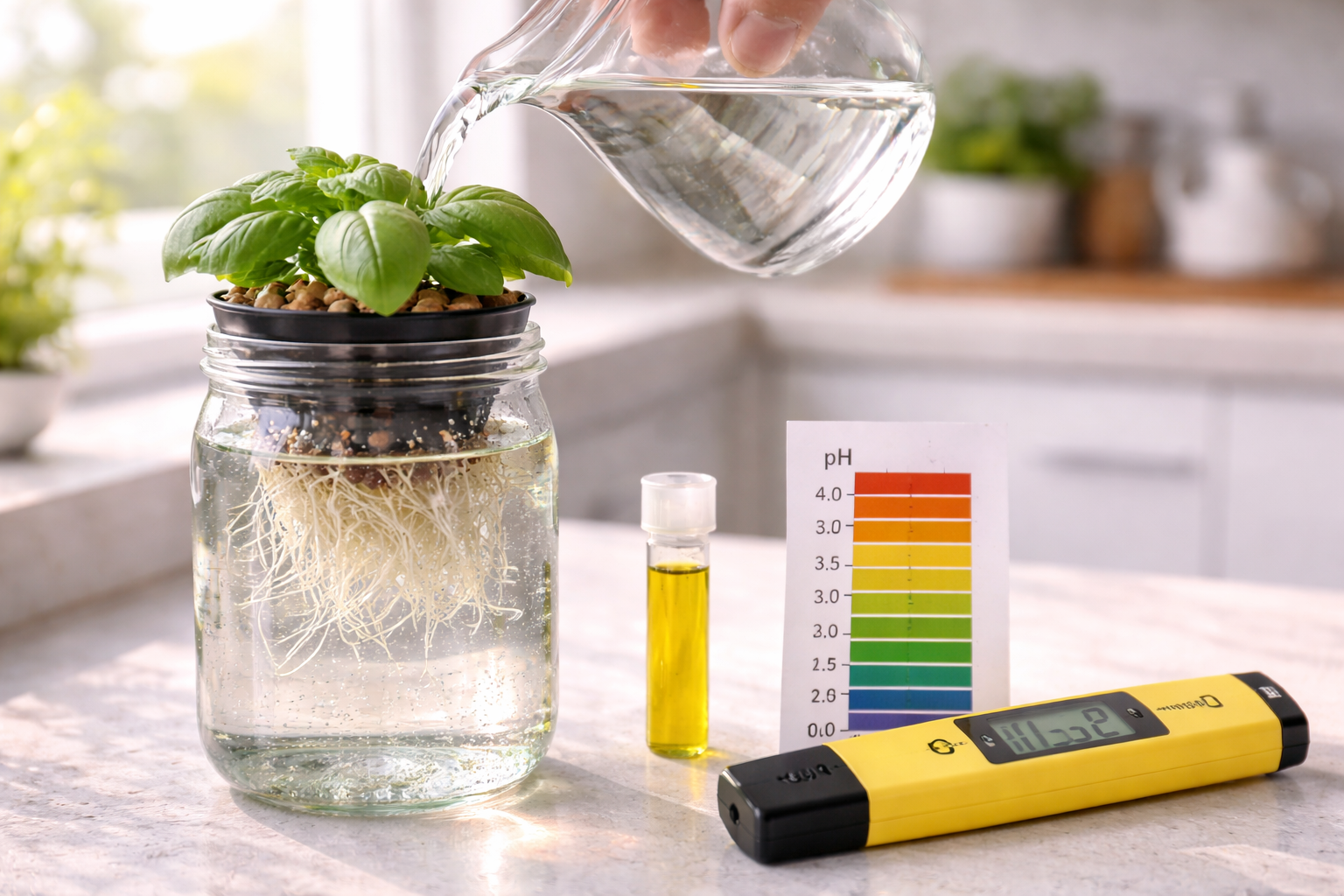
One of the first questions every new grower asks is whether tap water for hydroponics actually works. The short answer is yes — tap water is fine for most UK growers and most crops. But there are a few things you should test, a few situations where you should be cautious, and a few simple fixes that turn average tap water into perfect hydroponic water.
This guide explains exactly when tap water for hydroponics is safe to use, how to test what is in your water, what to do if you find problems, and when filtered or reverse osmosis water is genuinely necessary versus when it is overkill.
💧 The Quick Answer
In most UK areas, tap water for hydroponics works fine for growing herbs and leafy greens. Just let it sit overnight to dissipate chlorine, then add nutrients and adjust pH to 5.5-6.5. Filtered or RO water is only needed for fruiting crops in hard water areas.
Is tap water safe for hydroponic growing?
For most home growers, yes. UK tap water is among the cleanest in the world and meets strict drinking water standards. The minerals it contains (calcium, magnesium, sodium, traces of others) are mostly beneficial to plants, not harmful. The main concerns with tap water for hydroponics are not safety but suitability — specifically, the levels of chlorine, hardness, and the starting pH.
The reason commercial hydroponic farms often use filtered or RO water has nothing to do with safety. They use it to maintain absolute consistency across thousands of plants where small variations matter. For home growers with a few jars of lettuce or basil, tap water is perfectly adequate.
What is in your tap water and why does it matter?
UK tap water typically contains four things that affect hydroponic growing: chlorine, dissolved minerals (hardness), starting pH, and trace contaminants. Each can be measured and addressed if needed.
| Element | Typical UK Range | Hydroponic Impact |
|---|---|---|
| Chlorine | 0.2-1.0 mg/L | Kills beneficial bacteria, dissipates overnight |
| Hardness | 100-300 PPM | Adds calcium and magnesium (usually beneficial) |
| pH | 7.0-8.0 | Too high for plants, easily adjusted with pH Down |
| Chloramine | 0-2.0 mg/L | More persistent than chlorine, needs dechlorinator |
You can look up your specific area’s water quality report on your water authority’s website. Thames Water, Severn Trent, United Utilities, Anglian Water, and other UK suppliers all publish annual reports showing typical values for your postcode. This takes 5 minutes and tells you exactly what you’re working with.
How do you test tap water for hydroponics?
Three simple tests tell you almost everything you need to know about your tap water for hydroponics use. None require expensive equipment.
Test 1pH — Essential for everyone
Use a basic pH test kit (£4-6) or pH pen (£15-25) to measure your tap water before adding nutrients. UK tap water typically reads pH 7.0-8.0. This is too alkaline for plants but easily corrected once nutrients are added — they naturally lower pH, and pH Down adjusts the rest. For the complete pH adjustment process, see our how to adjust pH guide.
Test 2TDS or PPM — Recommended
A TDS meter (£8-15 from Amazon UK) measures the total dissolved solids in your water — essentially the mineral content.
| TDS Reading | Hydroponic Suitability |
|---|---|
| Under 200 PPM | Excellent for all crops |
| 200-400 PPM | Acceptable for most crops |
| 400+ PPM | May cause problems with sensitive plants |
High TDS pushes your nutrient solution above optimal levels once you add fertiliser. London and the South East typically fall in the 300-400 PPM range (hard water), while Scotland and Wales are often under 150 PPM (soft water).
Test 3Chlorine — Optional
You can buy pool test strips (£3-5) that measure chlorine levels. Most UK tap water contains 0.2-1.0 mg/L of chlorine, which dissipates naturally within 24 hours of leaving the tap uncovered. If your water authority uses chloramine instead of chlorine, you will need a dechlorinator (£3-5) because chloramine does not dissipate on its own. Check your water authority’s website — Thames Water uses chloramine in parts of London, while most other UK suppliers still use chlorine.
How do you treat tap water for hydroponic use?
If your tests reveal any issues, simple treatments make tap water for hydroponics perfectly safe and effective. These are the three most common treatments and when to use them.
Treatment 1Removing chlorine — Leave it overnight
The simplest treatment. Fill your container with tap water and leave it uncovered for 24 hours. The chlorine evaporates naturally into the air. By the next day, the water is essentially chlorine-free and ready to use. This works for chlorine but not chloramine. A 5-litre bucket left on the kitchen counter overnight is perfect preparation for the next day’s mixing.
Treatment 2Removing chloramine — Use a dechlorinator
Some UK water authorities use chloramine (chlorine bonded with ammonia) instead of chlorine because it lasts longer in the water supply. Chloramine does not evaporate — you need a dechlorinator product like Seachem Prime (£5-8 from any aquarium shop or Amazon UK). Add the recommended dose and your water is ready in minutes. One bottle lasts home hydroponic growers 6-12 months.
Treatment 3Adjusting pH — Use pH Down after nutrients
This is the most common treatment and applies to almost every hydroponic grower using tap water. After mixing your nutrients into the water, test pH and adjust with pH Down drops until you reach 5.5-6.5. The starting pH of your tap water becomes irrelevant once you add nutrients and adjust. For budget pH adjustment alternatives, see our how to adjust pH guide.
When should you use filtered or RO water instead?
Filtered or reverse osmosis (RO) water is sometimes recommended for hydroponics, but for most home growers it is genuinely unnecessary. Tap water for hydroponics works fine in the following situations:
✅ Tap Water Is Fine When…
- Growing leafy greens and herbs (lettuce, basil, mint, kale, spinach)
- Soft water areas with TDS under 200 PPM
- Single windowsill setups with 1-6 jars
- Beginners learning the basics of hydroponic growing
Filtered or RO water becomes worthwhile in these specific scenarios:
💡 When RO Water Is Worth It
- Hard water areas with TDS above 400 PPM (London, parts of East of England)
- Growing tomatoes, peppers, or strawberries (sensitive to mineral buildup)
- Large multi-plant systems where consistency matters
- Recurring nutrient lockout problems despite correct pH management
Intermediate level: understanding water hardness
Once you have mastered the basics of tap water for hydroponics, understanding water hardness gives you finer control over your growing. Hardness refers to the dissolved calcium and magnesium content of your water. While these are beneficial nutrients, they also raise the EC of your water before you have added any fertiliser.
If your tap water starts at 200 PPM TDS, that means you only have room to add 600 PPM of nutrients before reaching the typical lettuce target of 800 PPM. In hard water areas (300+ PPM starting), you may not be able to use full-strength nutrients without exceeding the safe range for sensitive crops.
| Water Type | Typical UK Areas | TDS Range | Nutrient Adjustment |
|---|---|---|---|
| Very soft | Scotland, Wales, Cornwall | Under 100 PPM | Full strength + Cal-Mag supplement |
| Soft | Devon, Northern England | 100-200 PPM | Full strength |
| Moderate | Midlands, Yorkshire | 200-300 PPM | Three-quarter strength |
| Hard | London, East England, Kent | 300-400+ PPM | Half strength or use RO water |
What next? Advanced water management
After understanding tap water for hydroponics, here are the natural next steps for serious growers:
- Buy a TDS meter (£8-15 from Amazon UK) to monitor mineral content of source water and nutrient solutions
- Test for specific contaminants if your tap water has unusual taste or smell — your water authority publishes annual reports
- Consider rainwater collection as a free, naturally soft alternative for outdoor hydroponic systems (see our balcony hydroponics guide)
- Explore RO systems if you grow multiple fruiting crops year-round (£60-150 for a basic home unit)
- Add Cal-Mag supplements if you switch to soft or filtered water to replace the lost calcium — see our nutrient deficiency chart for deficiency symptoms
Frequently asked questions about tap water for hydroponics
Can I use bottled water for hydroponics?
Yes, but it is unnecessarily expensive for most growers. Bottled spring water typically has a pH and mineral content similar to tap water. The only bottled water worth using for hydroponics is distilled water, which is essentially mineral-free and behaves like RO water. Bottled mineral water is not recommended because the mineral content varies and is not designed for plant use.
Should I boil tap water before using it for hydroponics?
No. Boiling does not remove the things that matter for hydroponics (minerals and pH) and it removes dissolved oxygen that benefits plants. Letting water sit at room temperature is the correct approach for chlorine removal.
Does softened water work for hydroponics?
No. Water from a home water softener should never be used for hydroponics. Softeners replace calcium and magnesium with sodium, and high sodium levels are harmful to plants. If you have a softened water supply, draw water from a tap that bypasses the softener (typically the kitchen cold tap, but check your installation).
Why is my tap water making the nutrient solution cloudy?
Cloudy solutions usually indicate hard water with very high calcium content reacting with phosphates in your nutrient mix to form calcium phosphate precipitate. This is harmless but reduces nutrient availability. The fix is using slightly softer water or adding nutrients to slightly acidic water (pH 6.0) before adjusting back up if needed.
Can well water be used for hydroponics?
Well water can work but needs more thorough testing than municipal tap water. Get a complete water analysis from your water authority or a testing lab to check for contaminants, mineral levels, and pH. Well water from agricultural areas may contain pesticide residue that should be filtered out before use.
How much does using tap water for hydroponics save compared to RO?
Significant amounts. A home RO system costs £60-150 upfront and produces water at approximately 1-2p per litre. Tap water costs essentially nothing for the small volumes used in home hydroponic systems. For a windowsill grower using 5-10 litres of water per month, the savings are tiny in absolute terms but the convenience is substantial.
Is London tap water too hard for hydroponics?
London water is hard (typically 300-400 PPM) but still usable for most hydroponic crops. It works fine for lettuce and herbs. For tomatoes, peppers, or strawberries grown long-term, London growers often switch to RO water or mix 50/50 tap + RO to reduce baseline mineral content. A TDS meter helps you monitor accumulated mineral buildup in your reservoir.
Will tap water from a hot tap work just as well as cold?
No — always use cold tap water. Hot water from the tank can contain trace metals from pipes and the tank itself, plus the heating process reduces dissolved oxygen levels. Cold water from a tap that bypasses any water softener is the correct choice for hydroponics.
Related posts you might find useful
- Hydroponic Nutrients for Beginners — Learn how to mix nutrients with your tap water
- Hydroponic Nutrient Schedule — Week-by-week feeding charts for common crops
- How to Adjust pH Without Expensive Tools — The essential pH management guide
- pH Keeps Dropping in Hydroponics — Diagnose and fix pH problems
- Hydroponic Nutrient Deficiency Chart — Identify deficiencies caused by water quality
- Hydroponic Nutrient Burn — Avoid over-concentration in hard water areas
- 10 Easy Hydroponic Plants — Most forgiving crops for any water type
Master Water and Nutrients
Our 19-page ebook Hydroponic Nutrients Demystified includes complete water testing guides, treatment options for different water types, and the science of why water quality matters for hydroponic success.
✓ Water testing guides · ✓ Treatment options · ✓ UK water regional notes · ✓ Instant PDF download